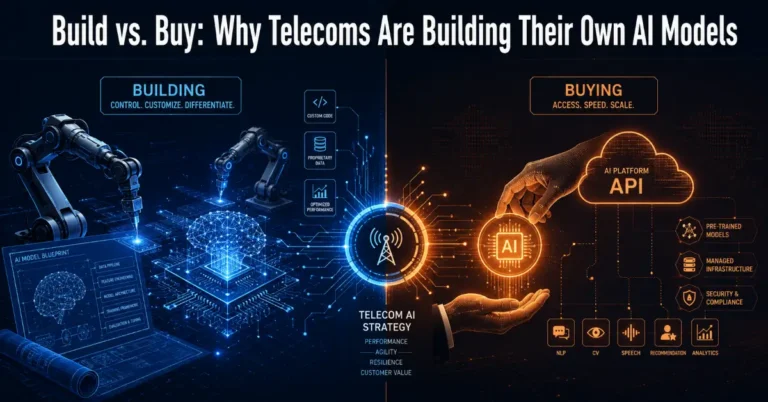
Three distinct patterns emerged from operators this year, and they carry meaningfully different implications for enterprise buyers evaluating telecom AI capability: building proprietary models, buying consumer AI as an enterprise managed service, and bundling third-party consumer AI subscriptions directly into mobile plans. Treating all three as interchangeable “the operator has AI now” is the mistake worth avoiding.

Inside AT&T’s OTel 2.0: what building your own model actually buys you
AT&T’s clearest build move this year was OTel 2.0, a telecom-focused open AI model built on Google DeepMind’s Gemma 4 31B-IT foundation and trained on 400 billion telecom-specific tokens curated from a pool of over one trillion processed tokens. That curation detail matters more than the headline parameter count: a model trained specifically on telecom-domain data is being optimised for the vocabulary, fault patterns, and operational context of network management, not adapted from a general-purpose assistant after the fact.
The launch paired the model with an AI Gateway that routes requests by cache-aware logic across models, processing roughly 45 billion tokens per day and cutting inference spend by up to 90 percent. That’s the practical payoff of building rather than buying: a purpose-built routing layer tuned to the operator’s own traffic patterns and cost structure, something that’s difficult to replicate by simply calling a third-party API at volume. OTel 2.0 was developed with GSMA, Microsoft, AMD, Dell, and Red Hat, and currently leads the GSMA Open Telco AI leaderboard — a signal that this isn’t a solo effort, but an industry-coordinated push toward telecom-specific model infrastructure.
SK Telecom’s A.X K2 and the case for sovereign-language models
SK Telecom’s build move tells a related but distinct story. The operator introduced its A.X K2 large language model, reporting improved mathematics, Korean-language, and scientific reasoning performance over its prior A.X K1, and claiming benchmark parity or superiority against Alibaba‘s Qwen and DeepSeek. Where AT&T’s OTel 2.0 is optimised for telecom-domain accuracy and inference cost, A.X K2 is optimised for something closer to linguistic and cultural sovereignty — a model tuned specifically to a national language and its reasoning conventions, rather than adapted from an English-first foundation model after the fact.
That distinction matters for any enterprise operating across multiple language markets or evaluating AI vendors with sovereignty or data-residency requirements. A model built domestically, for a specific language and regulatory environment, is a genuinely different commercial and compliance proposition than a global model with regional deployment options layered on top — and it’s the kind of factor that belongs in a vendor evaluation, not just a technical benchmark comparison.
When operators buy instead: Deutsche Telekom’s managed-service bet
Not every operator is building. Deutsche Telekom adopted OpenAI‘s ChatGPT Enterprise to support AI-native operations across customer care and core network workflows at group scale across Europe and the US — a buy decision, not a build one, and a useful counterpoint to AT&T and SK Telecom’s approach. Nokia, for its part, presented a framework this year for governed AI model lifecycle operations and monetisation across telecom networks, effectively offering the tooling to manage whichever models an operator chooses to build, buy, or blend.
The buy path trades the customisation and cost-control upside of a purpose-built model for speed of deployment and reduced internal AI engineering burden. Deutsche Telekom’s bet is that a mature, well-supported enterprise product from a frontier lab gets AI-native workflows into production faster than a multi-year internal model-training programme — a reasonable trade-off for an operator prioritising near-term operational deployment over long-term model ownership.
A third relationship: bundling consumer AI into mobile plans
The least discussed but arguably most consequential shift this year is the simplest one: three major operators began bundling ChatGPT and Gemini subscriptions directly into their mobile plans. This isn’t a build decision or a managed-service buy decision — it’s a distribution decision, turning the operator into a channel for someone else’s consumer AI product rather than a builder or integrator of enterprise AI capability at all.
For enterprise buyers, this pattern is worth watching mainly as a signal of where operator AI investment priorities sit. A consumer bundling play doesn’t tell you anything about an operator’s enterprise AI roadmap, model ownership, or data-handling posture — and conflating it with the build moves from AT&T and SK Telecom, or the managed-service move from Deutsche Telekom, risks drawing the wrong conclusions about what any given operator can actually deliver for an industrial AI deployment.
Why build vs. buy belongs in your vendor evaluation, not just your model comparison
The practical takeaway for industrial private network buyers is straightforward: watch whether your telecom or cloud partner is building proprietary AI models, buying enterprise AI as a managed service, or bundling consumer subscriptions — because that changes the vendor relationship you’re actually entering, not just the model you’re technically using.
- Building: A build-your-own model like OTel 2.0 signals cost-optimised, domain-tuned infrastructure — but also a longer-term platform dependency, since the operator’s roadmap and training priorities become your roadmap and priorities by extension.
- Sovereign building: A sovereign-language build like A.X K2 signals a genuine data-residency and regulatory-fit advantage in specific markets, but a narrower applicability outside those markets.
- Buying: A managed-service buy like Deutsche Telekom’s ChatGPT Enterprise adoption signals faster deployment and lower internal AI overhead, but less customisation and a dependency on a third-party frontier lab’s own roadmap and pricing.
- Bundling: A consumer bundling play signals distribution ambition, not enterprise AI capability — and shouldn’t be read as evidence of an operator’s readiness for industrial AI workloads.
None of these paths is categorically better than another — the right fit depends on your own priorities around cost, customisation, deployment speed, and data residency. But the questions to ask a telecom or cloud partner now include, explicitly, which of these paths they’re on, and what that means for how much control you’ll retain over your own AI roadmap once you’re integrated with theirs.
| Related Tool: AI Use Case Prioritiser
Deciding whether to build, buy, or bundle AI capability starts with a clear-eyed view of which use cases actually justify the investment. The TeckNexus AI Use Case Prioritiser ranks candidate AI applications by impact, feasibility, data readiness, and payback — giving you an evidence base for the build-vs-buy conversation before you commit to a vendor’s roadmap. Explore the AI Use Case Prioritiser on the TeckNexus Intelligence Platform. |