Chatgpt

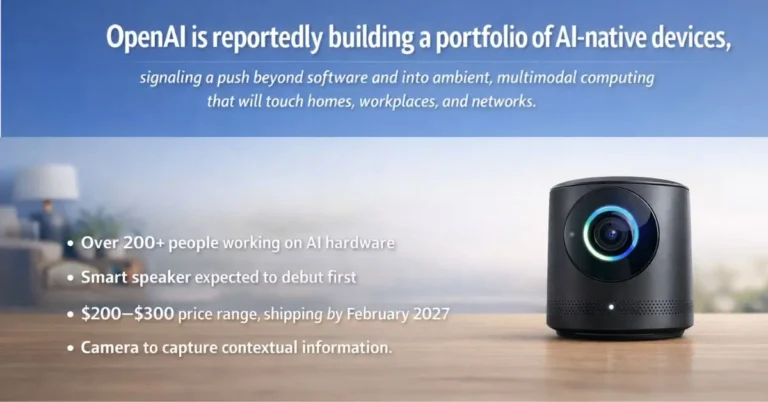
OpenAI is reportedly building a portfolio of AI-native devices, signaling a push beyond software and into ambient, multimodal computing that will touch homes, workplaces, and networks. Multiple reports indicate OpenAI has over 200 people developing a family of AI-enabled hardware, with a smart speaker expected to debut first. Early guidance points to a price in the $200–$300 range and a ship window no earlier than February 2027. The device is said to include a camera to capture contextual information about users and surroundings—an explicit bet on multimodal AI that fuses voice, vision, and environment for richer interactions.
AI-driven experiences are flipping the traffic mix, pulling more capacity demand toward the uplink than U.S. mobile networks have historically planned for. Generative and vision-based AI are shifting usage from predominantly downloads to more continuous and bandwidth-heavy uploads. Recent benchmarking shows U.S. 5G networks prioritize downlink KPIs more than peers in Asia, even as uplink usage climbs. RootMetrics’ drive testing in late 2025 found all three U.S. carriers set roughly one-fifth of their midband Time Division Duplex (TDD) frame resources for uplink. That gap becomes material as AI, livestreaming, and enterprise camera workloads expand. U.S. carriers continued to win experience awards in early 2026, even as their uplink allocations trailed global leaders.
Google has introduced a sharply priced AI Plus subscription in India to push generative AI into the mass market and counter OpenAI’s ChatGPT Go. The AI Plus plan launches at ₹199 per month for new users for six months, then moves to ₹399 per month. The bundle raises usage limits for Gemini 3 Pro, unlocks video generation within Google’s apps, expands NotebookLM’s “deep research” capabilities, and adds 200GB of storage across Google Photos, Drive, and Gmail. Family sharing is included, signaling a household-centric growth strategy.
Disney will invest $1 billion in OpenAI and become Sora’s first major content licensing partner, enabling fans to generate and share short videos that feature more than 200 characters and environments from Disney, Pixar, Marvel, and Star Wars. The agreement spans three years, excludes actor likenesses and voices, and extends to ChatGPT Images for IP‑compliant image generation. Disney will adopt OpenAI APIs across products and operations, including features for Disney+ and employee productivity, and may showcase select user creations on its streaming service. This agreement formalizes licensed synthetic media at scale and accelerates the convergence of UGC, premium IP, and AI tooling.
A cascade of offers from OpenAI, Google, and Perplexity—amplified by Airtel and Reliance Jio—signals a deliberate push to convert India’s scale into durable AI usage, data, and future revenue. With more than 900 million internet users, rock-bottom mobile data prices, and a young, mobile-first population, India offers the world’s deepest top-of-funnel for AI adoption. Giving away premium access—such as a year of ChatGPT’s low-cost “Go” tier, Jio’s bundling of Gemini, or Airtel’s tie-up with Perplexity Pro—maximizes trial, habituation, and data collection across diverse languages and contexts. Even a low single-digit conversion rate translates into millions of subscribers, while non-converters still contribute valuable signals that improve models.

SoftBank and OpenAI have formed SB OAI Japan, a jointly owned entity that will commercialize “Crystal intelligence,” a bundled enterprise AI offering focused on management and operations in Japan. The venture will combine OpenAI’s enterprise-grade models and tooling with localization, integration, and support led by SoftBank in-market. Crystal intelligence is positioned as a turnkey solution that pairs model access with domain-specific implementation, governance, and support. SoftBank plans to deploy the solution across its own group companies, validate outcomes in production, and recycle those learnings back into SB OAI Japan’s offerings.
OpenAI has signed a multi‑year, $38 billion capacity agreement with Amazon Web Services (AWS) to run and scale its core AI workloads on NVIDIA‑based infrastructure, signaling a decisive shift toward a multi‑cloud strategy and intensifying the hyperscaler battle for frontier AI. The agreement makes OpenAI a direct AWS customer for large‑scale compute, starting immediately on existing AWS data centers and expanding as new infrastructure comes online. AWS and OpenAI target the bulk of new capacity to be deployed by the end of 2026, with headroom to extend into 2027 and beyond.
Meta, Alphabet, and Microsoft signaled that AI infrastructure is now a multi-year capital priority measured in tens of billions per year. In their latest results, Meta guided capital expenditures into the $70–72 billion range with an even larger step-up expected the following year. Alphabet raised its 2025 capex outlook to $91–93 billion, up sharply from prior estimates. Microsoft reported $34.9 billion of capex in the most recent quarter, materially above expectations and up strongly year over year. These figures point to the largest synchronized build-out of compute, storage, and networking capacity in the history of cloud.
OpenAI has launched ChatGPT Atlas, a MacOS AI browser built around its chatbot, positioning agentic browsing and LLM-native search as the next front in the browser wars. Atlas reframes the browser as a conversational interface. It removes the traditional address bar and orients the experience around ChatGPT, with natural language as the primary way to navigate, retrieve, and summarize information. The initial release targets Apple’s MacOS, with OpenAI emphasizing a paid “agent mode” that can autonomously search, read, and act on the user’s behalf using the live browsing context. Agent mode will be available to paying ChatGPT subscribers, extending OpenAI’s monetization beyond API usage and premium chatbot tiers.
General Motors will begin rolling out a Google Gemini–powered conversational assistant across Buick, Chevrolet, Cadillac, and GMC in 2026, advancing the automaker’s in-cabin AI strategy and resetting expectations for voice-driven services in connected vehicles. GM plans to deliver a new assistant, built on Google’s Gemini family, as an over-the-air update via the Play Store to eligible OnStar-equipped vehicles from model year 2015 and newer. At launch, drivers should see more natural interactions: the assistant will understand free-form requests, maintain context across turns, and cope better with accents and phrasing. GM says the assistant will tap vehicle data to push maintenance alerts and route suggestions as well.
OpenAI is reportedly preparing a standalone app for its next-gen video model, positioning AI-only short video as a consumer format in its own right. The app reportedly delivers a vertical feed with swipe navigation, reactions, and remixing familiar mechanics that lower friction for discovery and creation. Every clip is generated by Sora 2 rather than uploaded, with current limits around 10 seconds per video. A recommendation engine powers a personalized “For You” experience, aligning with how short-form attention is won and retained today. A notable feature is identity verification tied to likeness usage. Expect provenance signals and watermarking frameworks (for example, C2PA-style manifests) to become table stakes for platforms that remix human likeness at scale.
ChatGPT users in the U.S. can now buy from Etsy sellers without leaving the conversation, with more than a million Shopify merchants “coming soon.” The feature, called Instant Checkout, is available to logged-in Free, Plus, and Pro users. It supports Apple Pay, Google Pay, Stripe, and credit cards. The flow is simple: ask for ideas, get curated products with images, prices, and reviews, tap Buy, confirm shipping and payment, and the merchant fulfills the order using its existing systems. Brands like Glossier, Skims, Spanx, and Vuori are expected to be part of the broader Shopify rollout.
Sponsored by Palo Alto Networks
⚡ Utilities ⏱ 8 min ✓ Free
This tool is built and hosted by TeckNexus.
Launch Tool →
Whitepaper
Airports are deploying AI surveillance, biometrics, and autonomous vehicles faster than most networks can secure them. See what 100 real-world airport deployments reveal about the airside/landside security gap — and the 4-layer framework built to close it....
Scroll to Top