AI uplink demand reshapes mobile networks
AI-driven experiences are flipping the traffic mix, pulling more capacity demand toward the uplink than U.S. mobile networks have historically planned for.

How AI shifts traffic from download to upload
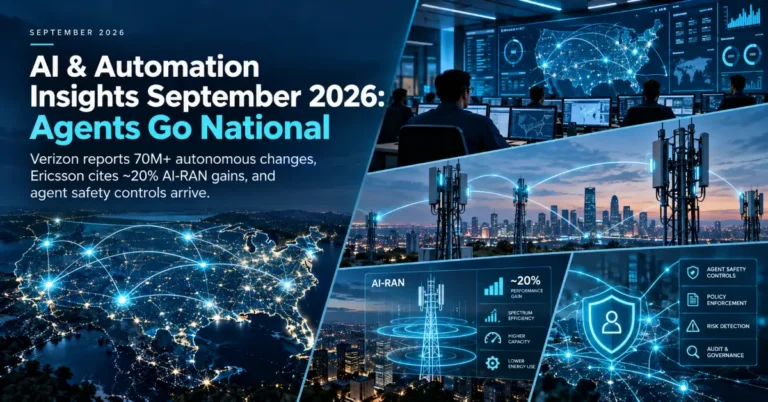
Generative and vision-based AI are shifting usage from predominantly downloads to more continuous and bandwidth-heavy uploads. Beyond photo queries to assistants like ChatGPT or Gemini, early smart glasses from major platforms point to persistent, real-time video streams headed to inference engines. In the enterprise, machine vision, remote inspection, and automation increase uplink intensity across factories, logistics, and field service. Industry forecasts now model uplink share of total mobile traffic rising substantially over the next decade, especially under medium to high AI adoption scenarios.
Low-latency uplink and edge compute requirements
Where AI inference runs matters. If on-device AI is insufficient, more requests move to cloud or operator edge locations, raising dependency on low-latency, jitter-controlled uplinks. Glasses and camera-first use cases are especially sensitive to transport reliability and upstream bandwidth, pressing operators to rethink scheduling, congestion control, and edge placement to meet responsiveness targets.
Variables that will drive uplink growth
Three variables will drive the ultimate network impact: the split between on-device vs. network AI processing; the degree to which Wi‑Fi offload absorbs traffic; and compression gains that could tame video uplink demands. These will decide whether uplink growth is incremental or step-change.
U.S. 5G carriers lag in uplink capacity
Recent benchmarking shows U.S. 5G networks prioritize downlink KPIs more than peers in Asia, even as uplink usage climbs.
Current uplink allocation in U.S. 5G
Ookla’s analysis of top-tier 5G samples indicates AT&T, T‑Mobile, and Verizon dedicate a smaller proportion of capacity to uplink than operators in markets like China. RootMetrics’ drive testing in late 2025 found all three U.S. carriers set roughly one-fifth of their midband Time Division Duplex (TDD) frame resources for uplink. While upload rates have improved since 2021 thanks to new spectrum and features, the uplink share of total capacity has largely held flat—or declined—in many markets.
Why download KPIs still dominate
Operators compete on headline download speed, video streaming, and coverage metrics tracked by Opensignal and Ookla, and those incentives bias networks toward downlink-heavy configurations. Notably, U.S. carriers continued to win experience awards in early 2026, even as their uplink allocations trailed global leaders. That gap becomes material as AI, livestreaming, and enterprise camera workloads expand.
FDD vs TDD: uplink flexibility explained
Legacy Frequency Division Duplex (FDD) splits fixed uplink/downlink channels and is less flexible for large uplink bursts. Midband 5G relies on TDD, which can tune the uplink/downlink ratio, but nationwide synchronization to avoid interference constrains how aggressively individual operators can shift frames to uplink without coordination.
How to boost 5G uplink capacity
Carriers have multiple tools to improve uplink throughput and consistency without undermining download performance.
Rebalancing frames and dynamic TDD
Adjusting TDD patterns to increase uplink slots in dense areas, venues, and industrial zones can relieve pressure where AI/video creation spikes. Dynamic TDD—shifting ratios in near real time—promises better utilization, but demands tight interference management and vendor support to avoid cross-link interference in co-channel deployments.
Uplink carrier aggregation and 5G Standalone
Extending uplink carrier aggregation across midband and supplemental FDD uplink can deliver immediate gains; live networks in the U.S. have already shown measurable benefits from two-carrier uplink aggregation on flagship devices. 5G Standalone (SA) improves uplink scheduling and enables features like UL MIMO, PUSCH enhancements, and sidelink evolution that will mature in 3GPP Release 18/19.
UL MIMO, device support, and RAN software gains
Higher-order UL MIMO, smarter schedulers, and interference cancellation on the uplink path can raise user-experienced throughput. Vendors including Ericsson and Nokia have prioritized uplink efficiency in recent software loads, and OEM roadmaps increasingly expose UL CA and power-saving features, expanding the addressable device base.
Spectrum and policy for uplink scaling
Spectrum availability and synchronization policy will shape how quickly U.S. operators can scale uplink capacity.
Midband releases and timing
Opensignal expects reliability and accessibility to benefit from additional spectrum releases, with the FCC planning more midband supply, including upper C-band tranches by mid-2027. While these moves primarily lift overall capacity, they also give operators headroom to redistribute some midband resources toward uplink without compromising downlink KPIs.
Network synchronization limits on TDD
In 3.5 GHz-class bands, market-wide frame alignment requirements limit per-operator deviation in TDD patterns. Industry coordination through the GSMA and ecosystem vendors will be essential to introduce more flexible, interference-safe uplink-heavy profiles as AI use increases.
5G‑Advanced uplink features and roadmap
5G-Advanced introduces uplink-centric features such as enhanced CA, joint UL scheduling across carriers, and improved power control, while future releases will refine cross-link interference mitigation—key to enabling dynamic uplink scaling.
FWA growth signals uplink strain
Fixed wireless access is scaling rapidly in the U.S., and its performance trends foreshadow how uplink-heavy usage stresses shared spectrum.
Subscriber growth and speed pressure
Ookla reports that FWA subscriptions surpassed 14 million by late 2025, but median speeds have softened as loads rise, with late-afternoon and evening slowdowns most evident among some user cohorts. Verizon’s stricter traffic management has produced more consistent low-percentile performance, hinting at the role of policy in preserving user experience under congestion.
Latency and indoor uplink requirements
FWA uplinks must support video calls, home security cameras, and cloud gaming; latency remains higher on some offers but is improving quarter by quarter. Broadband Forum guidance on distributing gigabit service over in-building wiring from a single 5G link underscores the need for smart in-home architectures that avoid turning the cellular uplink into the bottleneck.
What carriers and enterprises should do now
AI will not wait for networks to rebalance, so planning for uplink resilience should start immediately.
Actions for mobile carriers
- Map uplink hotspots tied to AI and creation (stadiums, campuses, logistics hubs) and pilot more uplink-heavy TDD patterns there.
- Expand uplink carrier aggregation across the midband and pair with supplemental FDD uplink; prioritize SA coverage where AI latency matters.
- Coordinate frame alignment and explore dynamic TDD trials with vendors to validate cross-link interference protections.
- Use traffic shaping to protect latency-sensitive uplink flows and expose uplink SLAs for enterprise segments.
Actions for enterprises and CIOs
- For AI vision or AR workflows, require proof points on sustained uplink throughput, variance, and round-trip latency on target networks.
- Consider MEC or private 5G for deterministic uplink where public macro cannot meet jitter/latency budgets.
- Align device procurement with UL CA support and 5G SA readiness to capture near-term uplink gains.
Uplink KPIs to watch
– Uplink share of TDD slots by market, median and 10th percentile upload speeds, UL CA availability, SA coverage, and edge zone latency. As AI adoption grows, the operators that rebalance for uplink first will win creation-centric consumers and camera-first enterprise workloads.