A telecom AI agent is an autonomous software system that reads the live state of a network and its customers, reasons toward an operator’s business goal, and acts across operational systems — rerouting traffic, reconfiguring a service, clearing a fault, resolving a ticket — without being instructed step by step.

At that level of description, it shares the same anatomy as any AI agent: it perceives, decides, and acts. What sets a telecom agent apart is not the model underneath but everything wrapped around it — what it is grounded in, the systems it is allowed to touch, the consequences of a wrong decision, and the goals it ultimately answers to. Treating the two as interchangeable is where a lot of network-AI strategy quietly goes wrong: a capability that looks impressive in a generic demo can be unusable, or unsafe, the moment it is pointed at a live carrier network.
New to the underlying mechanics? Our explainer on what AI agents are, the core components of AI agents and the rule-based versus LLM-based comparison cover the general anatomy. This piece is about what changes when you drop that anatomy into a live telecom network.
The same anatomy, a very different job
Every AI agent runs the same loop — it perceives its environment, reasons about what to do, acts, and learns from the result. A telecom agent runs the identical loop, but the network redefines every stage:
- Perceive — not static documents, but live telemetry, alarms, topology, and service KPIs streaming from the network and changing by the second.
- Reason — not open-ended, but bounded by SLAs, operator policy, and regulatory constraints that define what a “good” decision even is.
- Act — not a drafted message, but a change to a live service: a re-route, a configuration push, a capacity or scaling decision.
- Learn — not from a user’s thumbs-up, but from network outcomes measured against the operator’s targets.
- That reframing is the whole story. Hold it in mind, and the five practical differences below follow naturally.
Five differences that actually matter
On the surface, a telecom agent and a generic enterprise agent can look identical — both perceive, reason, and act. The distance between them shows up across five dimensions.
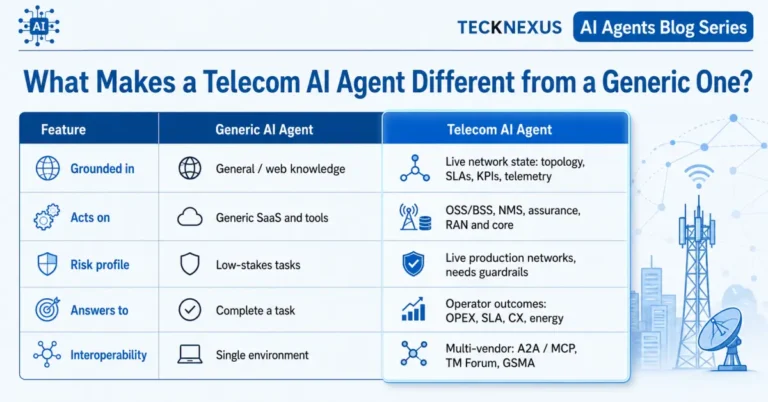
| Generic AI agent | Telecom AI agent | |
| Grounded in | General / web knowledge you supply | Live network state — topology, SLAs, KPIs, telemetry |
| Acts on | Generic SaaS and tools | OSS/BSS, NMS, assurance, ticketing, RAN and core |
| Risk profile | Low-stakes tasks | Live production networks — needs explainability + human checkpoints |
| Answers to | Complete a task | Operator business goals — OPEX, SLA, CX, energy |
| Interoperability | Single environment | Multi-vendor — A2A / MCP protocols, TM Forum, GSMA |
Grounding. A generic agent reasons over general knowledge and whatever documents you hand it. A telecom agent is only useful if it is grounded in the real, moving state of the network. An agent that recommends rerouting traffic is only as good as its live view of topology and load — and stale context is often worse than none, because it drives confident action on a picture that no longer holds.
The systems it acts on. Generic agents operate across familiar SaaS surfaces. A telecom agent has to reach into OSS and BSS stacks, network management and assurance platforms, ticketing, and increasingly the RAN and core. Wiring an agent into a two-decade-old OSS is frequently harder than the model work itself — the integration, not the intelligence, is the bottleneck.
The consequences of being wrong. A generic agent that misfires drafts a bad email. A telecom agent that misfires can degrade a live production network serving millions of subscribers. That single fact reshapes everything downstream — which is why explainability, guardrails, and human checkpoints are treated as first-class requirements here rather than as afterthoughts.
The goals it answers to. Generic agents are pointed at tasks. Telecom agents are pointed at outcomes an operator actually reports on: lower operating cost, protected SLAs, better customer experience, reduced energy draw. Success is defined in the operator’s terms and measured against them, not by whether a task is technically completed.
Interoperability. A generic agent usually lives inside one environment. A telecom network is multi-vendor by design, so agents must discover and work with one another across domains they do not own. That is why agent-to-agent and model-context protocols, and standards work from bodies like TM Forum and the GSMA matter far more in telecom than in most enterprise AI.
Where telecom AI agents actually operate
In practice, these agents show up in three broad areas, and the buyer inside the operator is different for each.
In the network. Assurance, configuration, and troubleshooting — the self-healing and self-optimizing behavior operators have chased for years. Vendors are already shipping here: Nokia has packaged pre-built agents into an autonomous-networks agent library, and Ericsson has extended agentic capabilities into private-network and RAN operations.
In the back office. OSS/BSS workflows such as service activation, RFP response, and billing exceptions. Vodafone, for example, has rebuilt parts of its RFP process around AI, and BT has reported agentic AI shortening IT service-desk resolution times.
On the customer front line. Moving beyond scripted chatbots to resolve issues and take action on a subscriber’s behalf. Verizon has deployed customer-facing agents built on Google Cloud’s Gemini while building others in-house, and operators including AT&T and T-Mobile have signalled ambitions to make agentic workflows — with human checkpoints — a core part of operations.
Curious where your company stands in the broader telecom AI agent ecosystem? Benchmark your company’s AI agent position against network equipment vendors, OSS/BSS providers, system integrators, and operators.
These three areas map to how the rest of this hub is organized: agents built by operators, agents from solution providers, and agents from the wider ecosystem. Explore the full landscape in the AI agents hub.
Why “different” also means “harder”
The same autonomy that creates the value is what raises the stakes. An agent that adapts its own behavior during execution is, by definition, less predictable than a fixed script — and on a carrier network, unpredictability has a cost. Three questions sit at the center of every serious deployment: how much authority to delegate, where to keep a human in the loop, and how to trace why an agent did what it did after the fact.
Data sovereignty adds another layer. Telecom agents are grounded in sensitive network and subscriber data governed by real regulatory constraints, which is one reason some operators favour operator-built or on-premise agents over fully outsourced ones. And because full autonomy is not a switch you flip, the industry increasingly frames the journey the way vehicle automation is framed — as levels, from assisted operations through to networks that plan and heal themselves with little human intervention. Most production deployments today sit at partial autonomy, with humans supervising. In that context, independent evaluation of the guardrails, not just the headline capability, is what separates a demo from something that can run in production.
How to evaluate a telecom AI agent
For operators and enterprises weighing vendor and operator claims, a short set of questions cuts through the noise:
- What is the agent grounded in, and how fresh is that data?
- Which systems can it write to — and what can it change autonomously versus only propose?
- What are the guardrails, and where exactly does a human stay in the loop?
- How does it explain its decisions after the fact?
- Does it interoperate across a multi-vendor estate, or does it assume a single stack?
- Which business metric does it move, and how is that measured?
- Where does the data live, and does that meet your sovereignty requirements?
This is the lens we apply across the hub — evaluating agents on evidence, not on demo polish.
Where is this heading
Two shifts are worth watching. The first is the steady climb up the autonomous-network maturity curve, from assisted operations toward networks that increasingly plan and heal themselves. The second is subtler: as agents become the primary things consuming network capabilities, the industry is starting to treat the agent — not the human developer — as the user to design for. That points toward machine-readable, agent-friendly network APIs, and a shift some describe as moving from developer experience to “agentic experience.”
Underneath both, the interoperability plumbing is maturing — agent-to-agent and model-context protocols, agentic frameworks from TM Forum, and industry-wide efforts through the GSMA — and it is increasingly assumed that 6G will be designed AI-native from the start rather than having intelligence bolted on.
Frequently asked questions about telecom AI agents
| Question | Answer |
|---|---|
| What is a telecom AI agent? | A telecom AI agent is an autonomous system that perceives live network and customer state, reasons toward an operator’s goal, and acts across network and IT systems without step-by-step human direction. |
| How is it different from a generic AI agent? | The model may be similar, but the grounding is different. Telecom AI agents rely on live network state, act across OSS/BSS, NMS, and RAN systems, operate in higher-risk production environments, support operator business outcomes, and often require multi-vendor interoperability. |
| Is a telecom AI agent just network automation? | No. Traditional automation follows predefined rules for predefined scenarios. A telecom AI agent pursues a goal and adapts its approach as conditions change. |
| What is the difference between an AI agent and agentic AI? | Agentic AI describes the broader capability: systems that act autonomously toward goals. An AI agent is a concrete instance of that capability deployed for a defined role. |
| Are telecom AI agents safe to run on live networks? | They can be, with the right guardrails. These include bounded authority, human-in-the-loop checkpoints, explainability, and staged rollout. Safety comes from the operating envelope around the agent, not the model alone. |
| Who is building telecom AI agents? | A mix of network operators, telecom solution providers, and ecosystem players are building them, including cloud platforms and standards bodies. This is also how the hub organizes the landscape. |
The short version: a telecom AI agent is not a generic agent that happens to sit in a network. It is shaped by the network — its data, its systems, its risks, and its goals. Keeping that distinction clear is the first step to evaluating any vendor or operator claim that follows. Explore how it plays out across operators, vendors, and the ecosystem, or follow the ongoing AI Agent Series.