TM Forum

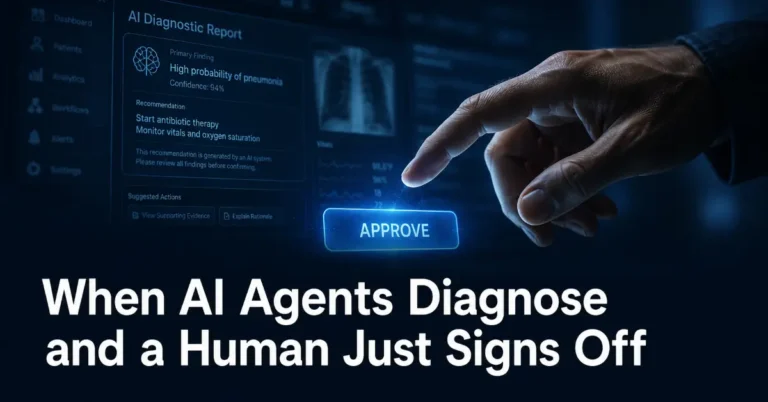
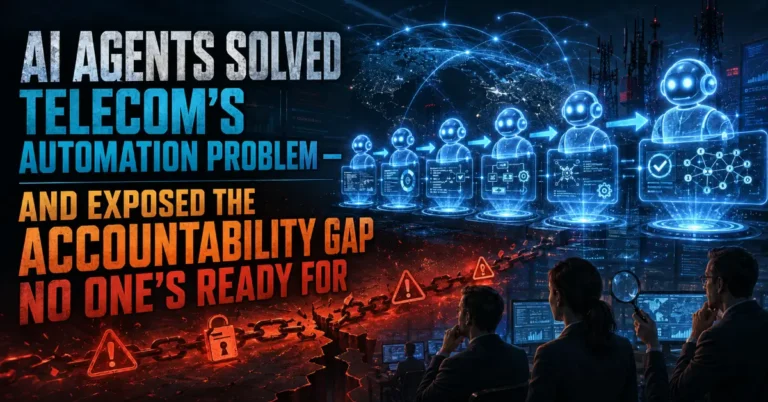
Nokia and Google Cloud's network agents no longer just recommend fixes — they diagnose faults and propose remediations that a human approves rather than performs. That single word, "approves," is where the real governance work needs to happen.
July 2026's roundup: agentic AI's accountability gap widens even as AI-RAN moves into government-backed programs, telecom builds its own AI models, and fresh capital reshapes the AI model layer — with the deeper compute and data-center buildout covered in our companion Digital Infrastructure Insights, July 2026.
Telecom just crossed a line it spent years approaching carefully. AI agents are no longer confined to recommending fixes to network engineers — in a growing number of deployments, they're diagnosing faults and proposing remediations that a human simply signs off on, rather than performs. Nokia's work with Google Cloud is a clear marker of how far this has come: agents built on Gemini now sit inside Nokia's Assurance Center, and early results point to fault-resolution times cut by more than half, sometimes by as much as 80 percent. That's the part of the story getting the headlines. It's also, in a sense, the easy part... The harder question — the one the industry has mostly deferred — is what happens structurally once agents stop merely proposing and start acting, especially across more than one system at a time.
June 2026's roundup: agentic AI moves from pilot to operational core across telecom networks, satellite consolidates through Rocket Lab's $8B Iridium acquisition and SpaceX's $75B IPO, AI-RAN's GPU divide matures into shipping products, US spectrum auctions return after a four-year hiatus, and telecom M&A accelerates globally.
June 2026 showed agentic AI scaling from pilot to platform: industry-wide standards momentum, AI-RAN field trials from Nokia, Amdocs and KDDI, and fresh capital across data centers on three continents. This full roundup covers every deployment, partnership, funding round and governance move from the month, with tools to prioritise AI use cases and plan the network around them.
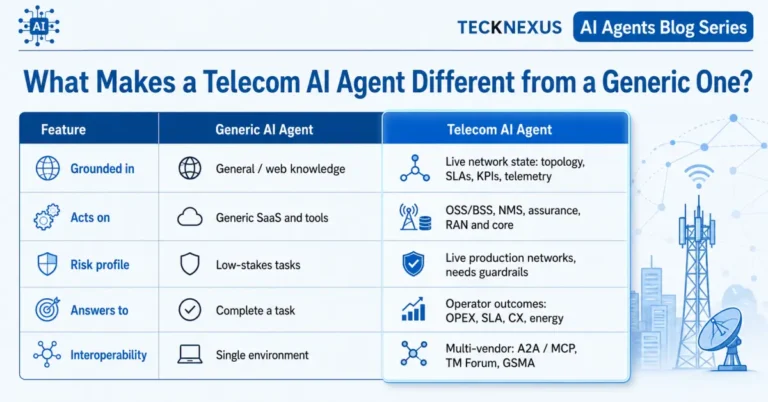
Telecom AI agents share the same anatomy as any AI agent - but grounding, systems, stakes, goals, and multi-vendor interoperability set them apart. Here are the five differences that matter, plus how to evaluate an agent before you trust it on a live network.
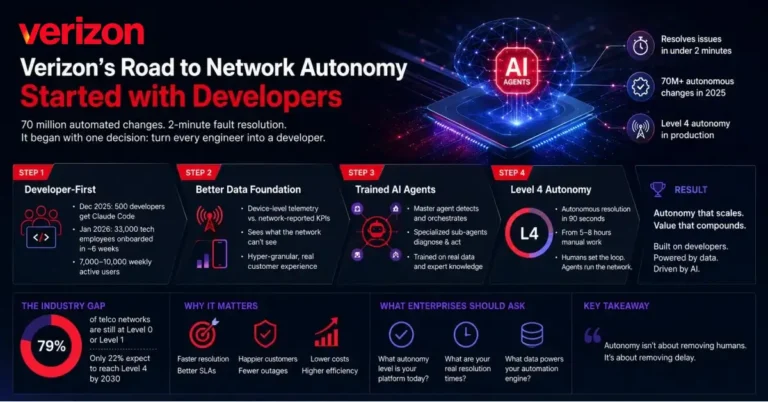
Verizon CTO Yago Tenorio has detailed the carrier's architecture for Level 4 network autonomy: 70 million automated changes in 2025, 33,000 engineers turned into software developers with Claude Code, and a common data layer that captures what the network couldn't previously see. The instructive element for enterprise buyers is the sequence, not just the destination.
T-Mobile's Dynamic CX applies AI to its Self-Organizing Network architecture, scanning public data sources - event schedules, ticketing platforms, social activity — to anticipate high-density demand before it strains the network. Launching ahead of the 2026 FIFA World Cup across eleven U.S. host cities, the capability shifts network management from reactive triage to proactive resource allocation. Opensignal data from February through May 2026 already shows T-Mobile leading mobile experience metrics in all eleven markets, a baseline Dynamic CX is engineered to sustain under peak load conditions.
TELUS Digital is using Mobile World Congress 2026 to move the AI-in-telecom conversation from pilots to proven production at scale. TELUS Digital reports processing more than two trillion tokens in 2025 through its Fuel iX generative AI platform for TELUS operations and customers. The portfolio spans AI for customer experience, application safety, and network modernization—built and battle-tested within TELUS before client rollout. The Network Design Services practice applies AI to planning and optimization while charting a path from legacy network stacks to cloud-native, automated environments.
Deutsche Telekom, Orange, Telefónica, TIM, and Vodafone unveiled a live, pan‑European edge federation at MWC 2026, marking a practical step toward an interoperable edge cloud that spans national borders. The five largest European operators demonstrated the European Edge Continuum, a federated edge capability now running in lab and pre‑production environments. The initiative provides a single entry point to deploy and manage applications across multiple operators’ edge nodes, with automated placement, security controls, and mobility‑aware continuity. The platform draws on components developed under the IPCEI‑CIS program backed by the EU’s NextGenerationEU funds, and is positioned for industrialization and commercial rollout next.
A new partnership between Infosys and Anthropic brings agentic AI into regulated, process-heavy industries, with telecom squarely in scope. Infosys will integrate Anthropic’s Claude models and Claude Code with its Topaz portfolio to build and operate enterprise-grade AI solutions across telecom, financial services, manufacturing, and software engineering. The collaboration emphasizes agentic AI—systems that can plan, call tools, and execute multi-step workflows with oversight—delivered with the controls, auditability, and policy enforcement that regulated sectors demand. Pairing Infosys’s domain depth with Claude’s reasoning and long-context capabilities gives operators a path to pragmatic automation that respects regulatory, safety, and transparency requirements.
India’s AI agenda increasingly spans silicon, data platforms, models, and applications, with an intent to catalyze domestic innovation and contribute to global ecosystems. For telecom leaders, the message is clear: AI is not a bolt-on capability but a system-level transformation that touches RAN, core, transport, cloud, and the enterprise edge. The AI economy runs on connectivity—low-latency access to data, assured bandwidth, location-aware processing, and programmable control. The operators that can fuse connectivity, compute, and data into a cohesive platform will set the pace for India’s next wave of digital growth.

Partner Hubs

Download content, access intelligence tools, and hear from executives.

Partner Events

  • M360 ASEAN
  • FutureNet Asia 2026
  • Network X Vienna 2026
Scroll to Top