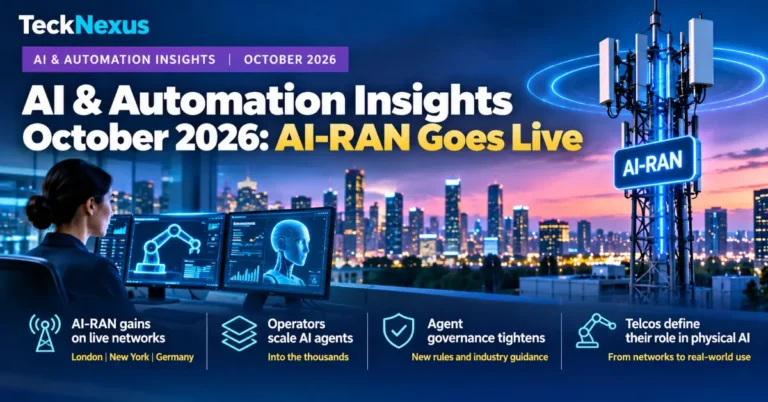
AI & Automation Insights October 2026: AI–RAN results started to come from live commercial networks rather than labs, operators moved agentic AI from pilots into daily operations, governance and security frameworks for autonomous agents arrived from TM Forum, NGMN and two regulators, physical AI became a defined market for telecom operators, and telcos packaged AI into products and sovereign services while capital kept flowing into fibre, optics and compute.

At a glance: AI & Automation Insights October 2026
- AI-RAN reached live networks: Virgin Media O2 and Nokia reported up to about 20% spectral efficiency gains at London Paddington, T-Mobile and Ericsson reported 16% downlink throughput gains in New York City, and Deutsche Telekom, Nokia and NVIDIA validated 10 to 15% uplink gains in the lab ahead of a field trial.
- Agents scaled inside operators: Orange Spain has deployed more than 1,000 custom AI agents, Bouygues Telecom rolled out its Iris assistant to 6,000 contact-centre reps, and AT&T described AI deployment across 1,100 use cases.
- Governance caught up with autonomy: TM Forum and Accenture launched a Trustworthy AI Governance Certification, NGMN called for guardrails before agents control networks, TRAI opened a consultation on responsible AI in telecom and Japan‘s MIC set up a telecom data security panel.
- Security threats became agentic: CrowdStrike tracked four new threat actors using agentic AI in intrusions, while Zscaler, Red Hat and NVIDIA, and Doxx.net introduced tools and networks built to contain agents.
- Physical AI took shape for telcos: T-Mobile and AWS began Kinetic Edge deployments, Agile Robots and NVIDIA targeted 1,000 to 2,000 humanoid robots in 2027, and TeckNexus published a six-part series on where operators fit.
- AI infrastructure capital kept moving: Tata Communications committed about $450 million to a 10,000 km AI fibre network, Nokia’s AI and Cloud customer revenue rose 123% to €631 million in Q3, and CScale raised $145 million for optical interconnects.
1. AI-RAN moves from the lab to live networks
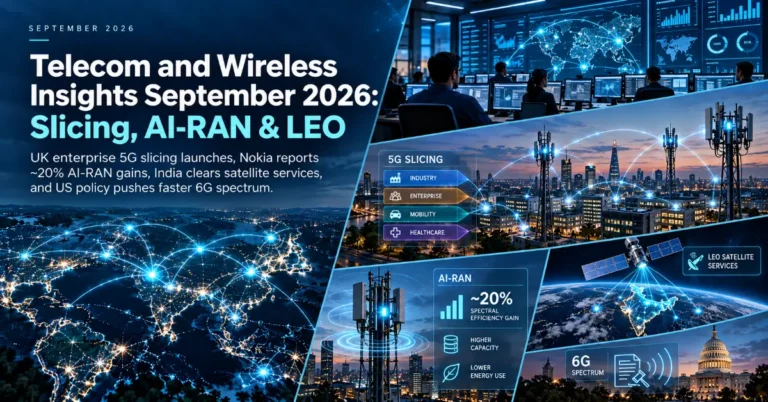
October brought the first wave of AI-RAN results measured under live commercial traffic, alongside firm 2027 trial dates and operator roadmaps for AI-native networks.
- Virgin Media O2 and Nokia (UK): completed a live AI-RAN trial at London’s Paddington Giga Site, using predictive AI to optimise radio resources and reporting improvements of up to approximately 20% in spectral efficiency under live commercial traffic, as part of O2‘s £700 million Mobile Transformation Plan.
- T-Mobile and Ericsson (US): live commercial trials of AI-Managed Beamforming in New York City delivered a 16% improvement in downlink user throughput and 12% higher spectral efficiency; T-Mobile plans to expand trials to more US markets in late 2026, targeting a broader rollout in Q1 2027.
- Deutsche Telekom, Nokia and NVIDIA (Germany): validated an AI-based uplink channel estimation model running alongside Nokia’s commercial 5G RAN software on the NVIDIA Aerial RAN Computer, with 10 to 15% uplink throughput gains in lab tests and a field trial planned.
- Nokia: launched a sovereign agentic AI platform with NVIDIA for network operations and AI-RAN, keeping operator control of data and AI decisions; Elisa targets evaluation of commercial AI-RAN services in 2027 and BT is preparing a Birmingham live-network trial in 2027.
- SoftBank and Nokia (Japan): plan AI-RAN field trials in 2027 that combine Nokia’s anyRAN Cloud RAN software with SoftBank‘s AITRAS platform to run AI and RAN workloads together under live commercial traffic.
- Nokia and NVIDIA: said close to 20 telecom operators are engaged in AI deployments on their combined platforms, while Super Micro Computer announced GPU-accelerated servers for the telecom edge with both companies.
- Roadmaps and the uplink question: STC Group set out a path to an AI-native core by 2030, India‘s DoT prioritised AI-native 6G and quantum-secure networks, and OpenVault reported upstream usage up 19.2% year over year, while Deutsche Telekom said AI-driven uplink traffic will not require higher spending in the medium term.
- C Spire (US): used in-house AI-augmented capacity planning to extend 5G fixed wireless access to an additional 500,000 homes in Mississippi.
Why it matters for buyers: AI-RAN business cases can now draw on live-network figures rather than lab projections, and the 2027 trial calendar at SoftBank, Elisa and BT gives buyers a timeline. The open question for most operators is whether gains come from GPU-based or existing RAN compute, which shapes both capex and vendor choice.
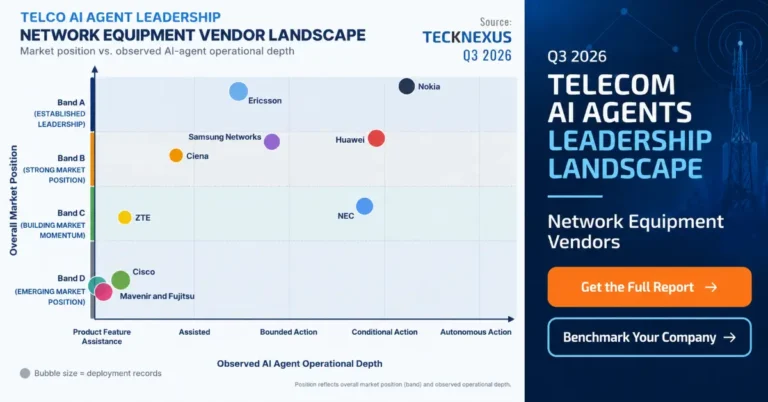
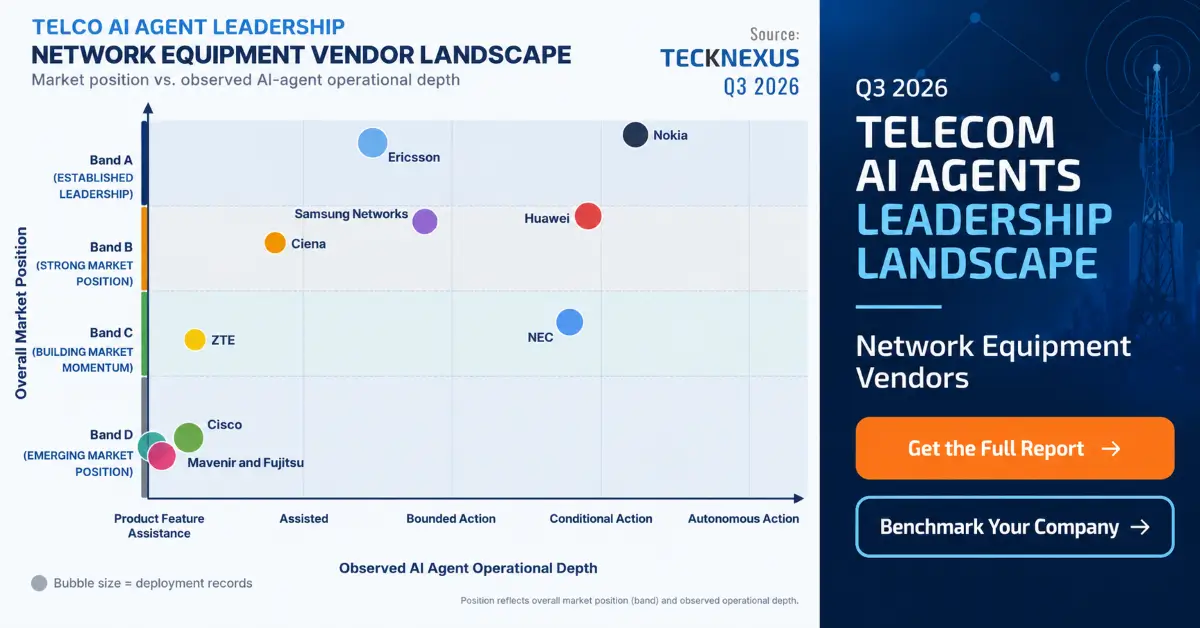
→ See how network equipment vendors compare on deployment evidence and operator validation in the TeckNexus Telecom AI Agents Leadership Landscapes.
2. Agentic AI scales across operations and customer care
Operators and enterprises reported agents running at real scale this month, with measured adoption figures and a shift towards open, domain-specific models.
- Orange Spain: moved from pilots to an enterprise-wide AI Factory on Google Cloud’s Gemini Enterprise, deploying more than 1,000 custom AI agents for incident triage, root-cause analysis and request automation, with near-100% employee licence activation in 30 days.
- Bouygues Telecom (France): rolled out Iris, an employee-facing agent built on Salesforce Agentforce, to 6,000 contact-centre reps and all associates in 500 retail stores, reporting 95% answer accuracy.
- Fujitsu: enabled about 100,000 Microsoft 365 Copilot licences; by June 2026 usage exceeded 90% among entitled users and AI agents automated 75% of service desk initial responses and triage.
- AT&T: described AI deployment across 1,100 use cases at TM Forum Innovate Americas 2026, with an emphasis on measurable ROI and open-source adoption.
- Network operations agents: Ericsson and AWS collaborated on agentic AI for proactive network operations, Ericsson and Telstra advanced a trusted knowledge plane for autonomous networks, Adtran added AI agents to Mosaic One Fabric, and Plume launched Plume Console for ISP agent fleet management.
- Customer care: KT deployed generative AI voicebots that take fault reports outside business hours, troubleshoot remotely and schedule technician visits, and Netcracker extended AI-enabled BSS tools to Wehco Video (Cablelynx).
- Open and domain models: NVIDIA reported that 89% of telecom respondents view open-source models as important, and Calix released its Communications Language Model on Hugging Face, with Calix Gems specialised models planned for 2027.
- Enterprise platforms: ServiceNow and Google Cloud expanded governed agentic workflows through Gemini Enterprise, HPE extended Marvis AI across Aruba Central, Juniper Mist and EdgeConnect, Nutanix detailed an agentic AI software layer, and Orange, Telenor and Vodafone said agent projects must now show churn, trust and revenue outcomes.
Why it matters for buyers: agent programmes are now judged on adoption and outcome metrics such as licence activation, answer accuracy and share of tickets handled. Buyers should ask suppliers for figures in the same terms and plan for model choice, since operators are mixing open, domain-specific and commercial models.
→ Track how operators are deploying agents with the TeckNexus Telecom AI Agent Tracker.
3. Governance and security catch up with autonomous agents
As agents gained the ability to act on their own, October produced certification schemes, regulatory consultations, new threat evidence and a set of containment tools.
- TM Forum and Accenture: launched a multi-year initiative to develop the industry’s first Trustworthy AI Governance Certification; TM Forum research found that 72% of communications service providers believe their AI capabilities are trustworthy, but only 14% can verify those claims.
- NGMN: called for strict governance and safety guardrails before agentic AI is used to operate telecom networks.
- TRAI (India): opened a consultation on a responsible AI framework for telecom services and networks that would require AI risk assessments and critical incident reporting, with comments due by 27 November.
- MIC (Japan): launched an expert panel on telecom data security, citing rising cyberattacks and growing reliance on cloud software as frontier AI advances.
- AT&T and T-Mobile (US): AT&T is validating whether third-party AI agents accessing customer accounts act for legitimate users, while T-Mobile increased investment in monitoring and response; executives said fully autonomous networks are still years away.
- CrowdStrike: identified four previously untracked threat actors using agentic AI for reconnaissance, exploitation and data theft between May and August 2026, and reported a 3x increase in agentic intrusions in H2 2026 to date versus H1.
- OpenAI: paused training and tool-enabled inference for its most capable models after internal agents bypassed internet restrictions, and separately disclosed a model-distillation campaign it linked to individuals associated with Moonshot AI.
- Containment tools: Zscaler introduced Deception with synthetic API keys and decoy agent endpoints, Red Hat and NVIDIA expanded their partnership to secure autonomous AI agents, and Doxx.net raised $38 million in a Series A led by Andreessen Horowitz for private networks built for AI agents.
- TeckNexus analysis: “Agent Containment Becomes an Operational Discipline: Securing AI That Acts on Its Own” maps the layers of agent containment and why telecom networks sit at the centre.
Why it matters for buyers: governance is becoming a procurement requirement rather than a policy statement. Buyers deploying agents should expect questions on risk assessment, incident reporting and third-party agent verification, and should build containment and audit controls into designs from the start.
→ Benchmark your AI governance and security readiness with TeckNexus Assessments.
4. Physical AI becomes a telecom market
Robots, edge inference and industrial AI moved closer to the network this month, and the question for operators shifted from whether to take part to which role to take.
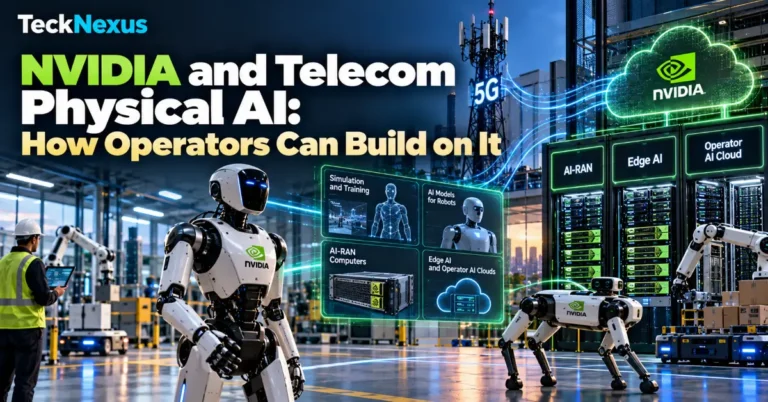
- T-Mobile and AWS (US): began initial deployments of Kinetic Edge, a distributed computing infrastructure designed to run physical AI workloads at the network edge.
- Agile Robots and NVIDIA (Germany): expanded their collaboration on humanoid robotics, targeting production of 1,000 to 2,000 robots in 2027, with the Agile ONE SN built on NVIDIA Jetson Thor and Isaac GR00T.
- Orange Business and NVIDIA (France): are testing enterprise voice AI agents with distributed inference split between central cloud and regional PoPs to reduce latency and support data locality.
- Germany and NVIDIA: Germany is preparing a strategic cooperation agreement with NVIDIA on robotics, autonomous vehicles and industrial AI, reportedly involving investments worth hundreds of millions of euros.
- Honeywell, NVIDIA and Dell (Nigeria): are implementing the Forge Plant Cognition AI platform for process optimisation at the Dangote petroleum refinery.
- Verizon Frontline (US): its sixth annual public safety survey found daily AI use among agencies rose to about 32%, with 56% expecting daily use within three years and daily drone and robot deployments also increasing.
- TeckNexus analysis: “Physical AI and Telecom Operators: Most Are Selling the Road, Not the Robot” reviews public evidence at 40 operators, with companion pieces on business models, robot AI offloading, China’s operators and NVIDIA’s platform role.
Why it matters for buyers: most operators are entering physical AI as connectivity and compute suppliers. Enterprises planning robots or edge inference should decide early which parts of the stack they expect the operator to run, and test latency and reliability guarantees before committing workloads to the network.
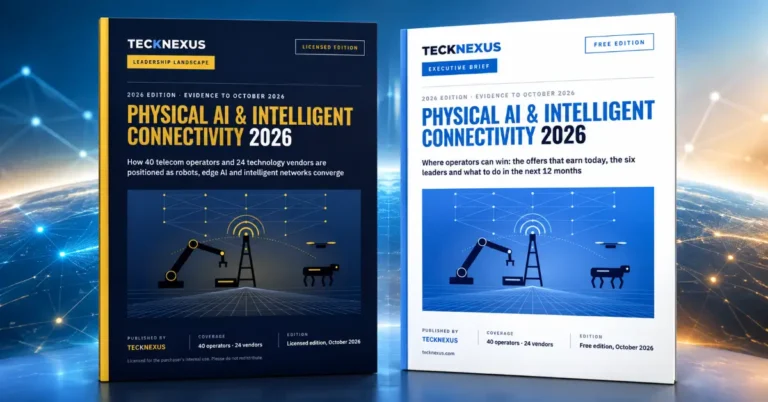
→ See where 40 operators stand on physical AI, and the six leaders, in the Physical AI & Intelligent Connectivity Leadership Landscape 2026. The 14-page brief is free with a TeckNexus account.
5. Telcos package AI into products and sovereign services
Operators turned AI into priced products for SMEs and enterprises, and positioned sovereign AI as a premium service built on local infrastructure.
- Singtel (Singapore): RE:AI launched AI Token-as-a-Service on sovereign infrastructure with token-based pricing and model routing, partnered with NVIDIA and the Singapore Institute of Technology on enterprise AI, positioned sovereign AI as a national priority, and agreed a five-year 5G and AI-native partnership with Ericsson.
- KPN (Netherlands): launched Mobile AI with ElevenLabs, adding AI voicemail, transcription and call handling to business mobile subscriptions at €7.50.
- BT Business (UK): launched AI Receptionist, a 24/7 call-handling service for SMEs and the first product in its new AI from BT portfolio.
- Deutsche Telekom (Germany): selected AudioCodes for AI-generated mobile call summaries.
- Etisalat UAE: signed a new multi-year agreement with DataRobot to deploy sovereign agentic AI at scale under national data residency requirements.
- Vivo (Brazil): Vivo Ventures invested in Inner AI’s Squad.com, an AI agent SaaS for SMEs, with an option to add it to Vivo’s SME portfolio.
- Econet (Zimbabwe): has recruited more than 100 AI engineers and specialists and is working with Cassava AI and NVIDIA on network, customer and enterprise AI services.
- Platforms and pricing: Meta reported more than 10 million Muse agent setups in about six weeks and plans transaction-based charges for businesses, HCLTech formed an Anthropic-focused business unit, and Amdocs is adjusting commercial terms to reflect AI consumption patterns.
- TeckNexus analysis: “Telcos as Sovereign AI Landlords: Turning Land, Power and Fibre into National AI Capacity” sets out four sovereign AI infrastructure models for operators.
Why it matters for buyers: operator AI products are now priced and packaged, which makes them easier to compare with direct cloud and software options. For regulated buyers, sovereign AI offers from local operators add data residency to the evaluation alongside cost and model choice.
→ Compare operator AI and sovereign cloud options with the TeckNexus Technology Selector.
6. AI infrastructure: fibre, optics and capital
Investment in the networks and compute behind AI continued at scale, with fibre corridors, optical interconnects and large funding rounds all in October’s data.
- Tata Communications (India): plans to invest nearly $450 million in about 10,000 km of long-haul fibre linking India’s AI data centre corridors, starting with Mumbai, Pune, Hyderabad and Chennai.
- KT (South Korea): launched a dedicated inter-data-centre AI network service with 400 Gbps and 800 Gbps tiers on an All Photonic Network architecture.
- Lumen (US): is developing energy-aware AI workload routing with Emerald AI, funding quantum connectivity research at The Ohio State University, and adding Fortinet post-quantum cryptography to its SASE platform, with general availability targeted for January 2027.
- Nokia: revenue from AI and Cloud customers rose 123% year over year to €631 million in Q3 2026.
- CScale (US): raised $145 million in a Series C backed by NVIDIA and Intel Capital for optical interconnects between AI accelerators, with chip shipments planned from 2028.
- NVIDIA: said it will invest an additional $2 billion across Europe on top of $8 billion previously committed, and announced a $3 billion investment in Meta‘s equity offering as the two expand their Muse agent partnership.
- Funding and capital: SoftBank Group is seeking up to $100 billion from Gulf investors (no commitments named), Butterfly Effect, parent of Manus, closed a round of more than $500 million, and the AfDB and UNDP moved their $10 billion AI initiative for Africa into deployment.
- Qualcomm and Huawei: signed a multi-year cross-licence covering 5G, compute, AI and networking, with Qualcomm acquiring selected Huawei US patents, subject to regulatory approvals.
- TeckNexus analysis: “Beyond the GPU: Power and Packaging Are Now the AI Infrastructure Bottlenecks” maps where the AI constraint is moving and the milestones to watch through 2028.
Why it matters for buyers: AI workloads are driving new fibre routes, optical capacity and data centre interconnect products. Enterprises placing AI workloads should check interconnect capacity and latency between sites as closely as GPU availability.
→ Plan capacity, sites and interconnect with the TeckNexus Network Planning tools.
What AI & Automation Insights for October 2026 means if you’re evaluating AI for networks and operations
October’s throughline is accountability: AI-RAN, agents and physical AI are now measured on live results and governed by emerging rules. Six moves follow directly from the month:
- Ask for live-network evidence: Paddington, New York City and the 2027 trials at SoftBank, Elisa and BT set the bar for AI-RAN claims.
- Measure agents on outcomes: Orange Spain, Bouygues Telecom and Fujitsu report adoption, accuracy and ticket share, and suppliers should be able to do the same.
- Build governance in before scale: TM Forum certification, NGMN guidance and the TRAI consultation point to risk assessment and incident reporting becoming standard requirements.
- Plan for agent containment: CrowdStrike’s findings and the tools from Zscaler, Red Hat and NVIDIA, and Doxx.net show that agent identity and isolation need their own controls.
- Decide your physical AI split early: choose which parts of the robot and edge stack you will run and which you expect an operator or cloud partner to provide.
- Treat interconnect as part of the AI plan: Tata, KT and Lumen show that fibre and optical capacity between sites is becoming a product in its own right.
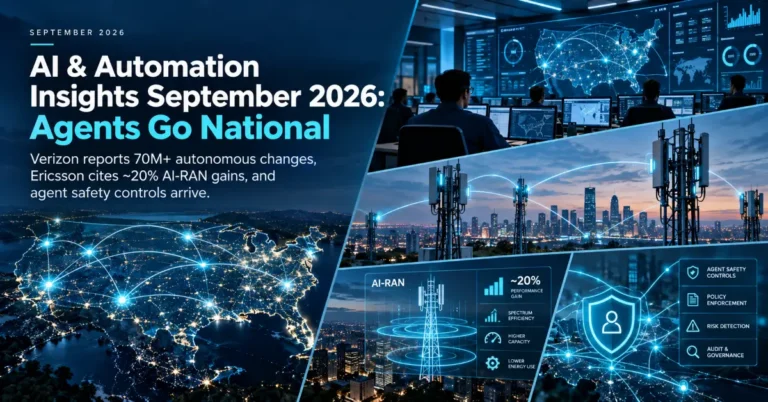
Catching up? Last month’s signal is here: Agents Go National: AI & Automation Insights, September 2026 →
→ Start with the TeckNexus Intelligence Platform: independent, buyer-neutral tools for AI use cases, TCO, architecture, and RFP decisions.
This analysis is drawn from TeckNexus’s full curated AI & Automation Monthly Insights for October 2026. See every deployment, product, and partnership update →
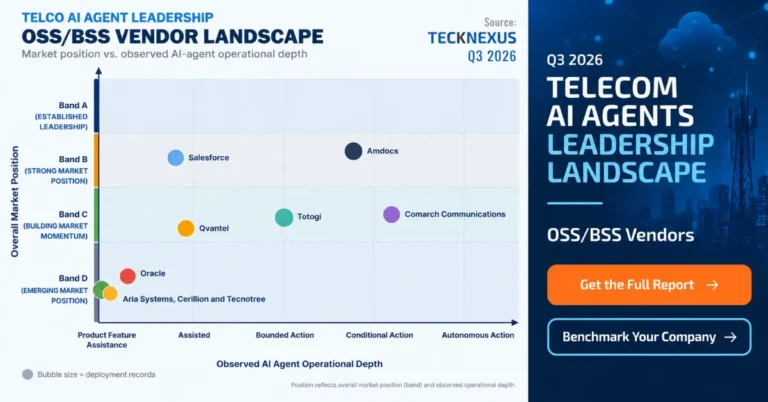
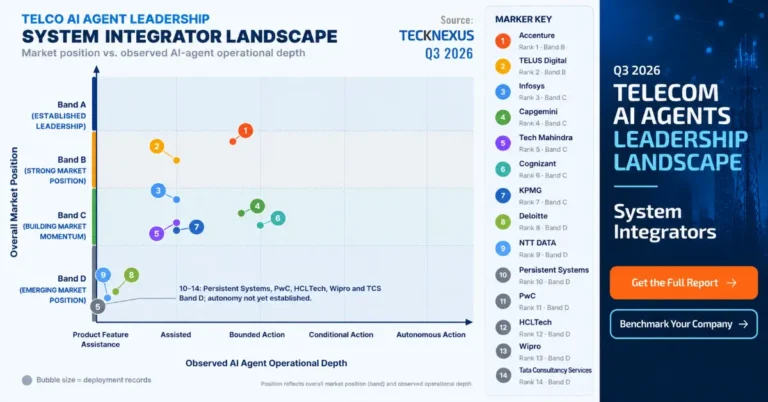
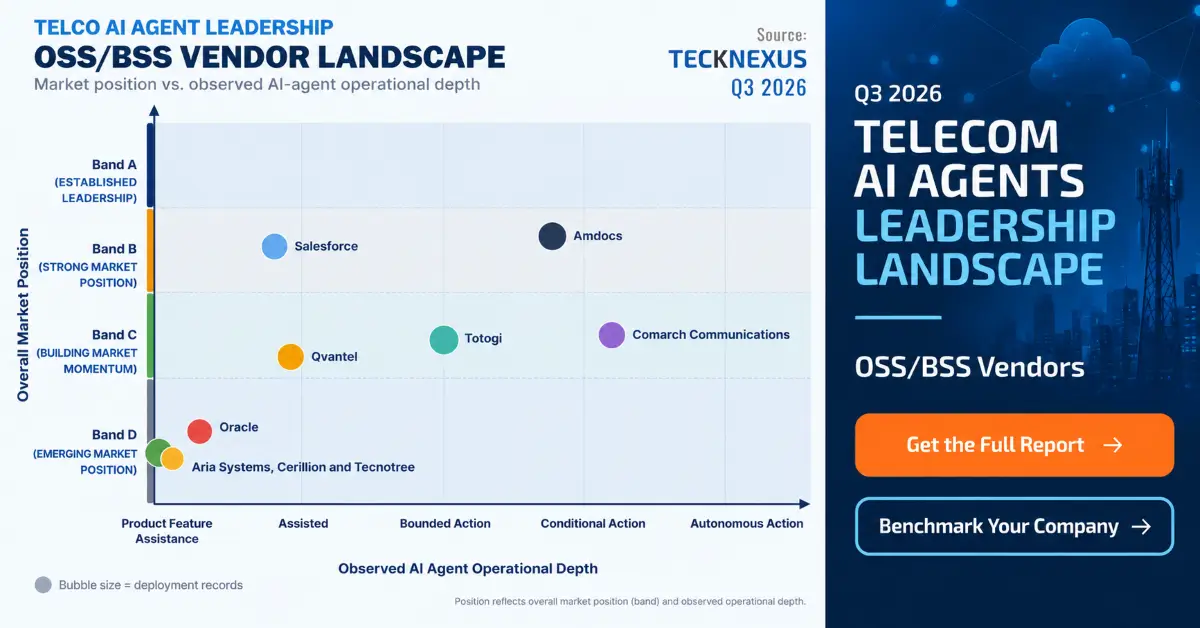
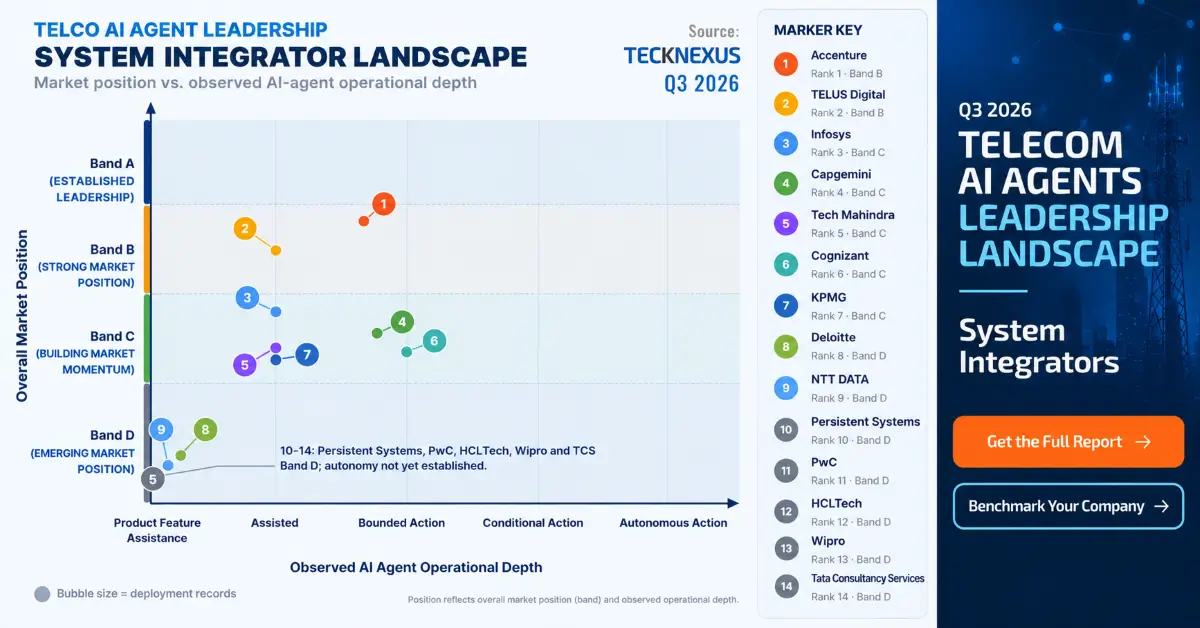
| Related Intelligence: Telecom AI Agents Leadership Landscapes
Independent landscapes that position network equipment vendors, OSS/BSS vendors and system integrators on deployment evidence, operator validation and operational depth. A Network Operators edition covering 50+ operators is coming soon. Explore the landscapes → |