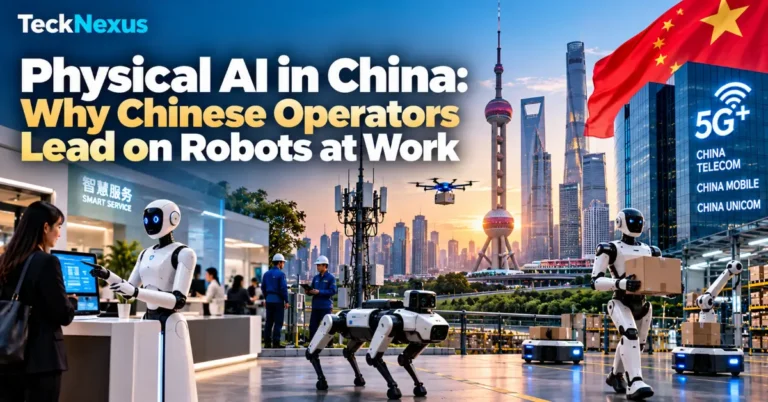
Across the telecom industry, most physical AI activity still lives in laboratories, trade show demonstrations and announcements of future plans. In China, the picture looks different. The country’s operators have humanoid robots greeting customers in service centres, a home robot on the market, a robot management platform reported to serve dozens of enterprise customers, and a dedicated network built to run an international humanoid robot competition.

Physical AI is still an early market everywhere, including in China. But on one measure, putting robots to work in real settings, China’s operators are furthest ahead. Hong Kong’s HKT shows a similar pattern on a smaller scale.

This article looks at what Chinese operators are doing in physical AI, the forces behind their lead and what operators elsewhere can take from it.
What physical AI looks like at Chinese telecom operators
The striking feature of physical AI in China’s telecom sector is its range. Activity spans almost every business model available to an operator, from connectivity to consumer products.
| Type of activity | What it involves | Examples |
| Robots in the operator’s own business | Using robots in customer service, offices and facilities | Humanoid and quadruped robots handling reception, guidance and item delivery at a China Mobile service centre in Hangzhou; a coffee-making robot in routine use at a China Mobile research park |
| Consumer robot products | Operator-branded robots for homes | China Mobile’s Lingxi quadruped, which patrols the home, detects hazards and checks on elderly residents |
| Robot platforms as a service | Software that connects, controls and schedules robots from many makers | China Unicom’s Gewu platform, supporting more than 30 robot types |
| Networks built for robots | Dedicated or specialised networks for robot workloads | China Unicom’s dedicated 5G-Advanced network for the World Humanoid Robot Games; China Telecom‘s EasyOn robot network developed with ZTE, DroidUp and AgiBot |
| Open robot software | Releasing robot software for others to build on | China Mobile’s open-source Open-RAIL, which lets robot AI run on the robot, at the edge or in the cloud |
| Investment and incubation | Funding and spinning out robot AI companies | China Telecom‘s AI institute incubating a humanoid robot model company; China Telecom leading a funding round in a robot training data start-up |
Few operators anywhere cover more than two or three of these at once. Several Chinese operators cover most of them.

See how China’s robot service builders compare with the six global leaders. Get the full Physical AI Leadership Landscape →
Physical AI in China: the robot event as a testbed
One of the clearest examples of how Chinese operators use physical AI is the World Humanoid Robot Games in Beijing. For the second edition in August 2026, China Unicom acted as the exclusive communications partner. It built a dedicated 5G-Advanced network for the robots, gave each robot its own network identity so staff could follow its location, competition status and operating data in real time, and reported keeping end-to-end latency for humanoid robots within 30 milliseconds.
The operator also set up a joint laboratory on embodied intelligence communications with the China Academy of Information and Communications Technology, the venue operator and several robot makers. After the event, it reported having collected 1.56 million robot operating data records through its management platform.
An event like this works as a large, public test of a robot network: many machines from many makers, moving unpredictably, in front of an audience. It produces engineering lessons, operating data and reference material that a laboratory cannot.
What China’s physical AI networks reveal about robot connectivity
The networks Chinese operators have built for robots also show what robot connectivity needs in practice, and how it differs from connectivity for people.
Each robot is managed as an individual. At the Robot Games, every robot had its own network identity, so organisers could see where it was, what it was doing and how it was performing. That is closer to fleet management than to a mobile subscription, and it is the foundation for any service that charges per robot.
Uplink is guaranteed per machine, not shared. The EasyOn robot network developed by China Telecom, ZTE and robot makers is described as providing a guaranteed 200 Mbps uplink for each robot, with up to 2 Gbps uplink in total, latency below 10 milliseconds and 99.99 percent reliability, according to the vendor. Whatever the exact figures in a given deployment, the design principle is clear: robots need dedicated uplink, not a share of whatever is left.
Positioning is part of the network. China Unicom combined its network with BeiDou satellite positioning corrections to locate robots at the Games to within decimetres. For robots that move through crowded or indoor spaces, knowing exactly where each machine is matters as much as keeping it connected.
Simplicity can matter more than scale. A robot network that does not need a traditional mobile core, as in the EasyOn design, can be set up quickly for a store, a factory floor or an event. That points to a category of compact, robot-specific networks that operators can deploy alongside their national infrastructure.
Five forces behind physical AI leadership in China
Chinese operators did not move faster by accident. Five forces, most of them specific to China’s market, explain the pattern.
- A robot industry on the doorstep. China’s robot makers, including AgiBot, Unitree, UBTECH and Leju, are local partners and suppliers. When an operator wants humanoids for a service centre or quadrupeds for a pilot, it can buy them domestically and work directly with the engineering teams. China Mobile’s humanoid robot order with AgiBot and Unitree in 2025, worth around 124 million yuan, was described at the time as the country’s largest humanoid robot order.
- National policy pointing the same way. China has made AI-powered robotics a central part of its industrial strategy. When national priorities favour embodied intelligence, large state-linked operators have strong reasons to show leadership in it.
- Operators that act like technology groups. China’s large operators run substantial digital technology subsidiaries, AI research institutes and investment funds. That gives them software teams able to build robot platforms, researchers able to develop robot AI and capital to back start-ups.
- Willingness to use robots internally first. Putting robots into their own service centres and offices gives Chinese operators operating experience, data and visible reference cases before they sell anything to customers.
- Networks being built for the uplink. Chinese operators are rolling out 5G-Advanced capabilities with much higher uplink capacity, the direction physical AI needs. China Unicom in Beijing, for example, has publicised large uplink capability across dozens of key scenarios, with embodied intelligence named as a target use.
China’s robot market gives operators scale
The wider robot market reinforces these forces. According to the International Federation of Robotics, China installed 354,000 industrial robots in 2025, 59 percent of all installations worldwide, and Chinese suppliers accounted for 55 percent of installations in their home market (IFR, World Robotics 2026).
For operators, that scale matters in two ways. It means more robots in factories, warehouses and logistics sites that will eventually need connectivity, management and support. And it means a domestic robot supply chain large enough to partner with on equal terms.
It is worth keeping perspective. The IFR has noted that real-world production use of humanoid robots in China is still largely limited to demonstrators and pilot projects, and expects commercialisation towards the end of the current five-year plan period (IFR, May 2026). Chinese operators are ahead in putting robots to work, but the market they are building for is still forming.
How Chinese operators approach physical AI products
A notable difference between China and most other markets is the willingness of operators to take product risk.
China Mobile’s Lingxi is the clearest example. A telecom operator launching its own consumer quadruped is unusual anywhere. It reflects a view that the home robot could become an extension of broadband and smart home services, sold through the same channels and supported by the same relationship. China Mobile’s interim results for 2026 reported deploying 45 benchmark applications for connected-home embodied intelligent robot services, which suggests the home is a deliberate focus rather than a one-off product.
The same willingness shows in software. China Mobile has released Open-RAIL as open source, a connection layer between robot AI models and real robots, and runs its own coffee-making robot on it. China Unicom has positioned its Gewu platform as a robot service platform for enterprises, with the company reporting more than 70 customers and 120,000 robots supported. China Telecom, with ZTE and robot makers, developed a compact robot network that does not need a traditional core network, and used it to run robots in an unmanned convenience store demonstration.
Each of these moves takes the operator closer to the robot and further from pure connectivity.
Hong Kong: physical AI deployment at a smaller scale
Hong Kong’s HKT follows a similar playbook, adapted to its market. Working with YuShu Technology, it has deployed a quadruped robot with vision AI to patrol and inspect sites for a leading Hong Kong concrete and aggregates provider, introduced embodied AI robots into a secondary school’s programming and language classes, and is exploring patrol robots for large campuses and venues.
HKT packages these as complete solutions, including installation, training, support and maintenance. It shows that the approach does not depend on the scale of mainland China’s largest operators. A focused operator with the right robot partner can put physical AI to work in specific settings.
What operators elsewhere can learn from physical AI in China
Not everything behind China’s lead can be copied. Industrial policy, the domestic robot supply chain and the structure of China’s operators are specific to that market. But several lessons travel well:
- Put robots to work in your own business. Service centres, network sites and offices offer real settings where an operator controls the risk and keeps the data.
- Use events as public testbeds. Large events concentrate many machines in one place and produce engineering lessons and reference cases quickly.
- Build the platform, not just the pipe. Software that manages robots from many makers gives an operator a role that grows with the robot market.
- Choose a robot partner and go deep. The strongest examples pair an operator with one or two robot makers and a specific use, rather than general partnerships.
- Design the network for the uplink. Robots send more than they receive. Networks planned around downloads will need rethinking for machine workloads.
Physical AI in China: frequently asked questions
Which Chinese telecom operators are active in physical AI?
China Mobile, China Unicom and China Telecom are all active, along with Hong Kong’s HKT. Their activity ranges from robots in their own service centres and consumer robot products to robot management platforms, dedicated robot networks and investments in robot AI companies.
Why is China ahead in physical AI deployment?
A large domestic robot industry, national policy that prioritises AI-powered robotics, operators with strong technology and investment arms, a willingness to use robots internally first, and networks being upgraded for high uplink capacity all contribute.
What is embodied intelligence?
Embodied intelligence is the term widely used in China for AI that operates through a physical body, such as a humanoid robot, quadruped or drone, so that it can sense, decide and act in the real world. It is broadly equivalent to physical AI.
Are humanoid robots in commercial use in China?
Humanoid robots are being used in service centres, events, offices and pilots, and some are offered as a service. Industry bodies such as the International Federation of Robotics expect broader commercialisation of humanoids later this decade.
China’s operators have shown what it looks like when telecom companies treat physical AI as a business to enter rather than a demand to connect. Their lead will not be permanent if others move, but for now they are setting the reference points for what an operator can do with robots.
See how China’s robot service builders compare with the six global leaders. Get the full Physical AI Leadership Landscape →
Related reads: Physical AI and telecom operators
Physical AI and Telecom Operators: Most Are Selling the Road, Not the Robot
Where operators fit in physical AI today, and why most still sell only the connection.
Can the Network Be the Robot’s Brain? Edge AI, AI-RAN and the Case for Offloading Robot AI
What it takes to run part of a robot’s AI in the network, and what operators are testing.
Physical AI Business Models for Telecom Operators: Who Pays, for What, and How
The offers operators can sell, from machine connectivity to packaged robot services.
NVIDIA and Telecom Physical AI: Why One Platform Sits at the Centre, and How Operators Can Build on It
NVIDIA’s role across AI-RAN, operator AI clouds and robot AI, and how operators can build on it.