Most discussion of physical AI in telecoms starts with technology: latency, uplink, edge computing, AI-RAN. Far less is said about money. Yet the commercial question is the one that will decide whether physical AI becomes a meaningful business for operators or remains a source of interesting demonstrations.

The early evidence shows operators experimenting with a surprisingly wide range of physical AI business models. Some are extensions of products operators already sell. Others look more like software, services or even consumer electronics. Each has a different buyer, a different way of pricing and a different set of capabilities the operator has to bring.
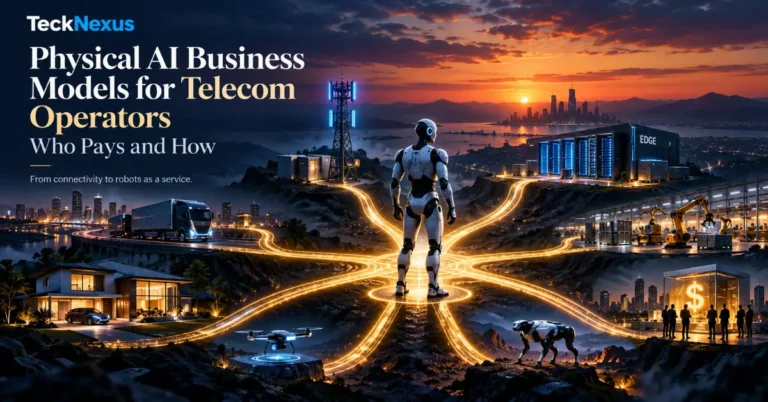
This article maps the physical AI business models now visible in the telecom market, explains how each one makes money, and looks at what separates the models likely to scale from those that will stay niche.
Why physical AI business models matter more than the technology
Telecom operators have been here before. Mobile data, the internet of things and early edge computing all generated enormous technical activity, and in each case a large share of the eventual value went to companies that built services on top of operator networks. Physical AI has the same risk built in.
Robots create value through work. A patrol robot replaces or supports a security round. A warehouse humanoid moves totes. A drone completes an inspection without anyone climbing a mast. The customer measures the robot by what it achieves, not by the network it uses. Any physical AI business model therefore has to answer a simple question: what part of that achieved work is the operator being paid for?
The answer differs sharply across the models below, and so does the share of value each one can capture.
Eight physical AI business models visible in the telecom market
The models fall along a line running from pure connectivity to full ownership of the outcome.
| Business model | Who pays | Typical pricing basis | Revenue type |
| 1. Connectivity for machines | Robot maker or enterprise | Per device, per SIM or per site | Recurring, low margin per unit |
| 2. Performance-guaranteed connectivity | Enterprise or event organiser | Per slice, per site or per service level | Recurring or event-based, higher margin |
| 3. AI compute as a service | Robot makers, AI developers, industrial firms | Per GPU hour, capacity reservation or subscription | Recurring, capital intensive |
| 4. Robot management platform | Enterprise running mixed robot fleets | Per robot per month or per site | Recurring software revenue |
| 5. Managed vertical solution | Enterprise in one industry | Per project plus managed service fee | Project and recurring |
| 6. Robot as a service or outcome service | Enterprise | Per task, per inspection or per hour of operation | Recurring, outcome linked |
| 7. Consumer robot products | Households | Device sale plus subscription | Hardware and recurring |
| 8. Data, training and investment | Robot and AI developers; operator balance sheet | Per project, per dataset or equity return | Project fees and capital gains |
These models are not exclusive. The operators furthest along tend to combine two or three, using connectivity as the entry point and adding platforms or services on top.
Business models: Six offers, from machine connectivity to packaged robot services. See which earn money today in our free physical AI brief →
Connectivity-led physical AI business models
Connectivity for machines is the most familiar model. The operator connects robots, drones or vehicles and charges per device, SIM or site. eSIM connectivity for humanoid robots and private 5G for factories and ports are typical examples. The model is easy to sell because buyers already understand it. Its weakness is that price per connection rarely reflects the value of what the connected machine does.
Performance-guaranteed connectivity is the step up. Here the operator commits to specific latency, uplink capacity, reliability or positioning accuracy for a machine workload, often through a network slice or a dedicated network. Port operators using slicing for automated vehicles and cranes, and event organisers using a dedicated 5G-Advanced network for a humanoid robot competition, are early examples. Pricing can follow the service level rather than the data volume, which is where connectivity starts to earn a premium.
The challenge for both models is proving the guarantee. Service levels for machines need monitoring, reporting and clear remedies when they are missed. Operators that build that machinery once can reuse it across many robot customers.
Compute-led physical AI business models
AI compute as a service sells processing capacity for training, simulating and running robot AI. The clearest example in the telecom market is a sovereign industrial AI cloud, built with a major GPU supplier and offered to industrial companies, small and medium-sized firms, start-ups and research institutions. Robotics developers use such capacity to train foundation models and run simulations before robots ever reach a factory floor.
This model has real demand behind it and a clear pricing logic, but it is capital intensive and places operators in competition with hyperscale cloud providers. Its strongest selling points for operators are data sovereignty, local presence and, increasingly, the ability to connect cloud training with edge inference on the same network.
A second compute model is still forming: hosting robot AI at the network edge or inside AI-RAN infrastructure, so robots can offload part of their processing. That model is mostly at laboratory and trial stage today, and its pricing has not yet settled.
Platform and service physical AI business models
Robot management platforms connect, control and schedule robots from different makers through one system, and are usually sold as a service. For enterprises running mixed fleets, the platform solves a real problem: every robot maker has its own software, and coordinating them is hard. For the operator, a platform position sits between the robot maker and the customer, where task data, scheduling and recurring software revenue accumulate. One Chinese operator reports more than 70 customers for its platform, which supports more than 30 robot types.
Managed vertical solutions package the network, the robot, the AI and the support into an offer for one industry. A construction safety patrol robot sold with installation, training, support and maintenance is a good example. So is drones as a service for mast and critical-site inspection, where the operator supplies aircraft, docking, sensors, communications, piloting and data delivery. In both cases the customer buys a working capability rather than components.
Robot as a service and outcome services go one step further and price by the work done: per inspection completed, per hour of patrol, per task. This is the model that captures the most value, because the price is tied directly to the outcome the customer cares about. It is also the model that transfers the most risk to the operator, which has to answer for the robot’s performance as well as the network’s.
Consumer, data and investment business models in physical AI
Consumer robot products are the least expected model for a telecom operator, but they exist. A home quadruped that patrols while residents are away, detects hazards such as gas leaks and checks on elderly family members fits naturally alongside home broadband and smart home services. The operator brings brand, retail channels and a billing relationship with millions of households. The hardware risk, however, is considerable.
Data and training services support the robot industry rather than running robots. Collecting teleoperation data, annotating sensor streams and supplying training datasets to robot makers is a growing service line for operator-owned digital services businesses. It monetises skills operators already have in large-scale data operations.
Investment and incubation give operators a stake in the robot layer without operating robots. Operator venture arms have invested in autonomous trucking and humanoid AI companies, and at least one operator has spun out a company to build a common control platform for robots from different makers, targeting commercial service in 2027. These moves rarely produce near-term revenue, but they buy insight, options and partnerships.
How to judge which physical AI business models will scale
Not every model will suit every operator. Five questions help separate the models with strong potential from those likely to stay small:
- Is the price linked to value? Models priced on outcomes or guaranteed performance can grow with the robot market. Models priced per connection grow only with robot numbers.
- Does it reuse what the operator already has? Spectrum, sites, edge facilities, enterprise sales and billing systems lower the cost of entry. Models that need entirely new assets, such as consumer hardware, carry more risk.
- Who carries the liability? When a robot fails to complete a task or causes damage, someone pays. Outcome-based models put that responsibility closer to the operator, which affects insurance, contracts and partner selection.
- Can it be repeated across customers? A one-off integration for a single site is a project. A packaged solution that can be sold to every port, construction firm or utility is a business.
- Does it compete with partners? Operators need robot makers, AI developers and integrators. Models that sit on top of partners, such as platforms, can create channel tension that has to be managed.
Common pricing approaches in physical AI services
Few operators publish physical AI pricing today, so the market is still finding its reference points. The approaches visible in adjacent markets, and likely to carry over, include:
- Per robot per month, the natural unit for platforms and connectivity bundles, familiar from fleet management and IoT.
- Per site, common for private networks and managed solutions where the site is the unit of deployment.
- Per task or per inspection, suited to drones and patrol robots where the work is countable.
- Capacity reservation, standard for GPU cloud and likely for edge AI capacity reserved for a robot fleet.
- Hybrid project plus service, an upfront fee for integration followed by a recurring managed service charge, the default for most early vertical deals.
Operators that can move customers from project pricing towards recurring, outcome-linked pricing will build the most durable physical AI revenue.
What the physical AI business model mix means for operators
The most practical path for most operators is likely to be a ladder rather than a leap. Start with connectivity and performance guarantees, where the operator’s position is strongest. Add compute where the operator has data centre assets and a sovereignty story. Then choose one or two industries where it has strong customer relationships and build a managed solution or platform there, with partners supplying the robots and AI.
Operators that try to cover every model at once risk spreading investment too thinly. Operators that stay only on the first rung risk watching value build up on their networks without sharing in it.
Physical AI business models: frequently asked questions
What is a physical AI business model?
A physical AI business model describes how a company earns money from AI-driven machines such as robots, drones and autonomous vehicles. For telecom operators, models range from connecting the machines to selling platforms, managed solutions or outcome-based services.
What is robot as a service?
Robot as a service is a model in which the customer pays for robots on a subscription or usage basis, often including software, maintenance and support, rather than buying the robots outright. Some versions price by the task or outcome delivered.
Which physical AI business model is most profitable for operators?
Models priced on outcomes or guaranteed performance can capture the most value, but they also carry the most risk and require the most capability. Connectivity is the easiest model to sell but captures the least value per robot.
Do telecom operators sell robots?
A small number do, mainly in China, where at least one operator has launched its own consumer robot. Most operators prefer to partner with robot makers and sell connectivity, compute, platforms or managed services around the robots.
Physical AI will produce revenue for telecom operators. The open question is how much, and that depends less on network technology than on which of these business models each operator chooses to build. The operators that decide early, and pick models that match their strengths, will set the reference points everyone else follows.
Six offers, from machine connectivity to packaged robot services. See which earn money today in our free physical AI brief →
Related reads: Physical AI and telecom operators
Physical AI and Telecom Operators: Most Are Selling the Road, Not the Robot
Where operators fit in physical AI today, and why most still sell only the connection.
Can the Network Be the Robot’s Brain? Edge AI, AI-RAN and the Case for Offloading Robot AI
What it takes to run part of a robot’s AI in the network, and what operators are testing.
Physical AI in China: Why Chinese Telecom Operators Are Furthest Ahead in Putting Robots to Work
How China’s operators put robots to work, and what other operators can learn from them.
NVIDIA and Telecom Physical AI: Why One Platform Sits at the Centre, and How Operators Can Build on It
NVIDIA’s role across AI-RAN, operator AI clouds and robot AI, and how operators can build on it.