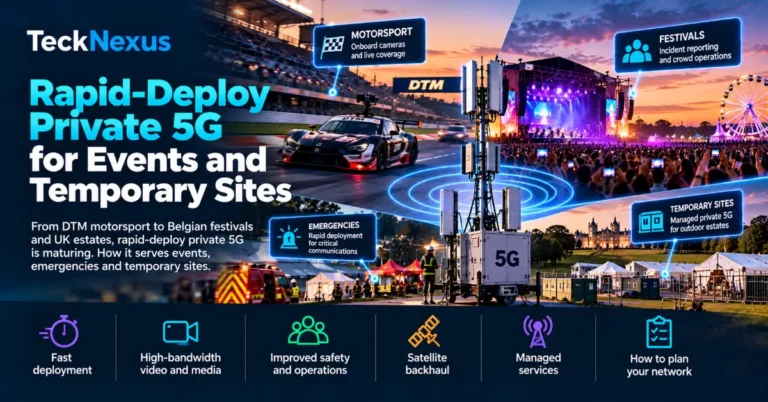
The classic image of a private 5G network is permanent: radios bolted to a factory ceiling or towers across a port, designed to run for a decade or more. October 2026 highlighted a very different kind of deployment. Riedel Communications, DTM and TV Skyline made private 5G the primary onboard camera transmission system for the DTM motorsport championship. Citymesh, Anykrowd and Nevron launched a private 5G incident reporting network for festivals and large events in Belgium. Teltronic installed a fast-deployment private 5G network for broadband data and video at an event. And Wifinity launched a fully managed private 5G service for large outdoor estates in the UK.

These networks are designed to go up quickly, serve a specific period or place, and move on or scale as needed. Rapid-deploy private 5G has been building for several months, with events and venues becoming a recurring use case in our August Private Network Insights and deployable defence and public safety networks featuring in September. October suggests it is maturing into a distinct segment of the market.

Why Rapid-Deploy Private 5G Is Gaining Ground
Temporary and mobile sites share a common problem: public networks are either absent, overloaded or unsuitable for critical use exactly when they are needed most. A festival or sporting event can bring tens of thousands of people into a small area, saturating public capacity. Remote worksites and large outdoor estates may have poor coverage. Emergency scenes need communications that work regardless of the state of local infrastructure.
Rapid-deploy private 5G addresses these gaps with dedicated capacity that the organiser controls. Uplink performance is a particular strength, which matters because many event and emergency applications, from broadcast cameras to body-worn video and drones, send far more data up than they receive.
Rapid-Deploy Private 5G Use Cases in October
The deployments span broadcasting, public safety, hospitality and enterprise connectivity, each with different priorities.

| Deployment | Setting | Main purpose | Notable detail |
| Riedel, DTM and TV Skyline | Touring motorsport championship | Live onboard camera transmission | 21 cars; 100 MHz; uplink up to 140 Mbps; four to seven antenna sites per circuit |
| Citymesh, Anykrowd and Nevron | Festivals and large events in Belgium | Visitor incident reporting to a command centre | Works when public networks are congested |
| Teltronic | Event operations | Broadband data and video | Fast-deployment private 5G |
| Wifinity | Large outdoor estates in the UK | Managed coverage where Wi-Fi is impractical | Provider obtains spectrum licences and scales with small cells |
| Raycom | Stadiums and venues | Security, analytics and fan services | Combines private 5G with AI video analytics and IoT |
| EAF for the Brazilian Navy | National secure government network | Mission-critical communications | LEO satellite backup with priority and pre-emption |
Motorsport Shows Rapid-Deploy Private 5G at Production Scale
The DTM deployment is the most significant signal of maturity. The championship is the first to adopt private 5G permanently as its primary onboard camera transmission system, carrying high-resolution video from all 21 race cars. Riedel’s Easy5G platform operates across 100 MHz of spectrum and delivers uplink speeds of up to 140 Mbps, while needing only four to seven antenna sites per circuit. It integrates with Riedel’s DIVA+ broadcast infrastructure, supporting new camera perspectives and fan experiences.
The significance lies in the operating model. A touring championship visits a different circuit for each event, so the network must be set up, tuned and taken down repeatedly within tight schedules. Moving from trials to permanent adoption shows that portable private 5G can meet the reliability standards of live broadcast, where a dropped feed is immediately visible to viewers.
Rapid-Deploy Private 5G for Public Safety and Crowds
Public safety is the second major driver. Citymesh, Anykrowd and Nevron’s Belgian service lets festival visitors report incidents through a mobile app to a central command centre, with the private 5G network maintaining service when public networks are congested or unavailable. Teltronic’s fast-deployment network provides broadband data and video for event operations, and Raycom is developing private 5G for stadiums and venues that combines dedicated wireless with AI video analytics, real-time communications and IoT monitoring for venue security.
Government users are adopting similar approaches at a larger scale. Brazil’s EAF demonstrated a secure national private network for the Brazilian Navy with terrestrial and low Earth orbit satellite connectivity, priority and pre-emption, and a one-year pilot. In September, Spain’s military emergency unit and Portugal’s army also invested in deployable private networks. Satellite backhaul is becoming a standard component, allowing rapid-deploy networks to operate where no fibre or microwave links are available.
Managed and Portable Rapid-Deploy Private 5G Services
Service providers are packaging rapid deployment into managed offers that remove complexity for customers. Wifinity’s UK service covers survey, design, deployment, monitoring and optimisation for large outdoor sites where extending Wi-Fi is costly, with Wifinity obtaining spectrum licences and adding small cells as sites grow. Target customers include holiday parks and defence estates. This mirrors a wider shift towards managed private networks, in which providers take responsibility for spectrum, operations and lifecycle management.
At the lighter end, portable public 5G is filling some of the same needs. Inseego and Verizon Business launched the MiFi PRO M4335 router for Verizon‘s Business Internet On-the-Go service, supporting up to 50 devices over Wi-Fi 7 with more than eight hours of battery life for temporary worksites, mobile teams, retail pop-ups, events and backup connectivity. For many temporary sites, the choice will be between a portable connection to a public network and a dedicated private network, depending on how critical and how large the operation is.
The Economics of Rapid-Deploy Private 5G
The business model for temporary networks differs sharply from permanent installations. Instead of a single site absorbing the full cost of equipment over many years, a portable kit can be reused across dozens of events or locations in a season, spreading its cost widely. That makes per-event, rental and as-a-service pricing natural fits, and favours providers that can keep their kits in constant use. For buyers, the comparison is less about capital outlay and more about the cost of failure: a lost broadcast feed, an unreported incident or a stalled worksite. Where those risks are high, a dedicated temporary network can pay for itself quickly, even when used for only a few days at a time.
Planning a Rapid-Deploy Private 5G Network
Temporary networks have their own planning considerations, distinct from permanent installations:
- Spectrum access for short periods: confirm how temporary or local licences work in each country and how quickly they can be granted.
- Uplink-first design: size the network for video, drones and sensors sending data upstream.
- Repeatable set-up: standardise kits, configurations and procedures so networks can be deployed and removed quickly.
- Backhaul options: plan for fibre where available and satellite or microwave where it is not.
- Device readiness: provision SIMs or eSIMs and test devices before arriving on site.
- Coexistence with venue Wi-Fi and public networks: coordinate frequencies and decide which traffic uses which network.
Venues that host events regularly may find that a permanent private network, designed to work alongside Wi-Fi, offers better long-term value, as explored in our analysis of private 5G and Wi-Fi convergence at airports and venues.
What to Watch in Rapid-Deploy Private 5G
Key signals over the coming months include other sports and broadcasters following DTM into permanent private 5G adoption, wider use of private networks for crowd safety at festivals and large events, growth in satellite-backed deployable networks for defence and emergency services, and more managed services for outdoor estates and temporary sites. As kits become smaller and set-up times shorter, rapid-deploy private 5G is likely to become a standard tool for any organisation that needs dependable connectivity in a place or at a time when public networks cannot provide it.
For more private network analysis, tools and assessments, explore TeckNexus Intelligence.