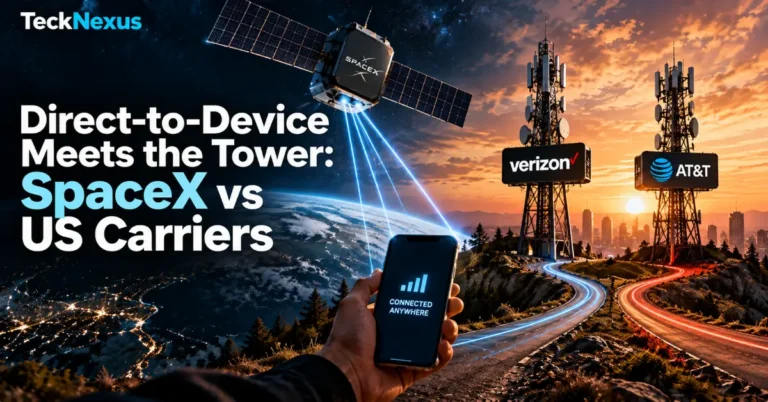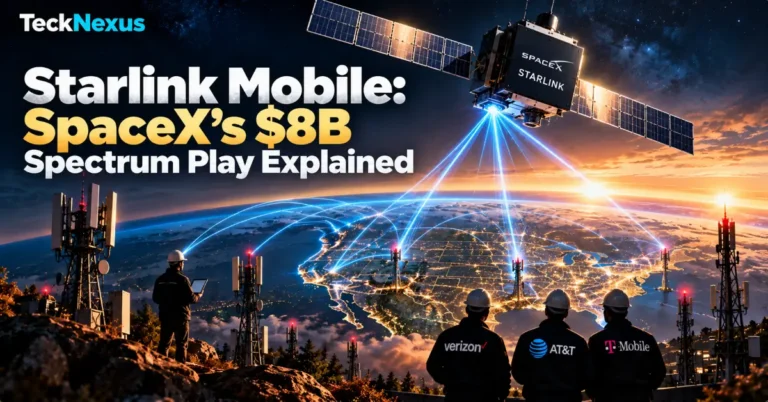
For most of its short history, direct-to-device satellite service has been sold as a coverage extension: a way for ordinary phones to send a message or make a call where no cell tower reaches. October 2026 suggested that Starlink Mobile has larger ambitions. In a matter of weeks, SpaceX agreed to acquire nationwide 800 MHz spectrum from Grain Management in a deal reportedly valued at about $8 billion, won FCC authorisation for a 15,000-satellite direct-to-device constellation, and secured approval to take over additional uplink spectrum. Its regulatory filings now describe radios feeding antennas on towers, rooftops and other structures.

Taken together, these moves describe a company assembling the components of a hybrid network that can serve users from orbit and from the ground. That is a different proposition from a satellite partner plugging gaps for terrestrial carriers, and it is unfolding just as the three largest US operators formalise their own satellite strategy. It is also the mirror image of what is happening in Europe, where operators are bidding to become satellite spectrum holders themselves.

Starlink Mobile’s Spectrum Stack Takes Shape
Spectrum is the clearest indicator of intent, and Starlink Mobile’s portfolio now spans three distinct roles. The 2 GHz holdings acquired from EchoStar remain the core band for satellite service. The 800 MHz licences add low-band frequencies that travel further and penetrate buildings better on the ground. AWS-3 uplink licences, assembled from EchoStar, an FCC auction and the newly approved transfer of Tristar’s licences, strengthen the return path from device to network across most of the country.
| Band | Source | Primary role |
| 2 GHz (AWS-4) | Acquired from EchoStar | Core band for satellite direct-to-device service |
| 800 MHz (about 14 MHz) | Grain Management, reportedly about $8B | Low-band reach and indoor coverage; added to satellite authorisations |
| AWS-3 uplink (1695-1710 MHz) | EchoStar, FCC auction and Tristar transfer | Supplemental uplink across near-nationwide footprint |
Industry estimates put Starlink Mobile’s total holdings at around 80 MHz after the Grain transaction, part of it uplink-only. That is meaningful for a new entrant, though still a fraction of the several hundred megahertz each national carrier operates. The mix matters more than the total: low-band for reach, a dedicated satellite band, and extra uplink are the building blocks of a network designed to work across both layers.
From Constellation to Hybrid Starlink Mobile Network
The FCC’s October authorisation covers up to 15,000 next-generation direct-to-device satellites in very low orbits, with half to be in place by October 2032 and the rest by October 2035. SpaceX is targeting speeds of up to 150 Mbps with the new satellites, compared with around 4 Mbps on the more than 650 first-generation direct-to-device satellites in service today, and plans to use Starship to launch them in volume.

The terrestrial side is newer and less defined. Earlier this year SpaceX floated a small-cell concept built around customers’ satellite dishes. Its latest FCC filing on the 800 MHz band instead describes sectorised antennas on towers, rooftops and other structures, language more typical of a conventional macro network. The deployment model, partners and timing have not been set out, but the direction is clear: the 800 MHz band is being positioned to serve users from the ground as well as from space.
How the US Carriers Are Responding to Starlink Mobile
On 1 October, AT&T, T-Mobile US and Verizon finalised a joint venture to pool spectrum for satellite coverage, an idea first explored in May. The venture is run by a board drawn from all three, with former AT&T executive Paul Roth as interim chief executive. Its stated aims are to nearly eliminate US dead zones, support first responders when terrestrial networks fail, deliver a more consistent direct-to-device experience through a standards-based approach, and work with rural operators.
Each carrier keeps its own satellite relationships alongside the venture. T-Mobile offers a commercial direct-to-device service with SpaceX, Verizon works with Skylo and AST SpaceMobile, and AT&T works with AST SpaceMobile while its business unit partners with Amazon Leo. Regulators are adding capacity on a separate track: the FCC has adopted rules opening more than 1,000 MHz in the 12 GHz and 42 GHz bands for satellite broadband, in-flight and maritime connectivity.
The result is an unusual market structure. The largest satellite operator is simultaneously a partner to one carrier, a spectrum holder in its own right and a potential terrestrial competitor, while the carriers are cooperating on satellite coverage even as they compete everywhere else.
The Engineering Logic of a Hybrid Starlink Mobile Model
Physics explains why a hybrid design makes sense. A signal from a satellite several hundred kilometres away loses far more energy than one from a cell site a kilometre away, a gap that industry engineers put at roughly 50 dB. Moving from 2 GHz to 800 MHz improves satellite reception only modestly, and buildings, forests and weather still block signals from space. Low-band spectrum delivers its biggest gains on the ground, where it extends coverage and improves indoor service.
That points to a layered architecture rather than a race between orbit and towers:
- Satellite layer: nationwide reach, coverage in remote and unserved areas, and resilience when ground networks fail.
- Low-band terrestrial layer: deeper indoor coverage and higher capacity where antennas can be placed on towers and rooftops.
- Uplink spectrum: a stronger return path from handsets, which is often the limiting factor for both satellite and cell-edge connections.
Scale is the counterweight. US carriers have invested more than $250 billion in network infrastructure since 2018 and over $200 billion in spectrum auctions in the past decade. Any terrestrial build by a new entrant is likely to be targeted at specific needs rather than a like-for-like national network, at least initially.
Two Models: Europe Versus Starlink Mobile in the US
The contrast with Europe is instructive. In October, Deutsche Telekom, Orange, Telefónica and Vodafone signed a letter of intent to explore a joint bid for Europe’s 2 GHz mobile satellite spectrum, offering wholesale access to all operators and sourcing the constellation from a partner. In Europe, terrestrial operators are moving up into satellite spectrum. In the US, a satellite operator is moving down into terrestrial spectrum. Both trends lead to the same place, integrated satellite and ground networks, but with different companies holding the strategic assets. Satellite direct-to-device has also had a mixed commercial start, with usage running below early expectations in some markets, which makes spectrum depth and service quality more important than headline coverage claims.
What Starlink Mobile’s Expansion Means for Enterprise Connectivity
For enterprises with remote or distributed operations, more competition between satellite and terrestrial providers is broadly positive. Mines, utility corridors, pipelines, farms, rail lines and maritime operations have long depended on patchy coverage or expensive dedicated links. A direct-to-device layer with far higher speeds, alongside carrier joint ventures promising to close dead zones, gives connectivity planners more options for coverage, backup and worker safety.
The practical step is to treat satellite as one layer in a multi-path design rather than a single answer. Device support for new bands, service level commitments, and how satellite service integrates with private LTE or 5G networks on site will matter more over the next few years than any single announcement.
What to Watch Next for Starlink Mobile
- FCC review and approval of the 800 MHz transfer from Grain Management.
- Launch cadence for next-generation direct-to-device satellites as Starship moves into volume service.
- Handset and chipset support for the 800 MHz and AWS-3 bands in satellite mode.
- The carrier joint venture’s first commercial service, standards choices and satellite partners.
- Any terrestrial deployment model or partnership that puts Starlink Mobile antennas on towers and rooftops.
For more insights on advanced connectivity, explore the TeckNexus Monthly Insights, and to share your perspective with our audience and generate qualified leads, partner with TeckNexus through an Intelligence Program.