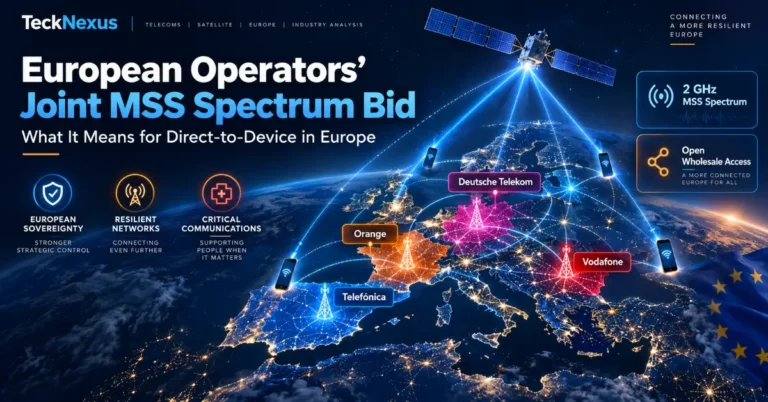
On its own, a non-binding letter is an early step. In context, it is one of the most consequential strategic moves European mobile operators have made in satellite connectivity. It shifts the question from which satellite company each operator should partner with to who should hold the spectrum that makes satellite-to-phone service possible at all. The four are signalling that, in Europe, the answer should include the operators themselves.

The MSS Spectrum Initiative at a Glance
| Item | Detail |
| Participants | Deutsche Telekom, Orange, Telefónica and Vodafone |
| Status | Letter of Intent signed 19 October 2026 to explore a joint bid; no final decision taken |
| Target | Future allocation of MSS spectrum in Europe, in the 2 GHz band |
| Operators’ role | Build key ground network infrastructure and coordination and monitoring functions in Europe |
| Satellite role | Constellation provided by a satellite partner, not yet selected; no direct investment by the operators in satellites |
| Access model | Open and non-discriminatory access for all mobile network operators to offer D2D services |
| Stated objectives | Universal coverage in underserved areas, stronger public network resilience, protection of critical communications, and support for a European constellation |
| Existing partnerships | Unaffected; current satellite agreements remain in place |
Why the 2 GHz MSS Spectrum Matters Now
The timing is set by regulation. Europe’s current 2 GHz MSS licences, awarded in 2009 following a selection procedure that began in 2008, expire in May 2027. They are held today by Viasat and EchoStar, each with a 2×15 MHz block. In May 2026 the European Commission proposed a new authorisation regime for the band, with rules taking effect from 2027.
The proposal reshapes the band around European policy priorities:
| Block | Proposed use | Who can apply |
| One third | Governmental services, interoperable with IRIS², the EU’s secure satellite connectivity programme | Operator able to connect with IRIS² |
| One third | Commercial services such as D2D, IoT and in-flight connectivity | Reserved for European entrants |
| One third | Commercial services | Open to EU and non-EU operators |
Applicants will need to show they can actually deploy the service. That requirement favours parties that already control both market access and network infrastructure. A consortium of four operators with tens of millions of subscribers, national networks and established regulatory relationships across the EU is well placed to meet it.
From Tenant to MSS Spectrum Holder in Direct-to-Device
Until now, the operator’s role in D2D has largely been that of a distribution partner. Satellite companies hold the spectrum or the constellation, and operators bring subscribers, roaming agreements and devices. That model has delivered fast progress, but it leaves operators negotiating access to a capability that is becoming part of the core mobile proposition.
Holding MSS spectrum changes the balance. An operator group that controls the spectrum and the ground segment can choose its satellite partner, set the wholesale terms and decide how satellite coverage integrates with terrestrial networks. Satellite becomes an extension of the mobile network rather than a separate service the operator resells. As Paolo Pescatore of PP Foresight put it, the opportunity is to make satellite coverage a seamless extension of mobile connectivity.
There is also a clear industrial parallel. In the United States, AT&T, T-Mobile and Verizon have formed a joint venture for D2D. The European initiative follows the same logic of pooling scale, but with a stronger emphasis on open wholesale access for every operator in the market, which aligns closely with the Commission’s competition and sovereignty objectives.
How the MSS Spectrum Bid Fits Existing Satellite Partnerships
The Letter of Intent does not replace any current arrangement, and the four operators already work with a range of satellite providers:
- Vodafone has a joint venture with AST SpaceMobile, Satellite Connect Europe, which has welcomed the new initiative.
- Orange works with AST SpaceMobile.
- Deutsche Telekom sells Starlink business broadband and has reportedly been in discussions on Starlink‘s direct-to-cell services.
- Telefónica’s UK joint venture, Virgin Media O2, offers D2D services using Starlink.
This portfolio approach is sensible. D2D is still an early market, constellations are at different stages of maturity, and operators need services in market today while the long-term spectrum framework is settled. The joint bid is a long-term structural play that sits above these commercial partnerships rather than competing with them. It also means the eventual choice of satellite partner for the consortium is genuinely open.
MSS Spectrum, Sovereignty and Resilience
The operators explicitly frame the initiative around the Commission’s goals for European sovereignty, security and resilience in critical connectivity. That framing reflects a real shift in European policy. Satellite connectivity is now treated as critical infrastructure, and recent events have sharpened concerns about relying on space systems governed outside Europe.
The proposed architecture addresses that concern in a practical way. Ground stations, network integration, coordination and monitoring would sit in Europe under operator control, while the space segment comes from a partner. Governance and market access stay European even where satellite technology is sourced internationally. The governmental block linked to IRIS² completes the picture, giving public authorities a dedicated channel alongside commercial services.
Resilience is equally tangible. A D2D layer integrated with terrestrial networks gives emergency services, utilities, transport operators and citizens a fallback when ground networks are disrupted by storms, floods, power failures or physical damage. For industrial organisations operating remote assets, from mines and wind farms to pipelines and rural rail lines, satellite coverage delivered through their existing mobile operator and SIM is a simpler proposition than managing a separate satellite contract.
What to Watch as the MSS Spectrum Process Unfolds
- Choice of satellite partner. The selection will define the service’s capability, timeline and the practical meaning of sovereignty in the model.
- The final Commission regulation. Block sizes, eligibility rules and deployment obligations will determine how competitive the 2027 selection process becomes.
- Competition review. The four are rivals in most national markets, so the regulatory treatment of a joint bid, and the strength of its open-access commitments, will be closely examined.
- Other operators’ decisions. Operators outside the consortium will need to decide whether to join, rely on its wholesale access, or pursue bilateral satellite deals.
- Devices and pricing. As Pescatore noted, success depends on execution, device compatibility and pricing that gives customers a compelling reason to pay.
- Transatlantic policy. The proposed limits on non-European operators have drawn attention in Washington, and the final regime will need to balance sovereignty goals with international trade relationships.
The Bigger Picture
Direct-to-device is moving from novelty to infrastructure. The question for European mobile operators has never really been whether satellite will reach the phone, but who will shape how it does. By pursuing MSS spectrum together, Deutsche Telekom, Orange, Telefónica and Vodafone are making a clear case that operators should be central to that answer, as builders of the ground network and holders of the spectrum, with satellite providers as partners.
If the model succeeds, Europe could end up with a shared, wholesale D2D layer open to every operator, governed in Europe and integrated with terrestrial networks from day one. That would be a distinctive outcome compared with other regions, and one that could redefine coverage, resilience and critical communications across the continent.
For ongoing analysis of satellite and non-terrestrial networks, 5G and critical connectivity, visit TeckNexus satellite and non-terrestrial networks