AST SpaceMobile

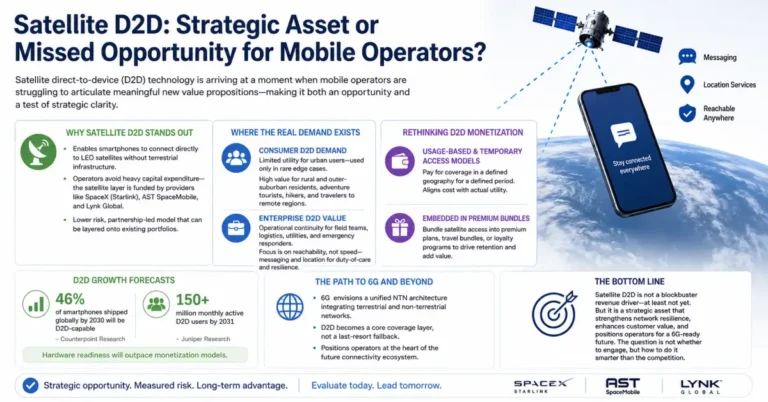
AST SpaceMobile is signaling a pivotal year ahead as it moves from demonstrations to commercial direct-to-device coverage with major operators and an aggressive launch schedule. The company’s plan to begin “intermittent nationwide” service in early 2026, followed by continuous coverage later in the year, is also a forcing function for device vendors, standards work, and MNO network integration. As AST scales to 45–60 BlueBird satellites by end-2026, pass frequency and overlap increase to support “continuous” service across the U.S., Europe, Japan, and other priority markets. AST reports over $3.2 billion in cash and liquidity.
A new joint plan from Vodafone and AST SpaceMobile aims to deliver satellite broadband directly to standard smartphones across Europe under a sovereign operational model. AST SpaceMobile has submitted plans through Germany for a space-based network designed to provide broadband directly to devices across Europe. Operations would run through SatCo, a Luxembourg-based joint venture with Vodafone announced earlier this year. The timing aligns with looming European spectrum decisions and intensifying competition in direct-to-device (D2D). S-band at 2 GHz is up for renewal across the region in 2027, and 700 MHz public protection and disaster relief (PPDR) frequencies are central to resilient communications strategy.
Virgin Media O2 has struck a multi‑year agreement with Starlink Direct to Cell to deliver satellite‑to‑mobile service across rural UK not‑spots, positioning O2 as the first British operator to integrate Starlink’s constellation with licensed mobile spectrum. Branded as O2 Satellite, the service will initially support messaging and basic data on existing smartphones when users move beyond terrestrial signal. O2 is targeting landmass coverage beyond 95% within a year of launch, using Starlink’s 650+ low‑Earth orbit satellites to act as “cell sites in space.” Customer rollout is planned for early 2026, with pricing to follow and an extra monthly fee anticipated.
A planned merger between Lynk Global and Omnispace aims to fuse spectrum assets, satellite technology, and SES’s multi-orbit infrastructure to scale 3GPP-compliant direct-to-device services worldwide. The combined company will pair Omnispace’s globally coordinated S-band holdings, about 60 MHz anchored by ITU filings and aligned to non-terrestrial network standards—with Lynk’s patented multi-spectrum D2D platform. SES, already an investor in both firms, will become a major strategic shareholder and provide access to its GEO and MEO assets and ground network to improve coverage, resiliency, and time-to-market. Lynk has already launched commercial messaging and alerting in small markets with a handful of LEO spacecraft.
New usage data shows AT&T subscribers are tapping into T-Mobile’s Starlink-powered T-Satellite more than expected, signaling a rapid shift in how carriers and customers think about direct-to-device connectivity. Speedtest intelligence indicates T-Mobile users account for the majority of direct-to-device (D2D) connections to Starlink, roughly six in ten overall and more than seven in ten among devices reporting active service at connection time. The surprise is AT&T’s footprint: about a third of observed connections come from AT&T subscribers, while Verizon’s share is minimal.
Verizon and AST SpaceMobile have advanced their partnership into a definitive commercial agreement to deliver space-based cellular coverage in the United States starting in 2026. The agreement enables Verizon subscribers to connect “when needed” to AST SpaceMobile’s low Earth orbit (LEO) satellites using standard, unmodified phones. AST says service will focus on coverage gaps across the continental U.S., and will extend Verizon’s premium 850 MHz low-band spectrum into remote areas. AST highlights successful space tests as proof points and positions the network for both commercial and government use.
EchoStar has reset its strategy after regulator-driven spectrum sales, trading long-cycle infrastructure bets for an asset-light, capital-rich posture focused on satcom growth. Federal Communications Commission scrutiny over spectrum utilization forced EchoStar to accelerate decisions it had hoped to phase over time. Complaints from rivals spurred investigations into whether the company was meeting buildout and use obligations. Even if EchoStar prevailed in court, the process risked tying up key licenses and stalling its direct-to-device (D2D) ambitions. The company opted to monetize holdings and remove uncertainty rather than fight a prolonged, value-destructive battle.
SpaceX’s $17 billion purchase of EchoStar spectrum signals a deliberate push to blend satellite and mobile connectivity at consumer scale. SpaceX is acquiring EchoStar’s AWS-4 and H-Block licenses, adding roughly 1.9–2.0 GHz spectrum into its portfolio for direct-to-device (D2D) service in the U.S. Owning licensed spectrum lets SpaceX widen capabilities beyond roaming-style add-ons, potentially toward a branded service that spans home broadband and handset connectivity. A two-year window for first compatible handsets is a realistic baseline. Analysts broadly expect Starlink to expand via partnerships: wholesale arrangements to MNOs for satellite fallback, and potentially an MVNO to bring a Starlink-branded phone plan to market.
France’s space agency CNES has selected Capgemini, Thales, and Thales Alenia Space to lead a national demonstration of 5G direct-to-device (D2D) satellite connectivity under the France 2030 investment program. The consortium will deliver “U DESERVE 5G,” a government-backed project designed to prove that standard mobile devices and fixed terminals can connect directly to a satellite using 5G non-terrestrial network (NTN) technology. The team will launch a low Earth orbit (LEO) demonstrator satellite equipped with an active antenna payload able to form and steer beams directly to devices. The trial will evaluate interoperability with terrestrial 5G, handover behavior between networks, and user experience under varying coverage conditions
SpaceX agreed to acquire EchoStar’s AWS-4 and H-Block spectrum licenses in a transaction valued at up to $17 billion, split between as much as $8.5 billion in cash and up to $8.5 billion in SpaceX equity. As part of the package, SpaceX will also cover approximately $2 billion in cash interest payments on EchoStar debt through November 2027. The parties have also signed a long-term commercial agreement that would allow EchoStar’s Boost Mobile subscribers to access SpaceX’s next-generation Starlink “Direct to Cell” service once live.
Rakuten Mobile and AST SpaceMobile completed Japan’s first satellite video call using unmodified smartphones in April 2025. This test marks a major advancement toward Rakuten’s Saikyo Satellite Service, set to launch in 2026, which will expand mobile coverage across remote and disaster-prone regions using AST’s LEO satellite network.
In Episode 222 of The G2 on 5G, analysts Will Townsend and Anshel Sag cover T-Mobile’s 6G equipment testing, Google’s mid-range Pixel 9a, Vodafone’s 200M IoT milestone, the GSA’s RedCap group, AT&T’s satellite trials for FirstNet, and MediaTek’s powerful new chipsets for phones and Chromebooks.

TeckNexus Newsletters

I acknowledge and agree to receive TeckNexus communications in line with the T&C and privacy policy

Tech News & Insight
Enterprises adopting private 5G, LTE, or CBRS networks need more than encryption to stay secure. This article explains the 4 pillars of private network security: core controls, device visibility, real-time threat detection, and orchestration. Learn how to protect SIM and device identities, isolate traffic, secure OT and IoT, and choose...

Sponsored by: OneLayer

     
Whitepaper
Private cellular networks are transforming industrial operations, but securing private 5G, LTE, and CBRS infrastructure requires more than legacy IT/OT tools. This whitepaper by TeckNexus and sponsored by OneLayer outlines a 4-pillar framework to protect critical systems, offering clear guidance for evaluating security vendors, deploying zero trust, and integrating IT,...
Whitepaper
Telecom networks are facing unprecedented complexity with 5G, IoT, and cloud services. Traditional service assurance methods are becoming obsolete, making AI-driven, real-time analytics essential for competitive advantage. This independent industry whitepaper explores how DPUs, GPUs, and Generative AI (GenAI) are enabling predictive automation, reducing operational costs, and improving service quality....
Scroll to Top

Feature Your Brand in Private Network Magazines

With Award-Winning Deployments & Industry Leaders
Sponsorship placements open until Nov 21, 2025