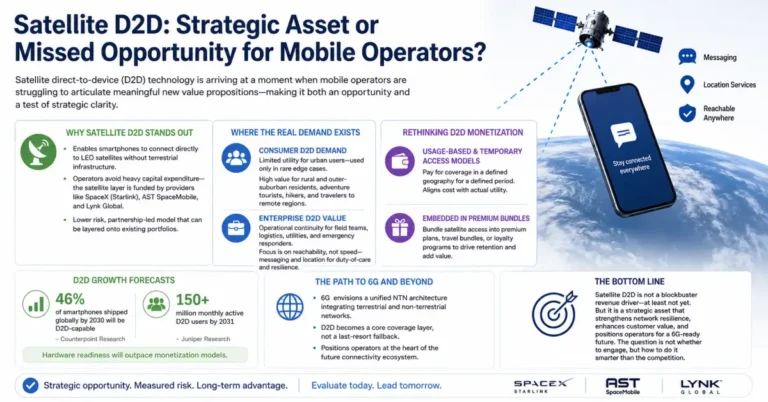
Satellite direct-to-device (D2D) technology is arriving at a moment when mobile operators are struggling to articulate meaningful new value propositions to consumers and enterprise customers alike — making it both an opportunity and a test of strategic clarity.

Why Satellite D2D Stands Out in a Flat Telecom Innovation Cycle
The telecom industry has not delivered a genuinely transformative consumer feature in years. Against that backdrop, satellite D2D — which enables smartphones to connect directly to low Earth orbit (LEO) satellites without terrestrial cell infrastructure — represents a rare injection of novelty. Crucially, operators are not on the hook for the capital expenditure required to build and maintain the satellite layer. That burden falls on satellite providers such as SpaceX‘s Starlink, AST SpaceMobile, and Lynk Global, who are competing aggressively for MNO partnerships.

This dynamic changes the risk calculus for operators. Rather than a heavy infrastructure bet, D2D is closer to a wholesale or partnership play — one that can be layered onto existing service portfolios without fundamentally restructuring balance sheets. For network strategists, that makes it worth serious evaluation, even if the near-term revenue upside appears modest.
Mapping the Real Addressable Market for Satellite D2D
Understanding the real addressable market for D2D requires moving beyond headline adoption figures and examining where genuine, recurring utility exists.
Consumer D2D Demand: Where Genuine Utility Exists Beyond Urban Markets
For the majority of urban subscribers, satellite D2D will function as a dormant capability — an RF chip that activates only in edge-case scenarios. T-Mobile‘s CEO Srini Gopalan acknowledged as much, noting that usage of the operator’s satellite messaging service has come in well below initial expectations. That candor is instructive. Urban consumers, who represent the bulk of most operators’ subscriber bases, simply do not encounter coverage gaps frequently enough to assign high value to satellite fallback.

The picture shifts considerably for rural and outer-suburban residents, where patchy terrestrial coverage is a persistent, daily frustration rather than an occasional inconvenience. For these users, D2D is not a novelty — it is a genuine connectivity solution. Similarly, adventure tourists, hikers, and travelers to remote regions represent a high-intent, if episodic, demand segment.
Enterprise D2D: Operational Continuity as the Core Value Proposition
On the enterprise side, the calculus is more compelling. Field service teams, logistics operators, utilities, emergency responders, and any organization operating in geographically dispersed or infrastructure-poor environments stand to benefit from guaranteed reachability. The value proposition here is not data throughput — current D2D capabilities are largely constrained to messaging and basic location services — but rather operational continuity and duty-of-care compliance. For CTOs and solution architects designing resilient communications stacks, D2D represents a low-cost insurance layer against coverage-driven downtime.
Rethinking D2D Monetization Beyond Legacy Subscription Frameworks
The mismatch between D2D’s use-case profile and conventional mobile tariff structures is one of the central strategic challenges operators must resolve to extract meaningful returns.
Usage-Based and Temporary Access Models: A Better Fit for D2D Consumption
Juniper Research has made a persuasive case that the subscription model — the default commercial framework for mobile services — is poorly suited to D2D for most consumer segments. A user who activates satellite connectivity three or four times a year while on a hiking trip has no rational incentive to pay a monthly premium. A more appropriate commercial construct mirrors the temporary access models already familiar from international roaming packages or travel eSIMs: pay for coverage in a defined geography for a defined period. This approach aligns cost with actual utility and removes the psychological barrier of paying for a service that sits idle most of the time.
Embedding D2D in Premium Bundles to Drive Subscriber Retention
For operators unwilling to build out a standalone D2D pricing tier, bundling offers an alternative path. Integrating satellite access into premium loyalty programs, travel bundles, or high-tier unlimited plans positions D2D as an added-value differentiator rather than a discrete SKU. Juniper’s analysis suggests that connectivity alone is insufficient to drive consumer uptake — operators will need to embed D2D within broader value propositions that resonate with their target segments. This is not a novel strategy; it mirrors how operators have historically commercialized Wi-Fi calling, HD voice, and visual voicemail.
D2D Growth Forecasts and the Long-Term 6G Integration Roadmap
Analyst projections provide useful directional signals, though early adoption data warrants some caution in interpreting them.
Chipset Integration Is Accelerating D2D Hardware Readiness Ahead of Monetization
Counterpoint Research projects that 46% of all smartphones shipped globally by 2030 will be D2D-capable, driven by chipset integration from players like Qualcomm and MediaTek embedding satellite modem support as a standard feature. Juniper Research forecasts monthly active D2D users exceeding 150 million by 2031. These figures suggest that the hardware precondition for mass adoption will be met well ahead of any monetization framework mature enough to capture it — a familiar pattern in telecom, where capability routinely outpaces commercial model innovation.
How 6G’s Unified NTN Architecture Elevates D2D From Niche to Core Infrastructure
The current D2D conversation is largely a 5G-era discussion, constrained by the technical limitations of non-terrestrial network (NTN) integration as defined in 3GPP Release 17 and Release 18. The 6G roadmap, however, envisions a fundamentally different architecture — one in which terrestrial and satellite layers are not loosely coupled fallback systems but deeply integrated components of a unified, AI-orchestrated network fabric. In that environment, D2D transitions from a niche coverage patch to a structural element of intelligent, always-on connectivity. Operators and vendors investing in NTN partnerships and standards engagement today are positioning themselves for that longer-term shift.
Three Priority Actions for Operators to Capture D2D’s Strategic Value
The strategic window for D2D is open, but it will not remain undifferentiated for long as device support becomes ubiquitous.
Operators should prioritize three actions: first, establish or deepen NTN partnerships with satellite providers to secure competitive wholesale terms before the market consolidates; second, develop flexible, usage-based commercial models that reflect actual D2D consumption patterns rather than forcing satellite into legacy subscription frameworks; and third, identify the enterprise verticals — logistics, utilities, field services, public safety — where D2D delivers quantifiable operational value and build targeted go-to-market motions accordingly. Treating D2D as a passive checkbox feature is a missed opportunity. Treating it as a strategic differentiator, even a modest one, is the more defensible posture in an industry where genuine points of difference are increasingly scarce.