AI Agent Competitive
Intelligence
Intelligence Journeys
AI Use Cases for Utilities
Private Broadband for Utilities

MediaTek

July 2026's roundup: Hughes Network Systems nears bankruptcy as SpaceX files to launch 100,000 satellites, Nokia's AI-RAN commercial deployments trail Ericsson's 15+ by a full order of magnitude, the FCC finalizes a $6.3B C-band incentive package and closes AT&T's $23B EchoStar spectrum deal, and fiber capital and industrial 5G both keep expanding globally.
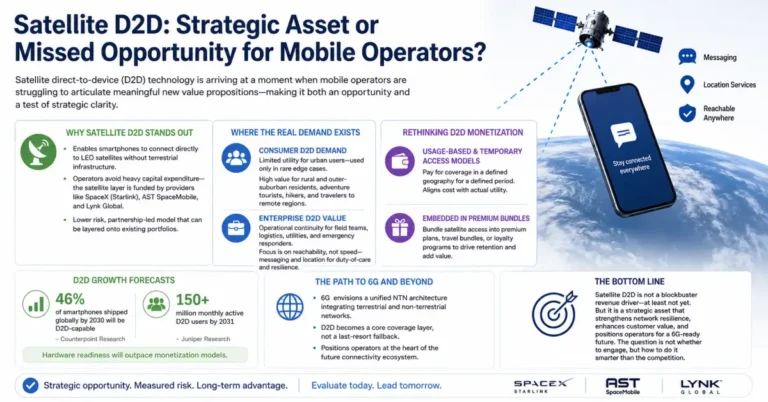
Satellite D2D offers MNOs a rare, low-CapEx differentiator. But unlocking its value demands smarter monetization, targeted verticals, and a long-term NTN strategy.
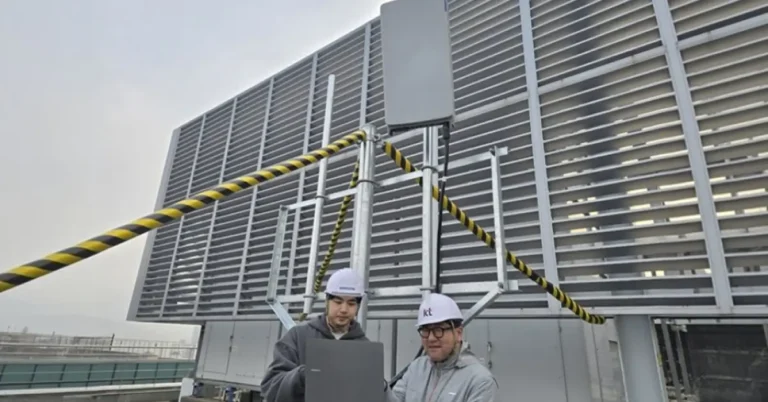
Samsung Electronics, working with KT Corporation and Keysight Technologies, has demonstrated 3 Gbps peak downlink in outdoor tests using an ultra‑dense antenna system and X‑MIMO in the 7 GHz band. The field trial took place at Samsung’s Seoul R&D Campus and pushed eight concurrent spatial streams from a base station to a single user device. The key enabler was a radio unit that packs roughly four times the antenna elements of today’s 5G massive MIMO gear into a similar physical footprint. Shorter wavelengths at 7 GHz make that density feasible without expanding the radio size.
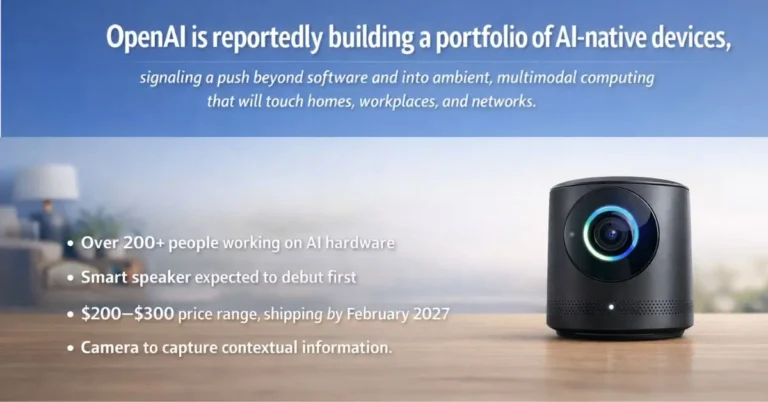
OpenAI is reportedly building a portfolio of AI-native devices, signaling a push beyond software and into ambient, multimodal computing that will touch homes, workplaces, and networks. Multiple reports indicate OpenAI has over 200 people developing a family of AI-enabled hardware, with a smart speaker expected to debut first. Early guidance points to a price in the $200–$300 range and a ship window no earlier than February 2027. The device is said to include a camera to capture contextual information about users and surroundings—an explicit bet on multimodal AI that fuses voice, vision, and environment for richer interactions.
The latest 3GPP cycle consolidates 5G-Advanced (Release 18), sets the agenda for Release 19, and frames early 6G studies, with direct implications for operator investment, enterprise use cases, and vendor roadmaps. Release 18, the first phase of 5G-Advanced, is moving from standards completion into implementation, bringing carrier-grade enhancements in spectral efficiency, energy savings, and mobility performance. Release 19 now builds on these foundations, prioritizing further RAN efficiency, XR and video delivery at scale, richer analytics/exposure in the core (NWDAF, NEF/CAPIF), and enterprise-grade reliability across private and public networks.
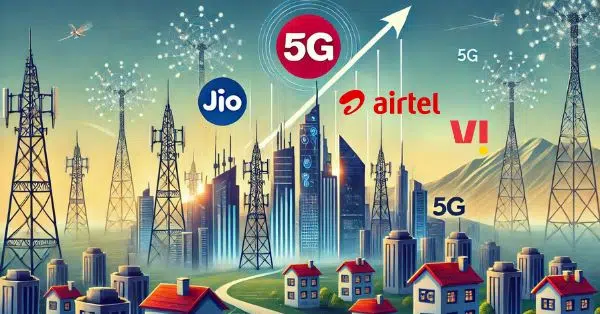
India’s 5G market has entered a scale phase, with momentum pointing to more than a billion subscribers and deeper network modernization over the next six years. Ericsson’s latest Mobility Report projects over 1 billion 5G subscriptions in India by end-2031, representing about 79% of the country’s mobile base. Average mobile data usage per active smartphone in India stands near 36 GB per month and is forecast to approach 65 GB per month by 2031. Two demand-side levers stand out: affordable 5G devices and expanding Fixed Wireless Access (FWA), accelerating mainstream adoption and opening a credible substitute to wired broadband in underserved areas.
Gartner’s latest outlook points to global AI spend hitting roughly $1.5 trillion in 2025 and exceeding $2 trillion in 2026, signaling a multi-year investment cycle that will reshape infrastructure, devices, and networks. This is not a short-lived hype curve; it is a capital plan. Hyperscalers are pouring money into data centers built around AI-optimized servers and accelerators, while device makers push on-device AI into smartphones and PCs at scale. For telecom and enterprise IT leaders, the message is clear: capacity, latency, and data gravity will dictate where value lands. Spending is broad-based. AI services and software are growing fast, but the heavy lift is in hardware and cloud infrastructure.
In Episode 222 of The G2 on 5G, analysts Will Townsend and Anshel Sag cover T-Mobile’s 6G equipment testing, Google’s mid-range Pixel 9a, Vodafone’s 200M IoT milestone, the GSA’s RedCap group, AT&T's satellite trials for FirstNet, and MediaTek’s powerful new chipsets for phones and Chromebooks.
MediaTek is showcasing wireless evolution towards 6G, including hybrid computing, a live LEO broadband NR-NTN trial, and SBFD.

Partner Hubs

Download content, access intelligence tools, and hear from executives.

Partner Events

  • FutureNet Asia 2026
  • Network X Vienna 2026
Scroll to Top