Inside Samsung’s 7 GHz 6G field trial: 3 Gbps with X‑MIMO
Samsung Electronics, working with KT Corporation and Keysight Technologies, has demonstrated 3 Gbps peak downlink in outdoor tests using an ultra‑dense antenna system and X‑MIMO in the 7 GHz band.

How X‑MIMO and ultra‑dense antenna arrays delivered 3 Gbps at 7 GHz
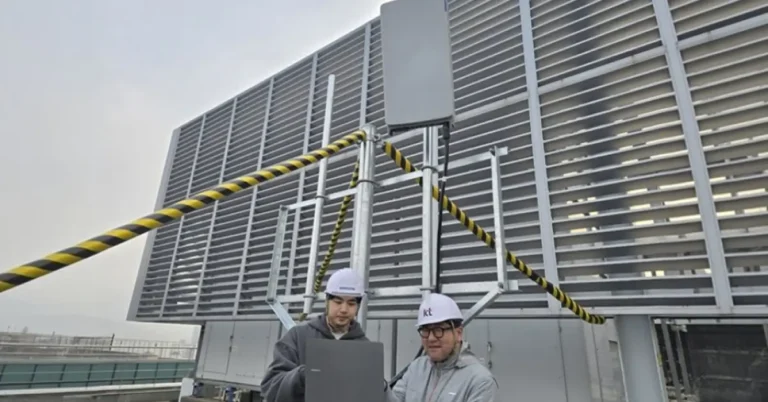
The field trial took place at Samsung’s Seoul R&D Campus and pushed eight concurrent spatial streams from a base station to a single user device. The key enabler was a radio unit that packs roughly four times the antenna elements of today’s 5G massive MIMO gear into a similar physical footprint. Shorter wavelengths at 7 GHz make that density feasible without expanding the radio size.

Keysight supplied test instrumentation and channel emulation, while KT contributed real‑world outdoor deployment practices to validate performance beyond the lab. Hitting 3 Gbps to one device is less about marketing speed tests and more about proving spatial multiplexing gains and antenna integration at a frequency band poised to become central to 6G.
Validated 7 GHz high‑layer MIMO—and remaining gaps in MU‑MIMO, uplink and mobility
The trial demonstrates that high‑layer MIMO at 7 GHz can deliver multi‑gigabit downlink in a live outdoor setting with production‑class radios. It validates radio‑frequency integration, beamforming control, and array calibration at much higher element densities than typical 3.5 GHz deployments. It does not, however, settle questions around multi‑user scheduling at scale, uplink performance, mobility at cell edges, or contiguous channel bandwidth availability—issues that will be critical as networks move from trials to commercial design.
Why 7 GHz FR3 and X‑MIMO will anchor early 6G rollouts
The 7 GHz range sits in the “upper mid‑band” (often called FR3), offering a practical balance between capacity gains and viable macro coverage, making it a strong candidate for initial 6G rollouts.
FR3 trade‑offs: macro coverage with higher capacity at 6–8 GHz
Compared to the ubiquitous 3.3–3.8 GHz 5G bands, 7 GHz can deliver significantly higher capacity thanks to wider channels and denser spatial layers. Unlike millimeter wave (>24 GHz), it propagates well enough to reuse many existing macro sites and in‑building systems with moderate densification. For operators, that means meaningful performance gains without the prohibitive site counts associated with mmWave.
X‑MIMO explained: denser arrays, higher spatial layers and spectral efficiency
X‑MIMO leverages shorter wavelengths to fit many more antenna elements into integrated radio/antenna units while keeping weight and wind load manageable. More elements unlock higher spatial multiplexing and finer‑grained beamforming, which translates into higher spectral efficiency and better interference control. In practical terms, the radio can push more simultaneous data streams per user or across multiple users, improving peak rates and cell‑edge experience.
These gains are particularly relevant for traffic patterns driven by AI services, cloud gaming, XR, and fixed wireless access—workloads that need both bursts of very high throughput and consistent capacity during busy hours. For FWA in particular, customer‑premises equipment can accommodate larger antennas and dedicated power, making FR3 an attractive option for multi‑gigabit last‑mile alternatives.
6G ecosystem impacts: spectrum, RAN design, devices and backhaul
Samsung’s result is a timely signal for spectrum strategy, radio design roadmaps, and network modernization plans that will bridge 5G‑Advanced to 6G.
FR3 spectrum policy: harmonization, coexistence and contiguous bandwidth
The 7 GHz neighborhood is complex. Parts of upper 6 GHz are already designated for license‑exempt use in some markets, while others are weighing IMT licensing; above 7 GHz, incumbents include fixed links and satellite services. Regional decisions at upcoming regulatory conferences and national proceedings will determine whether contiguous 200–400 MHz blocks are available for mobile. Global or multi‑regional alignment is essential to make device and infrastructure economies of scale work. Operators and vendors should engage early on coexistence studies, emission masks, and guard‑band strategies.
RAN design at 7 GHz: power, thermal, site loading and backhaul scaling
Quadrupling antenna density raises practical considerations: radio unit power draw, thermal management, and site load (weight, wind, and space) must stay within existing constraints to avoid costly civil works. Backhaul will also need attention; if a single UE can hit 3 Gbps under favorable conditions, aggregate cell throughput will surge, putting pressure on fronthaul/backhaul capacity and synchronization. Cloud RAN and vRAN with hardware acceleration may help manage compute‑intensive beamforming and AI‑based optimization, while Open RAN interfaces must prove they can support tight timing and calibration for high‑layer MIMO.
Inter‑vendor interoperability, calibration over CPRI/eCPRI or O‑RAN fronthaul, and automated beam management will be key engineering challenges as arrays get denser and channels get wider.
Device readiness: 7 GHz RF front‑end, filters, antennas and power
Most current smartphones top out at four downlink layers and lack 7 GHz support. Moving to 7 GHz with eight layers will push new RF front‑end designs, filters, power amplifiers, and antenna modules. Expect early adoption in FWA CPE, industrial gateways, and premium handsets first, with broader penetration following spectrum harmonization. Battery life and thermal constraints on handsets will shape how aggressively networks schedule high‑layer SU‑MIMO versus multi‑user MIMO.
6G timeline and actions: 5G‑Advanced to IMT‑2030 and near‑term planning
The trial aligns with the industry’s march from 5G‑Advanced to 6G, but commercial timelines still point to the end of the decade, making early planning essential.
From 5G‑Advanced (Rel‑18/19) to IMT‑2030 (Rel‑20+)
3GPP Release 18 (5G‑Advanced) has begun elevating MIMO, AI‑native RAN features, and energy efficiency; Release 19 extends that trajectory into 2025–2026. Early 6G features are expected to coalesce in Release 20 and beyond, aligning with the ITU‑R IMT‑2030 framework that sets 6G requirements. Candidate technology submissions and detailed evaluations will run through the latter half of the decade, with initial commercial launches around 2030 in leading markets. Trials like Samsung’s inform channel models, hardware feasibility, and deployment assumptions that feed into those standards.
Operator and enterprise next steps for FR3 trials and deployment planning
Begin FR3 planning now. Commission propagation studies at 6–8 GHz in representative urban, suburban, and indoor scenarios to refine site reuse assumptions and beam management strategies. Inventory structural headroom on priority rooftops and towers for denser arrays. Stress‑test backhaul and timing architectures with multi‑gigabit per‑user bursts. Engage vendors—including Samsung, and test partners like Keysight—on X‑MIMO roadmaps, radio weights, power profiles, and calibration methods. For enterprises exploring private 5G/6G, target FWA pilots and high‑throughput campus links where FR3’s balance of reach and capacity can deliver clear ROI.
Signals to track through 2027: spectrum decisions, chipsets, trials and O‑RAN specs
Track national spectrum consultations on upper 6 GHz and 7–8 GHz for IMT, chipset roadmaps from Qualcomm, MediaTek, and others that add FR3 support, and additional multi‑vendor field trials demonstrating multi‑user X‑MIMO and mobility. On the standards front, watch 3GPP studies on FR3 channelization, power classes, and UE antenna schemes, plus O‑RAN specifications that address calibration and beamforming for ultra‑dense arrays. Each step will determine how quickly Samsung’s 3 Gbps milestone can translate from a promising trial into deployable, scalable 6G networks.