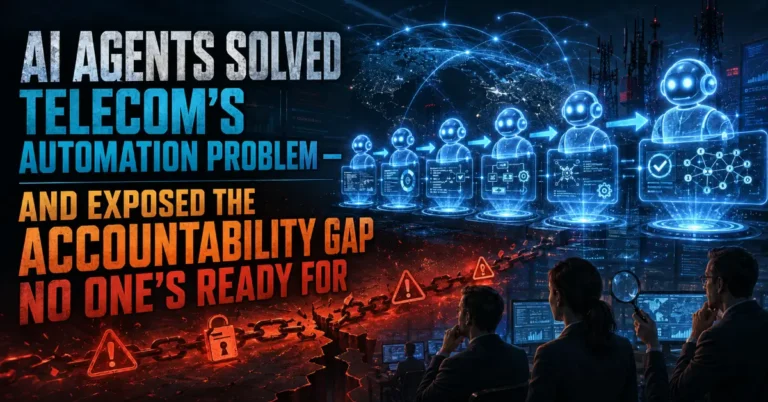
Telecom just crossed a line it spent years approaching carefully. AI agents are no longer confined to recommending fixes to network engineers — in a growing number of deployments, they’re diagnosing faults and proposing remediations that a human simply signs off on, rather than performs. Nokia’s work with Google Cloud is a clear marker of how far this has come: agents built on Gemini now sit inside Nokia’s Assurance Center, and early results point to fault-resolution times cut by more than half, sometimes by as much as 80 percent. The design keeps a human in the approval loop at every step — a deliberate constraint the companies frame as the reason this wave of automation is likely to stick where earlier attempts stalled.

That’s the part of the story getting the headlines. It’s also, in a sense, the easy part. Getting an agent to propose a good fix is becoming table stakes across enough vendors and pilots that it’s no longer a differentiator on its own. The harder question — the one the industry has mostly deferred — is what happens structurally once agents stop merely proposing and start acting, especially across more than one system at a time.
Network Automation AI Solved the Easy Part — AI Agent Orchestration Is the Coordination Problem
Telefónica and Nokia are already past single-agent diagnostics. The two companies are piloting agentic AI aimed at making network APIs easier to expose, discover, and consume, in step with GSMA Open Gateway’s broader push toward interoperable, developer-ready telecom capabilities. What’s notable is the next layer: the companies are now testing how agents hand work off to each other — one agent finding a capability, another chaining it into a sequence, a third executing the call — so that multi-step API access becomes repeatable rather than one-off.
That handoff is where the interesting problem actually lives. A single agent taking a single action inside a defined approval workflow is straightforward to audit. A chain of agents, each acting on a judgment call made by the one before it, is a fundamentally different kind of system. Standards bodies have noticed. TM Forum used MWC Barcelona 2026 to launch its AI-Native Blueprint, and one of its three founding workstreams is dedicated specifically to securing agent-to-agent interaction — establishing shared guardrails, a common policy language, and an ontology that lets operators and vendors reason about agentic risk in the same terms. The project’s member roster reads like a cross-section of the entire industry, spanning major operators, hyperscalers, and systems integrators. The fact that a standards body felt the need to stand up a dedicated workstream for this, rather than folding it into existing security frameworks, is itself telling: operators are treating multi-agent coordination as a genuinely new risk category, not a bigger version of an old one.
AI Agent Governance: Naming the Real Telecom Accountability Risk
It’s worth being precise about what the new risk actually is, because “AI agents are risky” is too vague to act on. The specific shift is this: once an agent has meaningful operational access to live network systems, it becomes a new kind of attack surface in its own right. A compromised or misdirected agent isn’t just a bug to patch — it’s a system explicitly built to take autonomous action on production infrastructure. If its decision-making is manipulated or its access misused, the blast radius looks nothing like a typical software vulnerability, because the whole point of the agent was to act, not merely to report.
That reframes the conversation. The open question isn’t really “is the model good enough” — most deployments now in the field suggest it largely is. The open question is whether the surrounding accountability structure has kept pace: who owns the decision, what gets logged, what triggers a rollback, and who signs off when a decision was actually the product of three agents chained across two vendors’ systems.
This pattern isn’t unique to network operations, and the vendors building the deepest infrastructure for it seem to know that. NVIDIA‘s telecom autonomy stack is a useful example of the shape governance is starting to take: privacy-preserving synthetic data tooling for training without exposing real subscriber data, blueprints for agents that need to run for extended periods rather than complete a single task, and a sandboxed runtime that restricts what any given agent can touch on operator systems. Partner work built on that stack ranges from synthetic-data model fine-tuning to self-healing radio operations with remediation that’s designed to be auditable after the fact, to anomaly detection tuned for telecom-scale traffic. The choice to build sandboxing and auditability into the platform itself, rather than bolt it on once something breaks, is a tell: the vendors closest to real production deployment are already treating governance as core infrastructure rather than a compliance checkbox.
Agentic AI Telecom Adoption Is Real – Governance Maturity Isn’t
None of this is theoretical anymore. Enterprise survey data puts agent deployment in production at roughly half of organizations surveyed, but the ROI is heavily concentrated among a smaller group — those pairing agent rollouts with deep integration into existing CRM, ticketing, observability, and security tooling rather than running agents as standalone pilots. A distinct cohort, on the order of one in eight surveyed leaders, has pulled meaningfully ahead as true agentic AI early adopters. That gap matters: most of the industry is still one or more steps behind the organizations setting the pace, and the gap is architectural, not just a matter of time.
The shift from single chat assistants to systems of cooperating agents is especially relevant for telco operations specifically, where a customer-care agent grounded in policy and knowledge bases, a diagnostics agent reading from OSS/BSS and inventory systems, and a remediation agent proposing (or in some cases executing) changes increasingly need to function as one coordinated system rather than three separate tools bolted together. That coordination layer is precisely where governance is least mature. Most enterprise AI governance frameworks were written with a single model answering a single query in mind — not a handoff between agents operating with different scopes of access to different systems.
A Playbook for AI Agent Governance in Telecom
- Separate “can the agent act” from “should this agent chain be trusted.” A well-scoped single agent with a human approval gate is a fundamentally different risk profile from a chain of agents acting on each other’s outputs — evaluate and govern them as separate categories, not variations on the same problem.
- Insist on bounded, auditable access before scale, not after. The vendors furthest ahead treat sandboxing and full logging as core architecture from day one, not a layer retrofitted once something goes wrong.
- Track standards participation as a buying signal. Vendor engagement with efforts like TM Forum‘s agentic security workstream is a reasonable proxy for who’s building toward interoperable governance versus proprietary lock-in.
- Measure integration depth, not deployment count. The ROI data is consistent across multiple studies: agents wired into existing observability, ticketing, and security tooling outperform standalone pilots by a wide margin.
- Assume the accountability question will get asked eventually — answer it before an incident forces the issue. Decide now, on paper, who owns a decision made by a multi-agent chain spanning more than one vendor’s systems.
The AI Agents Telecom Accountability Question Worth Sitting With
The industry answered “Can AI agents make telecom networks self-healing” faster than almost anyone expected. Fault-resolution improvements in the 50-to-80-percent range aren’t a promise anymore — they’re a reference case operators can point to today. The question operators, vendors, and enterprise buyers now have to sit with is less comfortable: if an agent chain spanning multiple vendors’ systems takes a wrong action on live infrastructure tonight, does anyone in your organization actually know who’s accountable, what gets rolled back, and how fast? For most of the industry, the honest answer right now is: not yet.
Related Tool
| AI Prioritiser – TeckNexus’s buyer-neutral framework for evaluating and sequencing AI agent use cases by governance readiness and ROI, useful to enterprises and vendors alike when deciding where agentic AI should touch live infrastructure first. |