At a glance- Private Network Insights for May 2026
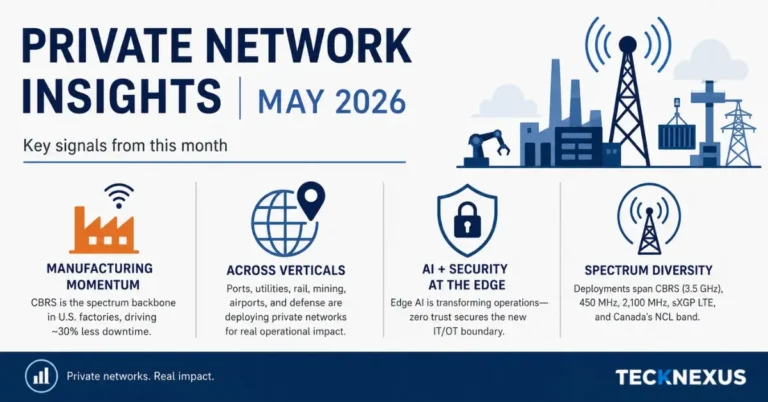
- 75% of U.S. private 5G networks run on CBRS today, projected to reach ~86% in U.S. factories by 2032 (Analysys Mason, via OnGo Alliance / NCTA).
- CBRS private networks are cutting manufacturing downtime by ~30%, while enabling automation, predictive maintenance, and real-time analytics (Spectrum for the Future / OnGo Alliance report).
- CIMPOR connected 10,000+ sensors across cement operations over a private 5G network with Vodafone Portugal and Ericsson — a benchmark for high-density industrial IoT scale.
- Defense went rapid-deploy: Anduril and Nokia Federal Solutions fielded a 5G Comms Sentry Tower operational in under three hours.
- Spectrum diversity is real: May saw deployments on CBRS (3.5 GHz), 450 MHz LTE for utilities, 2,100 MHz, sXGP private LTE, and Canada’s NCL shared band — one size does not fit all.
1. Manufacturing: CBRS is now the spectrum of record
The month’s defining theme. Independent analysis this May moved the manufacturing-plus-CBRS story from anecdote to baseline: a large majority of U.S. factory private 5G is heading to CBRS, and the operational evidence is catching up — roughly a third less downtime, plus automation and predictive maintenance gains. The deployments echoed it. CIMPOR’s 10,000+ sensor private 5G network with Vodafone Portugal and Ericsson is a flagship for industrial IoT density. TeraGo and Ericsson activated a private 5G testbed at McMaster’s Manufacturing Research Institute, and Sumitomo Electric demonstrated edge-AI factory safety over private 5G MEC with sub-150ms detection-to-warning response.

Why it matters for buyers: if you’re scoping a factory network, CBRS is now the default starting assumption in the U.S., not an alternative to be justified. The open question is the policy backdrop — a 2024 proposal to relocate CBRS users to a different band remains an industry debate, so spectrum strategy deserves explicit attention in any business case rather than being treated as settled. → Model the spectrum and cost tradeoffs with the [TeckNexus Spectrum Planning tool] and [TCO Calculator].
2. Vertical spotlight: the private network use cases broaden well beyond the factory
May made clear that private networks are landing across every industrial vertical TeckNexus tracks:
- Ports: Spark New Zealand and Ericsson deployed private 5G at Port Nelson.
- Utilities: Nokia‘s 450 MHz LTE (Band 31) brought long-range, deep-penetration connectivity to Brazil’s smart grid for AMI, SCADA, and distribution automation — while U.S. utilities signaled a sharper focus on private LTE and broadband for outage management.
- Mining: an industry overview underlined that autonomous mining runs on a deliberate mix of private 5G, industrial LTE, fiber, specialized Wi-Fi, operational radio, and satellite backup.
- Airports: U.S. airports are weighing CBRS not just for coverage but as a revenue stream, offering wireless services to stakeholders.
- Rail: BAI Communications is set to deliver a private 5G network for operational radio, train comms, and signalling.
The deepest analytical thread TeckNexus published this May centered on utilities — specifically the collision of grid AI and grid security. As intelligence moves from the control room to the substation — small language models, autonomous agents, and hardened edge routers enabling faster fault detection, predictive maintenance, and real-time load optimization — the attack surface moves with it. TeckNexus’s May analysis makes the case that private mobile networks are becoming the communications foundation for AI-enabled utilities, purpose-built for mission-critical OT and uplink-heavy telemetry that public and legacy networks weren’t designed to carry, and that a zero-trust model is the security architecture suited to the IT/OT boundary utilities now operate across, in a threat environment shaped by campaigns like Volt Typhoon and Salt Typhoon. Read the full thread: Edge AI in the Substation: The New Frontier of Grid Intelligence, Zero Trust for the Grid: Why IT/OT Convergence Demands a New Security Model, Protecting the AI-powered Grid: The Case for Private Mobile Network Security, and The Grid Is Getting Smarter. Is Your Security Ready? — the last drawing on perspectives from Anterix, GE Vernova, and Palo Alto Networks.
Why it matters for buyers: the reference architectures now exist outside manufacturing. A ports or utilities buyer no longer has to extrapolate from factory case studies — there’s vertical-specific evidence to anchor a business case. And for utilities specifically, the AI and security questions now have to be designed together: distributed intelligence at the edge demands distributed security, and the network choice underneath both is the foundational decision. → See the deployment patterns for your sector in [TeckNexus Vertical Intelligence].
3. Private Network Spectrum diversity: the band is a design decision, not a default
One of May’s quieter but important signals: the spectrum choices were genuinely varied. The same month saw deployments span several bands, each chosen for a reason:
- CBRS (3.5 GHz) dominated U.S. manufacturing.
- 450 MHz LTE served utilities, chosen for its long-range propagation and deep penetration.
- 2,100 MHz carried Beeline Russia’s expo deployment.
- sXGP private LTE underpinned NEC and Takenaka’s crane-safety system.
- Canada’s NCL shared band (n48/n77/n78) was covered by BLiNQ’s expanded small cells, alongside CBRS.
Coverage geometry, building penetration, device ecosystem, and regulatory regime all push toward different bands.
Why it matters for buyers: spectrum is an early, high-leverage decision that constrains everything downstream — device selection, coverage design, cost. Getting it wrong is expensive to unwind. The technology choice and the ownership/architecture choice are equally consequential and equally early — and both are now answerable in minutes with free, vendor-neutral tools. → Match technology to use case with the TeckNexus Technology Selector — 17 questions, a consultant-grade LTE / 5G / CBRS recommendation in about 8 minutes — then settle who owns what and where your data sits with the TeckNexus Architecture Selector, a 15-question, vendor-neutral walk-through of ownership, data residency, and vendor engagement.
4. Technology & products: deployment speed, security, and the vendor field
The product news pointed to two themes buyers care about: faster deployment and a hardened security perimeter. Anduril and Nokia Federal’s Sentry Tower (under three hours to operational) and EZRA’s compact, fast-setup private 5G system both target the “stand it up quickly” problem — as does a tethered hexacopter platform reported delivering private LTE/5G coverage from 100–200m, a novel rapid-coverage approach. On the security side, OneLayer launched a certified-integration program to tie its private-cellular security orchestration to routers and firewalls — a sign the market is moving from “can we secure private cellular?” to “how do we operationalize it across the stack?” That operationalization question is exactly what the month’s utility-grid analysis pushed further: securing private cellular at the stack level is the enabling step, and a zero-trust architecture across the IT/OT boundary is where the most security-sensitive verticals are heading. Nokia pushed an Open RAN interoperability strategy aimed at scaling private networks and industrial 6G R&D, and Future Technologies signaled where the next wave is heading by combining private 5G with integrated sensing and communications (ISAC), an early 6G-era capability.
The supplier field also broadened in ways buyers should note:
- Nextivity positioned a neutral-host solution for automation, robotics, IoT, and AI-driven workloads.
- Telia is delivering a digital platform over high-availability 5G infrastructure, including private networks.
- BAI Communications is offering IT/OT and private LTE/5G design services.
- CENGN is connecting Canadian deployers through its pan-Canadian Living Lab.
- Antevia Networks announced an end-to-end private 5G offering aimed squarely at SMEs and smaller organizations — a segment often underserved by enterprise-scale vendors.
Why it matters for buyers: time-to-operational and security integration are now differentiators between vendors, not table stakes you can assume, and the widening field (including SME-focused and neutral-host options) means more procurement choice across deployment sizes. All of it belongs in your RFP scoring. → Build a structured vendor comparison with the [TeckNexus RFP Scorecard Generator] and [Security Assessment].
5. Private Network Adoption signals: the market is broadening geographically and structurally
Beyond the headline verticals, May’s spread of “firsts” is itself the story: Norway’s first private 5G FWA network (EdgeNectar with Private Networks AS), Russia’s first corporate private 5G (MegaFon), private 5G for construction safety in Israel, Vietnam pursuing a 5G core that serves both public and enterprise private networks, and Boingo connectivity for the U.S. Marine Corps in Guam. The breadth ran wider still: Beeline Russia deployed private 5G at an industrial expo on Yadro equipment (2,100 MHz) with tests planned across 11 cities; in Australia, ISCO integrated X2M’s data/AI platform with private 5G to replace fixed NBN links — private cellular displacing fixed connectivity outright. And at the Los Angeles Convention Center, Boldyn Networks rolled out Wi-Fi 7 for high-density venue connectivity — a reminder that private cellular and next-gen Wi-Fi increasingly compete for the same venue use cases.
Why it matters for buyers: a broadening global supplier and deployment base means more reference points, more competition on price, and more locally available expertise — all favorable to enterprise buyers building a case now. And the ISCO case is a signal worth watching: private cellular is starting to displace fixed links, not just Wi-Fi.
6. Funding & corporate: capital keeps flowing, especially outside the mature markets
The money side of the ecosystem stayed active in May:
- EZRA (a ZHAW-affiliated startup) secured CHF 100,000 to advance a compact private 5G system for temporary deployments in Switzerland.
- Enquantum picked up a strategic platform backing under EZRA for advanced networking and post-quantum cybersecurity.
- Integratel Perú is advancing a US$110mn 5G/fiber investment with Huawei-led site renewals in Lima.
- Movistar Peru reported that multiple private networks are already operating in the country — a sign that the region continues to build momentum.
Why it matters for buyers: funding into compact, portable, and security-hardened private 5G points to where the next product wave is forming — and sustained investment in markets like Latin America widens the supplier and reference base buyers can draw on.
Every May item, with full source detail, is on the curated Private Network Monthly Insights page →.
What this means if you’re evaluating a private network
May’s throughline is that the technology risk has largely been answered — the live questions are now spectrum, architecture, deployment speed, and security integration. If you’re early in evaluation, three moves follow directly from this month:
- Treat CBRS as your U.S. default and model the alternatives deliberately rather than defaulting to licensed spectrum out of habit — but factor the policy uncertainty into the business case. Pressure-test the choice in minutes with the Technology Selector.
- Anchor your business case in vertical-specific evidence now that ports, utilities, rail, and mining have their own reference deployments — and for utilities, design the AI and security questions together from the start.
- Score vendors on time-to-operational and security integration, not just throughput — that’s where May’s product news showed real separation. Settle ownership and data residency early with the Architecture Selector.
Catching up? Last month’s signal is here: Private Networks Are Accelerating: April 2026 Monthly Update.
→ Start with the TeckNexus Intelligence Platform — independent, buyer-neutral tools for spectrum, TCO, architecture, and RFP decisions.
This analysis is drawn from TeckNexus’s full curated Private Network Monthly Insights for May 2026. [See every deployment, product, and partnership update →]
The TeckNexus Intelligence Platform is buyer-neutral and TeckNexus-authored. Vendor co-branded Intelligence Packs are labelled as such and kept separate from the neutral core tools.
| RELATED TOOLS
Not sure which spectrum and architecture fit your site? Spectrum and ownership are the earliest, highest-leverage decisions in a private network build — and the most expensive to unwind. The free, vendor-neutral TeckNexus Technology Selector returns a consultant-grade LTE / 5G / CBRS recommendation from 17 questions in about eight minutes, and the Architecture Selector maps who should own what, where your data sits, and how to engage vendors from 15 questions. |