Anterix

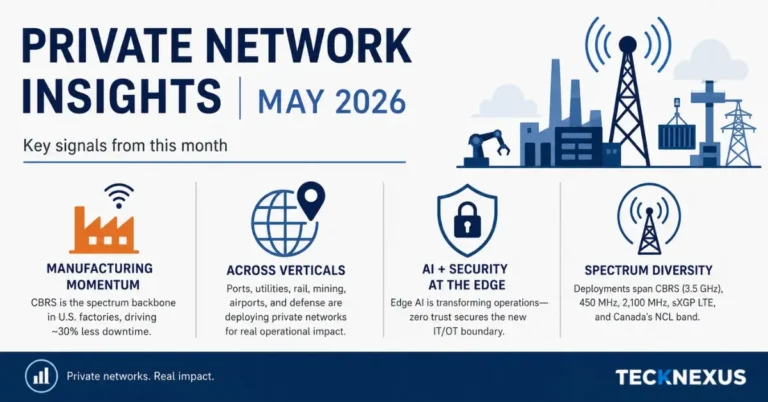
Private 5G became an industrial default in May 2026, with CBRS now the U.S. factory spectrum of record. This month's roundup spans deployments across manufacturing, ports, utilities, rail and defence — plus a deep utilities thread on grid AI and security — and what the shift means for buyers scoping spectrum, architecture and security.
AI is moving from the data center to the substation — and the attack surface is expanding with it. Anterix, GE Vernova, and Palo Alto Networks lay out why private mobile networks are the only communications foundation that keeps pace with both the opportunity and the threat.
This whitepaper explains how utilities can use secure AI-enabled private mobile networks to modernize operations, support distributed intelligence, improve resilience, and strengthen cybersecurity across critical infrastructure. It covers AI applications, private network advantages, zero trust principles, multilayered security architecture, and governance considerations for AI-ready utility environments.
Welcome to the TeckNexus Private Networks: Energy & Utilities Edition. Across energy and utility operations, connectivity has evolved from a supporting tool into a strategic foundation. As utilities modernize critical infrastructure, integrate distributed energy resources, and strengthen cybersecurity and grid resilience, communications must deliver determinism, security, and operational control. Private LTE and 5G networks are increasingly fulfilling that role.

This edition highlights real-world private network deployments from organizations such as Memphis Light, Gas and Water (MLGW), GMR Energy, and major European utility operators. These initiatives—delivered in collaboration with ecosystem leaders including Nokia, Anterix, Hubbell Power Systems, Niral Networks, Druid Software, TDF, and members of the broader private wireless ecosystem—show how utilities are moving from pilots to production-grade networks supporting grid modernization, worker safety, and mission-critical operations.

We proudly feature the 2025 TeckNexus Private Networks Award winners, recognizing utilities, technology providers, and partners setting new benchmarks for execution in energy and utility environments. Through deployment stories, executive perspectives, and partner insights, this magazine underscores the power of collaboration across utilities, vendors, integrators, and industry organizations.

Readers will also find the Smart Utilities Connectivity Blueprint—a practical framework distilled from global deployments. It illustrates why visibility must come before automation, how ownership and control models shape outcomes, and how utilities can scale digital transformation without compromising reliability or safety.

A clear message runs through every story in this edition: utilities don’t invest in private networks for technology alone—they invest for outcomes. The leaders featured here show what’s possible when connectivity is aligned with operational realities and long-term grid strategy.
Anterix and Hubbell partner to demonstrate how private LTE networks in the 900 MHz band help electric utilities detect and mitigate DER islanding risks. With the rise of distributed energy resources, fast and reliable Direct Transfer Trip (DTT) over private LTE ensures safety, improves grid reliability, and offers a scalable communications alternative to fiber and copper-based systems.
Ubiik has secured Anterix certifications for its router and base station, signaling readiness for private LTE deployments on Anterix’s 900 MHz Band 106 spectrum. Anterix awarded Anterix Active badges to Ubiik’s Pyxis 5G LPWA RA810 router and its goRAN+ base station, confirming they meet Anterix operating criteria for 900 MHz private LTE. In addition, the high-power Pyxis RA320X variant received an Anterix Capable badge, validating a 28 dBm transmit option that extends reach compared to standard 23 dBm LTE modules. Together, the router and RAN designations give utilities and critical infrastructure providers a tested, end-to-end path to deploy pLTE on B106. Band 106 is licensed 900 MHz spectrum aligned with 3GPP LTE that Anterix has aggregated across the U.S., Puerto Rico, Alaska, and Hawaii.
T-Mobile's auction of its 800 MHz spectrum has attracted significant interest from utilities and engineering firms. This development could reshape spectrum ownership and enhance 5G deployment, especially as Dish Network faces financial hurdles. Key players like Burns & McDonnell and Anterix are emerging as potential buyers, underscoring the strategic importance of this auction for private wireless networks and critical infrastructure.

Your Brand. Our Intelligence Tools.

Capture leads at the point of evaluation. Talk to Us →

Sponsored by Palo Alto Networks
⚡ Utilities ⏱ 8 min ✓ Free
This tool is built and hosted by TeckNexus.
Launch Tool →
Whitepaper
This whitepaper explains how utilities can use secure AI-enabled private mobile networks to modernize operations, support distributed intelligence, improve resilience, and strengthen cybersecurity across critical infrastructure. It covers AI applications, private network advantages, zero trust principles, multilayered security architecture, and governance considerations for AI-ready utility environments....
Whitepaper
Non-terrestrial networks are rapidly evolving from experimental satellite systems into an increasingly important part of the global 5G connectivity landscape. This eBook, developed by Radisys in collaboration with TeckNexus, explores how 3GPP standardization, satellite architecture innovation, and software-driven network design are reshaping NTN deployment models. It examines the transition from...
Whitepaper
Private cellular networks are transforming industrial operations, but securing private 5G, LTE, and CBRS infrastructure requires more than legacy IT/OT tools. This whitepaper by TeckNexus and sponsored by OneLayer outlines a 4-pillar framework to protect critical systems, offering clear guidance for evaluating security vendors, deploying zero trust, and integrating IT,...
Scroll to Top