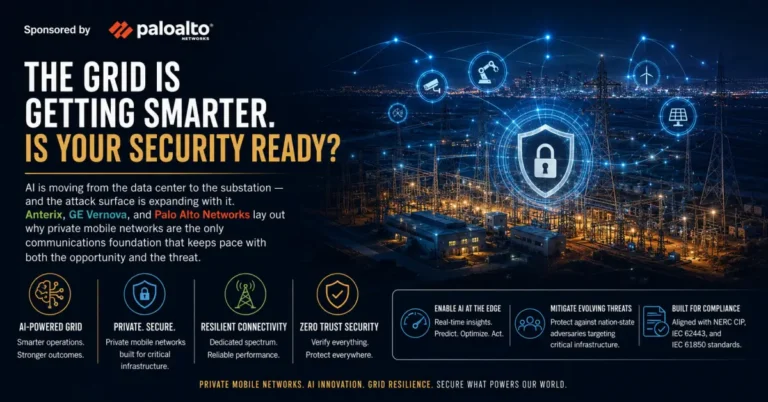
The electrical grid is undergoing its most profound transformation in a century. Intelligent electronic devices now monitor and automate substations at the edge. Distributed energy resources are reshaping how power flows. AI is moving from the data center to field equipment. And through it all, the attack surface is expanding — fast.

A new collaborative whitepaper from Anterix, GE Vernova, and Palo Alto Networks makes the stakes explicit: utilities that are slow to adopt AI-enabled private mobile networks risk falling dangerously behind — not just in operational efficiency but in resilience against nation-state threat actors already embedded in critical infrastructure.
From Reactive to Predictive: What AI Changes for Utilities
Traditional grid management relied on scheduled maintenance and reactive responses to outages. AI flips that model. With intelligent analytics running on near-real-time sensor feeds, utilities can now predict asset failures before they occur, optimize load balancing dynamically, detect energy theft, and manage the integration of EV charging and renewable generation — all simultaneously.
Small language models (SLMs) are accelerating this shift. Unlike cloud-dependent large language models, SLMs run directly on edge devices with constrained compute and storage. This means intelligence now lives at the substation, the renewable energy gateway, and the field router — not just in a centralized data center. Utilities can deploy autonomous agents that manage localized grid functions independently, forming multi-agent systems that adapt the grid in real time to disruptions and demand changes.
The productivity and reliability gains are real. But so are the new vulnerabilities.
The Security Problem AI Creates
Every new device, every edge AI workload, and every data stream introduced into a utility’s infrastructure is also a potential attack vector. The whitepaper is direct about this: AI creates the risk of spoofed sensor data, poisoned AI models, and falsified asset status reports. If an adversary corrupts the data that an AI system acts on, the consequences for grid stability can be catastrophic.
The threat is not theoretical. Two state-sponsored campaigns — Salt Typhoon and Volt Typhoon — have demonstrated the sophistication and patience of modern adversaries targeting critical infrastructure. Salt Typhoon penetrated US telecommunications systems to surveil, intercept, and harvest metadata at scale. Volt Typhoon established footholds in IT networks as a staging point for lateral movement into OT systems — the operational technology that controls physical grid equipment.
Both campaigns exploit a common vulnerability: reliance on public networks and the assumption that perimeter defenses are sufficient. They are not.
Private Mobile Networks as the Foundation
The response recommended by the whitepaper’s three authors is not incremental. It calls for utilities to rebuild their communications foundation around private mobile networks (PMNs) — dedicated, licensed-spectrum networks that utilities own and control.
PMNs offer capabilities that public carrier networks simply cannot match for mission-critical utility operations. Every endpoint is uniquely identified and continuously verified through SIM-based authentication. Traffic segmentation isolates telemetry, control commands, and fault data. Utilities control their own access policies, device onboarding, and encryption standards — built on 3GPP security frameworks designed for exactly this kind of mission-critical environment.
Critically, PMNs are optimized for the uplink-heavy traffic profile that AI workloads demand. Streaming large volumes of sensor, video, and telemetry data to AI models requires high-capacity, low-latency uplink performance — something public mobile networks, built for consumer download traffic, are not designed to deliver.
A Layered Security Architecture for the AI-Ready Grid
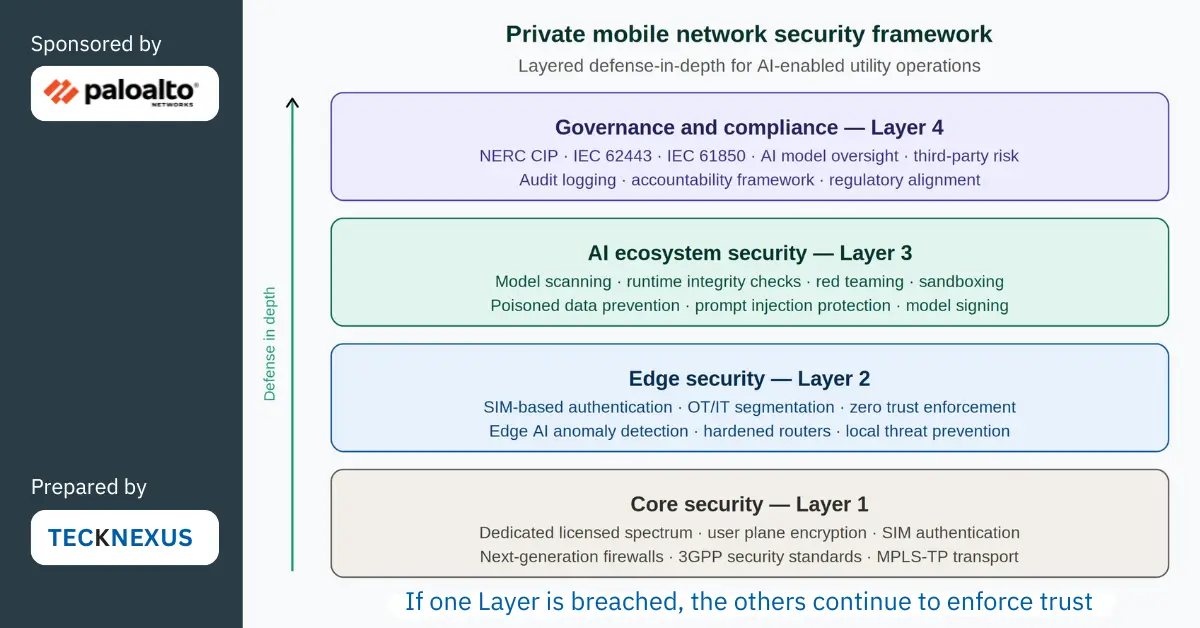
The whitepaper outlines a four-layer security framework that utilities should build on top of a PMN foundation. At the core, encrypted and resilient transport integrates diverse access technologies — licensed narrowband, LTE, broadband over powerline, Wi-Fi — into a unified, failover-ready backbone. At the edge, SIM-based authentication and segmentation policies create enforcement zones that isolate OT and IT traffic. The AI ecosystem layer introduces runtime integrity checks, model scanning, and adversarial red-teaming to protect AI models and training data from compromise. Governance and compliance bind it all together, aligning with NERC CIP, IEC 62443, and IEC 61850 frameworks.
Zero trust principles run through every layer. No device, user, or application is trusted by default. Every interaction is continuously verified. Anomalous behavior triggers immediate investigation before it cascades into operational disruption.
What Utility Leaders Need to Know About AI, PMNs, and Grid Resilience
The integration of AI into utility operations is not optional — it is the path to the reliability, efficiency, and resilience that regulators, shareholders, and customers will demand in the decade ahead. But AI deployed on insecure communications infrastructure is not an upgrade. It is a liability.
Private mobile networks, paired with a purpose-built, AI-aware security architecture, give utilities the control they need to operate intelligently and securely in a threat environment that is only becoming more sophisticated. The question utility technology and operations leaders need to answer is not whether to modernize — it is whether their current communications and security posture is ready for what AI deployment actually demands.
For most utilities, the honest answer is that the work starts now.
Assess Your Utility’s Private Network Security
TeckNexus has developed a free Private Network Security Assessment for Utilities, co-created with Palo Alto Networks. The 5-section assessment maps your security gaps to real threat scenarios – including Salt Typhoon, Volt Typhoon, AI data poisoning, and unencrypted OT traffic — and delivers a prioritised action plan tailored to your environment. Launch the Free Private Network Security Assessment.
Related Tools
Haven’t yet determined which private network technology fits your utility environment? Start here. 17 questions, 8 minutes, free – Private Network Technology Selector.
Determine who should own your network infrastructure, where your data sits, and how to structure vendor engagement. 15 questions, 6 minutes, free – Private Network Architecture Selector.