
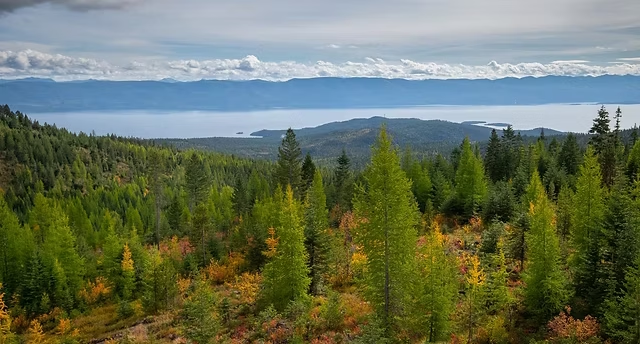
Most private network deployments solve one connectivity problem. This one had to solve two at once, on the same infrastructure, across terrain that made either problem hard on its own: fixed AI-enabled cameras that needed serious bandwidth, and autonomous drones that needed to roam freely across nearly 50 miles of rugged, tree-covered property.
The property in question is a 100,000-acre Rocky Mountain ranch, and the answer its security team landed on wasn’t two networks stitched together. It was one private 5G network built from six different vendors’ technology, engineered to operate as a single system.
A Property That Broke Every Conventional Option
The ranch’s connectivity requirements ruled out the usual playbook almost immediately. Public cellular coverage was sparse to nonexistent at the remote locations where security infrastructure needed to live. Wi-Fi couldn’t deliver the range or the mobility a patrolling drone fleet required. Extending fiber to individual camera locations along a seven-to-eight-mile private road was impractical given the terrain and distance. Even the trail-camera solution under consideration fell short, lacking the bandwidth advanced video analytics demanded.
The requirements were specific and, taken together, unforgiving: one secure network serving both fixed and mobile systems, reliable coverage at remote camera sites and drone patrol areas, enough bandwidth for AI-enabled video surveillance, full mobility for autonomous drones, no costly fiber runs to individual cameras, and interoperability across equipment from multiple technology providers, validated before anything reached the ranch. Underneath the specifics sat a broader industry pattern: organizations increasingly need one common connectivity layer that can carry multiple applications and device types, rather than a separate network stood up for every new use case.
Six Vendors, One Operational Network
Alliance Corporation, serving as project distributor, network architect, and integration coordinator, designed a CBRS-based private 5G network built around Moso Networks’ Canopy 5GOD2 high-power outdoor gNodeBs operating in CBRS Band n48, paired with Pente Networks’ RAN-agnostic HyperCore 5G Core. Six outdoor radios were strategically positioned along mountain edges to deliver targeted coverage to remote camera sites and designated drone patrol areas, rather than attempting blanket coverage across the entire property.
Global Telecom’s Titan 5100 outdoor 5G user equipment connected the remote security sites into the network, while ESP’s platform managed the cameras and handled the AI-enabled video analytics: fire detection, thermal imaging, facial recognition, and license plate recognition. Fiber served as the primary backhaul between the RAN and the 5G core, with Starlink standing by as a secondary path if the fiber connection failed.
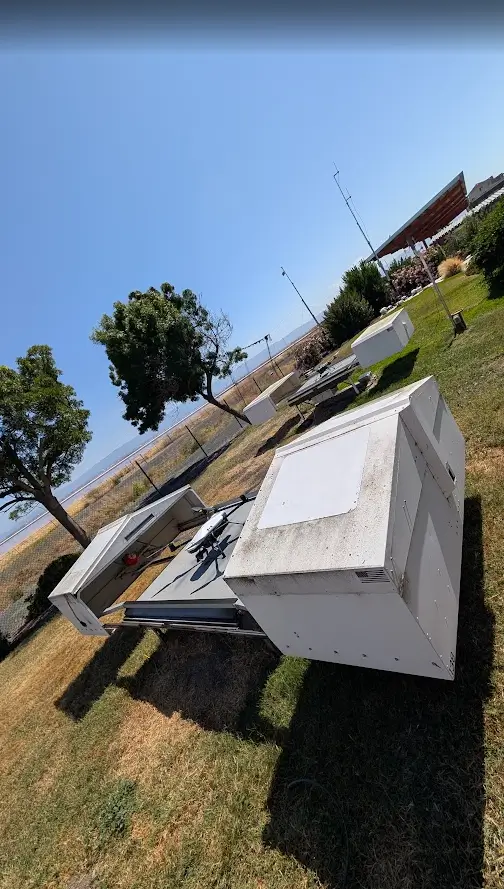
The riskiest part of the project wasn’t any single vendor’s technology, it was whether all of them would work together in the field. Alliance addressed that risk before a single radio shipped to the ranch. The team traveled to Nightingale Security’s California laboratory and connected the autonomous drone system’s LTE module to a Moso outdoor eNodeB, confirming the drones could operate over the private cellular network well before deployment. That single validation step moved a major interoperability risk out of the remote deployment environment, where troubleshooting would have been far more costly, and into a controlled lab setting where it could be resolved cleanly.
What One Network Now Carries
100,000 acres of Rocky Mountain terrain, spanning nearly 50 miles, secured on one private 5G network.
- Targeted infrastructure. Six Moso Canopy 5GOD2 radios deliver connectivity precisely where it’s needed, at remote camera sites and designated drone patrol areas, rather than requiring blanket coverage across the whole ranch.
- Fixed and mobile on one network. Three autonomous surveillance drones operate alongside fixed security cameras on the same private infrastructure.
- Advanced analytics at the edge. The network carries fire detection, thermal imaging, facial recognition, and license plate recognition, applications that demand real bandwidth, not just basic connectivity.
- Less physical infrastructure. Wireless connectivity eliminates the need to run fiber to individual remote camera locations.
- De-risked integration. Validating drone interoperability in a lab before field deployment avoided what could have been costly, difficult troubleshooting on-site.
- Built-in resilience. Fiber carries the network under normal conditions, with Starlink as a secondary path if that primary connection fails.
The longer-term value is structural: rather than running separate connectivity solutions for cameras and for autonomous systems, the ranch now operates on one private 5G foundation capable of supporting both, with room to carry whatever security application comes next.
Why CBRS Beat Every Alternative
Private 5G over CBRS was the only option that offered the specific combination of coverage, capacity, and mobility the ranch actually needed. Public cellular didn’t reach the remote areas in question. Wi-Fi couldn’t provide the range or mobility autonomous drones required. Fiber to remote cameras was impractical, and the trail-camera alternative lacked the bandwidth for serious video analytics.
CBRS-based private 5G closed all of those gaps at once, delivering dedicated wireless infrastructure that could serve stationary cameras and mobile drones as a single connectivity layer, with radios positioned deliberately rather than blanketing the property. The multivendor architecture made that possible in practice: pairing Moso’s RAN with Pente’s RAN-agnostic HyperCore 5G Core gave the project team the flexibility to integrate best-fit technology from different providers into one operational network, rather than being locked into a single vendor’s full stack.
Six Companies, One Chain of Command
Alliance Corporation served as project distributor, overall private 5G network architect, and integration coordinator, a role considerably broader than supplying equipment. Alliance designed the CBRS-based architecture, selected and coordinated every technology component, drew on prior Moso implementation experience to recommend the platform, paired the Moso RAN with the Pente HyperCore, coordinated the drone interoperability validation at Nightingale Security’s lab, managed the multivendor integration across RAN, core, UE, backhaul, camera systems, and remote sites, worked alongside Redtail Communications during bring-up and commissioning, and carried the project from validated components through to a production network.
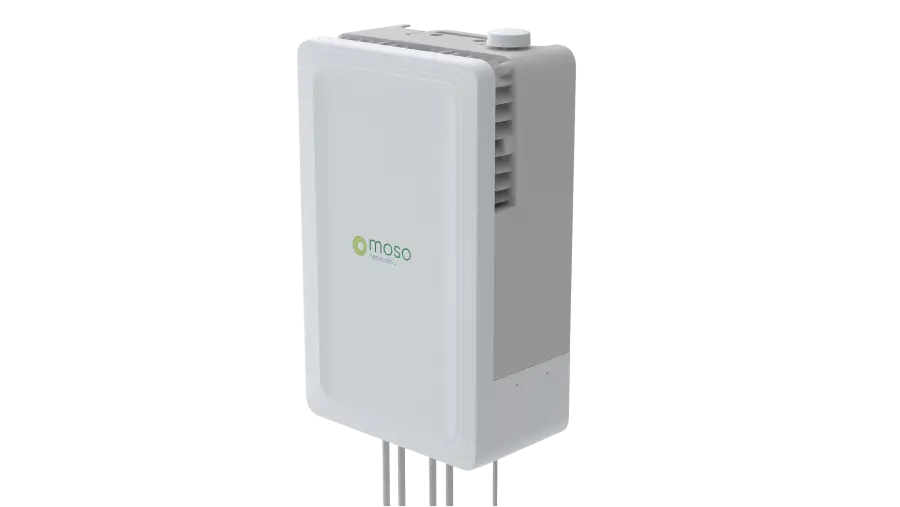
Moso Networks provided the private 5G RAN, Canopy 5GOD2 high-power outdoor gNodeBs delivering targeted coverage to remote camera sites and drone patrol areas.
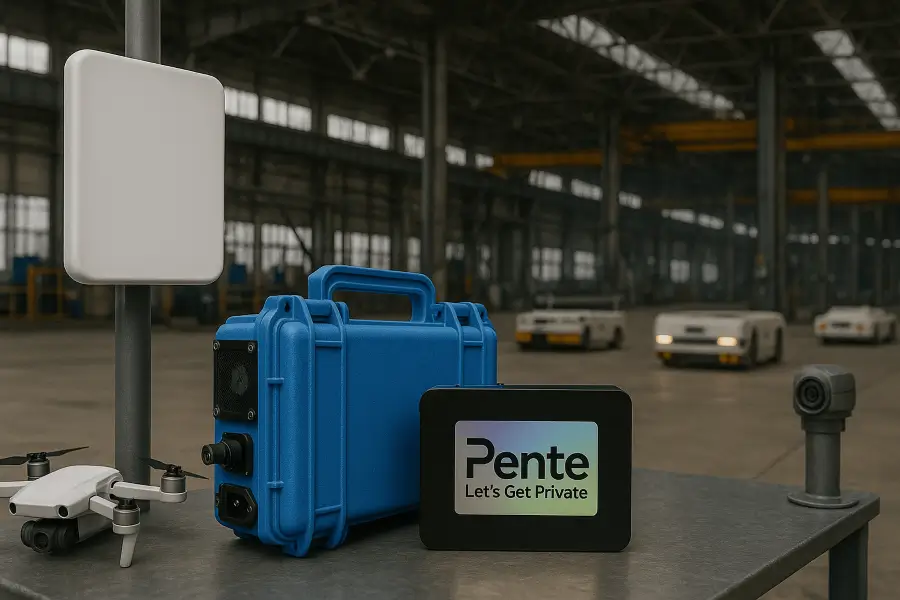
Pente Networks provided the HyperCore 5G Core, whose RAN-agnostic architecture supported integration with Moso’s RAN and managed device access, data sessions, and mobility for both camera-site UEs and autonomous drones.
- Redtail Communications served as solution integrator for field deployment, handling remote-site infrastructure including rectifiers, UPS backup, switching, enclosures, and towers, along with installation of cameras and outdoor radios, working alongside Alliance during network bring-up and commissioning.
- Nightingale Security provided the autonomous surveillance drones and partnered with Alliance on the pre-deployment interoperability testing that validated the drone system against Moso’s private cellular network before field deployment.
- Global Telecom provided the Titan 5100 outdoor 5G user equipment connecting remote security sites to the private network.
- ESP managed the cameras and delivered the AI-enabled video surveillance and analytics powering fire detection, thermal imaging, facial recognition, and license plate recognition.