
As enterprises across manufacturing, energy, utilities, and critical infrastructure deploy private cellular networks to power digital transformation, they inherit a structural blind spot: cellular networks were designed to identify subscribers, not devices. This leaves organizations with no native visibility, no Zero Trust enforcement, and no way to detect cellular-specific threats.
OneLayer closes this gap with a purpose-built platform that transforms private cellular networks into fully manageable, enterprise-grade secure environments. Already deployed with 13 utilities, including Evergy, WEC Energy Group, Southern Linc, and TECO, as well as Fortune 100 and 500 mining and manufacturing operators globally, OneLayer is setting the emerging industry standard for private network security.
The Blind Spot Built Into Cellular Networks
Cellular networks were designed for mobile network operators whose primary asset is the subscriber, identified by IMSI, not the device. This architectural assumption leaves enterprises blind to what is actually operating on their OT and IIoT infrastructure. Devices connecting via cellular routers or adapters are invisible to standard tooling, creating unmanaged blind spots in asset inventory across critical environments.
Zero Trust Network Access requires reliable, persistent device identity, but in cellular environments the traditional identifiers, SIM cards and IMEIs, are weak. SIM cards can be swapped between devices, and cellular routers obscure the devices behind them. Without accurate device context, network segmentation is reduced to static, APN-level policies that are coarse, error-prone, and vulnerable to misconfiguration.
Detecting security incidents specific to cellular networks, SIM swapping, unauthorized device manufacturers, IMEI spoofing, abnormal radio behavior, requires cellular expertise that enterprise IT and OT teams typically lack. Traditional security tools cannot interpret cellular-layer signals, leaving this attack surface unmonitored.
Turning Radio Signals Into a Device Identity
OneLayer was purpose-built to solve these challenges. The platform integrates directly with the cellular network core, using SPAN to monitor attach requests, radio capabilities, handovers, and other cellular-layer signals. From this data, OneLayer builds a comprehensive and persistent device fingerprint called ONEID by correlating all available identifiers: IMSI, IP address, MAC address, APN, radio attributes, and behavioral signals.
- Tracks every device holistically, even when SIM cards are swapped or devices connect through cellular routers and adapters, eliminating the blind spots that exist in every private cellular deployment today.
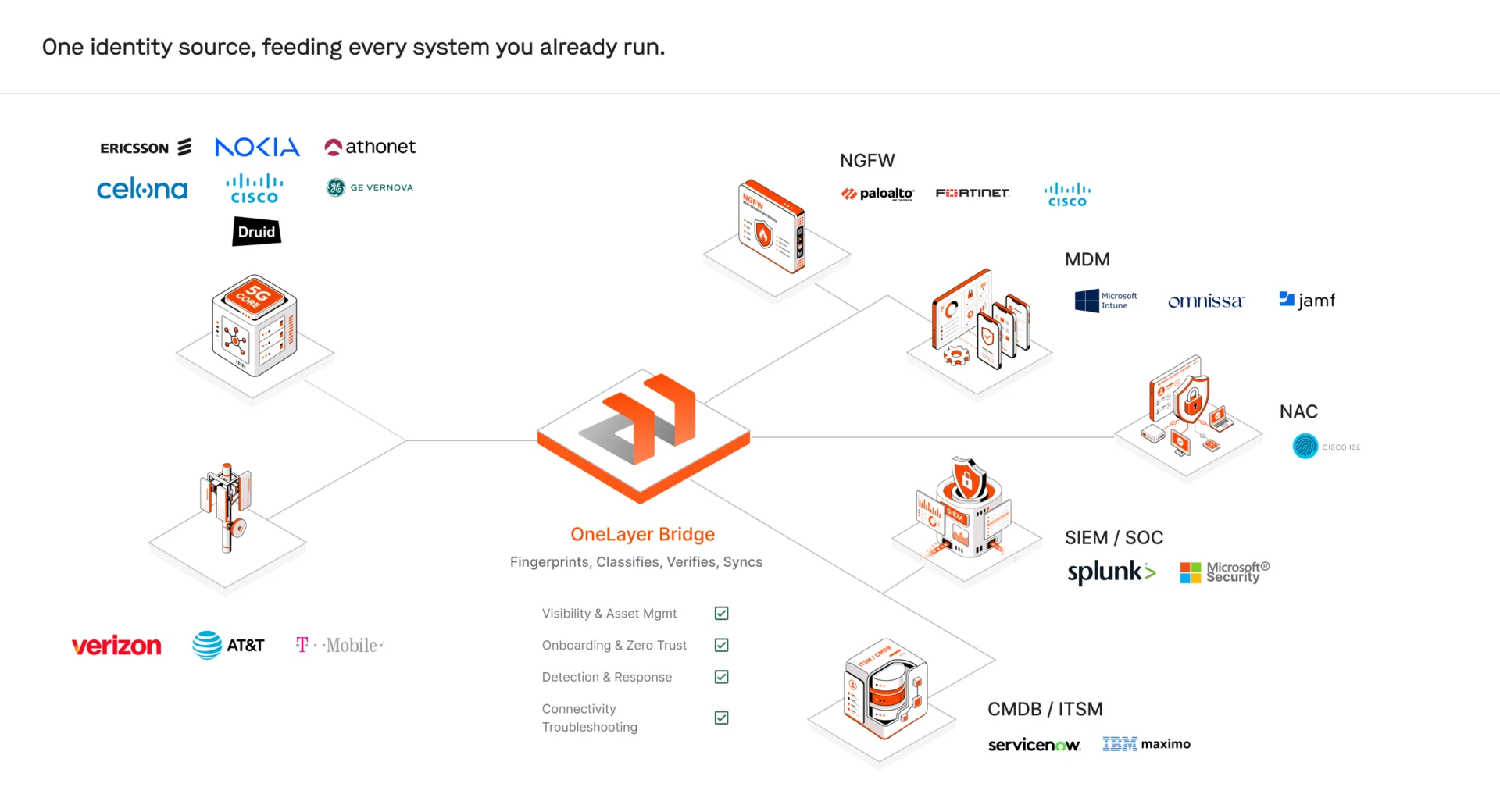
- Enforces Zero Trust micro-segmentation, context-based access controls beyond static APN-level segmentation, integrating with Palo Alto Networks, Fortinet, and Check Point firewalls.
- Detects cellular-specific threats in real time, SIM swaps, unauthorized manufacturers, device modification, abnormal radio behavior, and policy violations, threats IT and telecom tools cannot detect.
- Automates device onboarding at scale, zero-touch onboarding scaling from dozens to thousands of devices without bottlenecks.
The platform is fully vendor-agnostic, integrating with Nokia, Ericsson, Palo Alto Networks, Fortinet, Check Point, Claroty, Cradlepoint, Digi, MultiTech, ServiceNow, and SolarWinds.
Proof Across Four Very Different Networks
A Fortune 100 Global Manufacturer
OneLayer is deployed across the manufacturer’s private LTE and 5G network spanning dozens of factories worldwide, under the company’s “No Asset Left Behind” initiative requiring complete visibility and Zero Trust enforcement across all connected assets.
The deployment delivers complete visibility into
- All cellular and non-cellular devices, including assets hidden behind cellular routers;
- Zero Trust access control with context-based micro-segmentation preventing lateral movement;
- automated device onboarding enabling seamless scaling across global production sites;
- Over 300% ROI with reduced operational costs and improved security posture.
“OneLayer is simply the right piece in the puzzle of our private cellular network global rollout vision, supporting a wide variety of innovative use cases. OneLayer’s solution enables us to enhance operational efficiency and flexibility while facilitating automated and autonomous operations.” – Principal Architect, Fortune 100 Manufacturer
“We initiated a program called “No Asset Left Behind” because we realized we needed to know about and manage all assets, not just network traffic. We needed this to apply to our private cellular networks in worldwide manufacturing sites. OneLayer seamlessly provided us with that visibility, including to non-cellular devices connected to the LTE/5G networks.” – Risk Management Manager, Fortune 100 Manufacturer
“OneLayer supports the dramatically increased number of networks and devices enabled by 5G technology. OneLayer’s platform is key to the effective scaling of our private cellular investment.” – Lead of Global Infrastructure, Platform and Cloud, Fortune 100 Manufacturer
300%+ ROI reported by a Fortune 100 manufacturer after deploying OneLayer across its global private LTE/5G footprint.
Evergy

Evergy selected OneLayer to manage and secure its fast-growing private LTE network, which supports 1.7 million customers across Kansas and Missouri, with thousands of OT/IoT devices scaling to tens of thousands. The deployment delivers automated device onboarding with delegation across teams, reducing operational burden, and end-to-end Zero Trust security extending Evergy’s existing frameworks into the private LTE domain.
“We needed a way to manage the growing number of OT devices connected to our private cellular network. We required automation and delegation of device onboarding steps alongside complete visibility to all devices at all times. OneLayer did all of that, in addition to providing operations and security frameworks for our private LTE networks and connected devices.” – J.J. Stutler, Manager, Wireless Engineering and Operations, Evergy

WEC Energy Group
Deployed across WEC’s private cellular infrastructure, OneLayer delivered step-change improvements in operational efficiency.

“What used to take us 15 steps we now have down to 1 or 2 steps before we can act.” – Steven Liegl, WEC Energy Group

Southern Linc
OneLayer secures and scales all devices across Southern Linc’s regional LTE network, which spans 122,000 square miles across Alabama, Georgia, and southeastern Mississippi.
“Our partnership with OneLayer allows us to scale and secure all of the devices on our network so we can effectively and efficiently expand network utilization. OneLayer’s Bridge platform gives us control of connected assets on our LTE network and provides essential tools to better manage and secure our network as usage expands.” – Alan McIntyre, Vice President of Engineering and Operations, Southern Linc

One Tool Catches What Nothing Else Sees
During a proof-of-value with a major European manufacturer, OneLayer detected a banned-manufacturer device operating deep inside a sensitive OT network segment. An employee had removed a SIM from a Level 1 router and inserted it into a personal phone, breaking Purdue model adherence and introducing an unauthorized device into the OT communications network. No other tool on the network caught it.
A New Category, Now Being Validated by the Market
OneLayer is pioneering a new category of enterprise security: device-centric security, visibility, and orchestration for private LTE/5G networks. Before OneLayer, there was no vendor-agnostic solution bridging the gap between enterprise IT/OT security practices and private cellular infrastructure.
Major security and infrastructure vendors are now entering the market mirroring OneLayer’s messaging, validating both the problem and the approach. OneLayer has been mentioned in multiple Gartner Hype Cycles, named a 2024 Gartner Cool Vendor, and featured in Forrester reports. Its vendor-agnostic model lowers the barrier for enterprises to secure their cellular environments regardless of their existing vendor stack, with the potential to set the standard for how private cellular networks are managed and secured globally.
Why Wi-Fi’s Weak Spot Needed a Cellular-Native Fix
Private LTE and 5G are increasingly the network technology of choice for industries undergoing digital transformation, chosen for coverage, reliability, low latency, and support for OT/IIoT workloads that Wi-Fi cannot serve. However, cellular technology introduces a structural security gap: no native device identity layer, no enterprise-grade access controls, and no built-in threat detection.
OneLayer integrates at the cellular core level, interpreting telecom-layer signals such as attach requests, radio capabilities, and handovers, and translating them into actionable enterprise security context. This works across all cellular technologies, 5G SA, 5G NSA, LTE, and CBRS, and all major core vendors, purpose-built for how cellular networks actually function.
OneLayer and Its Ecosystem: Who Provides What
OneLayer is the primary technology provider, responsible for platform design, deployment, and ongoing support: integration with the private cellular core via SPAN monitoring, the ONEID device fingerprinting engine, Zero Trust policy enforcement via firewall and NAC integrations, asset visibility, automated onboarding, threat detection, and continuous platform updates and customer support. OneLayer operates as the sole vendor-agnostic player in this space.
- Ericsson and Nokia. Cellular core vendors whose infrastructure OneLayer integrates with to monitor network traffic and device signals.
- Palo Alto Networks, Fortinet, and Check Point. Enforcement partners; OneLayer provides device context enabling Zero Trust firewall policies.
- Cradlepoint, Digi, and MultiTech. Cellular router partners; OneLayer detects and manages devices hidden behind these routers.
- World Wide Technology (WWT) and Burns & McDonnell. Channel and integration partners supporting enterprise deployments.