
The next wave of industrial transformation will be driven by Physical AI, humanoid robots, autonomous mobile robots, drones, and other intelligent machines that collaborate to automate manufacturing and warehouse operations. But enabling these systems to work together safely and efficiently requires more than high-speed wireless connectivity. They must also share an extremely accurate and common sense of time.
Cumucore, together with partners Qualcomm, Mitsubishi Electric, Node-H, and Askey, has demonstrated Time-Sensitive Networking (TSN) over 5G with 200-nanosecond clock synchronization accuracy. This breakthrough enables wireless devices to use the same 5G network for both deterministic communications and precise time synchronization, eliminating the need for separate synchronization infrastructure and enabling a new generation of collaborative Physical AI applications, without sacrificing the flexibility and scalability of wireless connectivity.

When Robots Need to Share a Clock, Not Just a Network
To maximize productivity, humanoid robots, autonomous mobile robots, drones, and other intelligent machines must operate as coordinated teams rather than independent devices. Just as humans collaborate by sharing a common understanding of time, AI-powered machines require precise synchronization to execute tasks simultaneously, hand over materials, avoid collisions, and respond instantly to changing production conditions.
Today, machines often rely on application-level handshaking and waiting mechanisms to coordinate their actions: one machine completes its task, signals the next machine, waits for confirmation, and only then can the next operation begin. This introduces latency, increases software complexity, and limits the overall throughput of automated production lines. As the number of collaborating robots and autonomous systems grows, these delays accumulate, reducing the productivity gains that Physical AI promises.
Traditionally, the level of synchronization needed has been achieved using wired Time-Sensitive Networking over Industrial Ethernet. While highly effective, wired infrastructure limits mobility, increases installation complexity, and reduces the flexibility required by modern smart factories. Extending deterministic synchronization to wireless networks has become one of the industry’s most critical challenges: wireless networks must provide sub-microsecond clock synchronization while maintaining carrier-grade reliability, deterministic performance, and seamless mobility, despite the natural delay variation, or jitter, that radio scheduling, propagation, and changing wireless conditions introduce.
Extending the Factory’s Clock Across a Wireless Network
The solution extends Time-Sensitive Networking from wired Industrial Ethernet into a 3GPP-compliant private 5G network, enabling deterministic wireless communication and precise time synchronization for mobile industrial devices. Rather than treating wireless connectivity and synchronization as separate functions, the solution integrates both into the same 5G infrastructure, allowing factories to replace Ethernet cables without sacrificing deterministic performance.
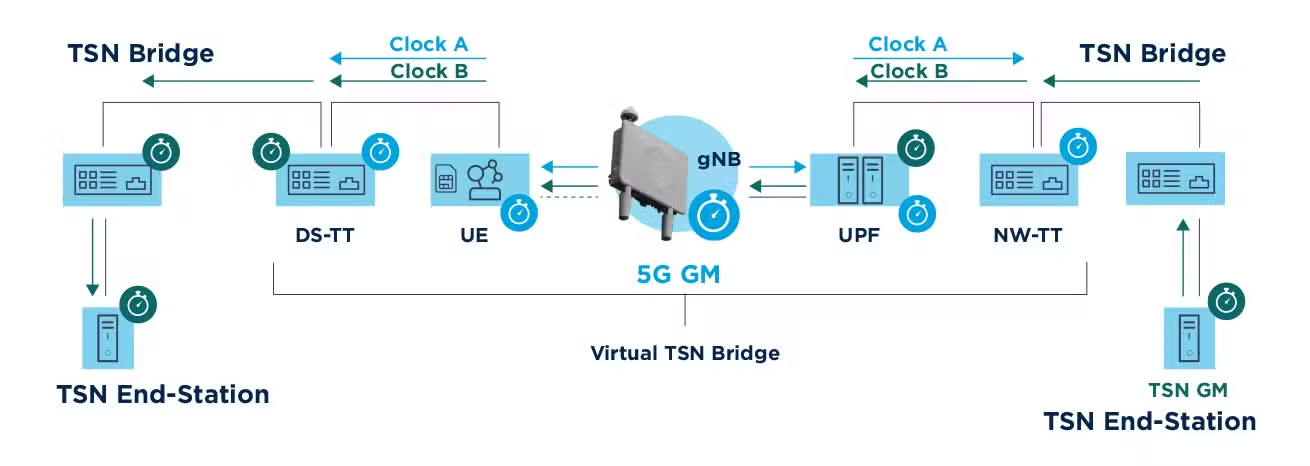
The implementation follows the 3GPP Time-Sensitive Communication (TSC) architecture, including support for 5GLAN, Ethernet PDU Sessions, a Network Time Synchronization Function (NW-TT), and a Device-Side Time Synchronization Function (DS-TT). The NW-TT, implemented within the 5G Core, interfaces directly with the factory TSN network and acts as the gateway between the wired and wireless timing domains. The industrial network distributes the Grandmaster Clock using IEEE 1588 Precision Time Protocol (PTP) and the IEEE 802.1AS (gPTP) TSN timing profile, and the NW-TT shares this common reference clock with the 5G base station, ensuring the radio access network and the factory Ethernet network operate from the same synchronized time source.
The DS-TT, located in the 5G device, bridges the synchronized 5G network with the industrial application or Ethernet TSN endpoint. Together, the NW-TT and DS-TT extend the TSN timing domain transparently across the wireless network, allowing robots, PLCs, sensors, actuators, and other industrial equipment to participate in the same deterministic control system regardless of whether they are connected by cable or over 5G. The base station continuously broadcasts network timing information through System Information Block 9 (SIB9), and Cumucore’s timing algorithms running in the NW-TT and DS-TT continuously compensate for dynamic delay variations, enabling devices to accurately recover the common network time despite changing radio conditions.
What 200 Nanoseconds of Accuracy Actually Enables
200 ns clock synchronization accuracy demonstrated between wireless devices over a commercial private 5G network.
By synchronizing all industrial devices to a common clock, the network fundamentally changes how machines collaborate. Today’s industrial automation is primarily transactional, machines continuously exchange commands, acknowledgements, and synchronization messages before each operation, with each robot or controller waiting for the previous operation to complete before starting the next. As the number of collaborating machines increases, these waiting periods accumulate, reducing production throughput and increasing application complexity.
With deterministic synchronization, machines no longer depend on continuous application-level handshaking. Instead, multiple robots, PLCs, machine tools, autonomous mobile robots, drones, and humanoids execute coordinated actions at precisely scheduled times using the same synchronized clock, allowing industrial applications to move from transaction-based coordination to time-based execution:
- Sub-microsecond deterministic synchronization while maintaining full mobility.
- One converged network for both industrial communications and precise time synchronization, eliminating dedicated synchronization infrastructure.
- Standards-based interoperability using 3GPP Release 16/17, IEEE 1588 PTP, IEEE 802.1AS (gPTP), TSN, Ethernet PDU Sessions, and commercial 5G infrastructure.
- Support for fully mobile industrial assets, including robots, AGVs, AMRs, drones, and humanoids, while maintaining deterministic synchronization.
- Simplified OT architecture, reducing network complexity and increasing manufacturing flexibility.
Based on industrial automation studies and Cumucore’s engineering analysis, manufacturers can expect an estimated 20 to 40 percent productivity improvement in applications where machine waiting time represents a significant portion of the production cycle. The exact improvement depends on the application and the degree to which transactional coordination can be replaced by deterministic execution, but reducing idle time between cooperating machines directly increases production throughput while improving process consistency.
From Helsinki to Tokyo: Proving It Works With Real Hardware
The project’s path to this point spans a multi-year effort combining research, standards implementation, ecosystem collaboration, and commercial validation. It began with participation in the EU Horizon 2020 5G-SMART project from 2020 to 2023, which established the technical foundation for integrating 5G into industrial automation and contributed to 3GPP standardization and Industry 4.0 requirements. Between 2023 and 2025, Cumucore implemented the 3GPP Release 16/17 Time-Sensitive Communication features, building the TSN over 5G architecture including NW-TT integration, IEEE 1588 PTP and IEEE 802.1AS timing support, Ethernet PDU Sessions, 5GLAN, and the deterministic synchronization algorithms that compensate for air-interface jitter.
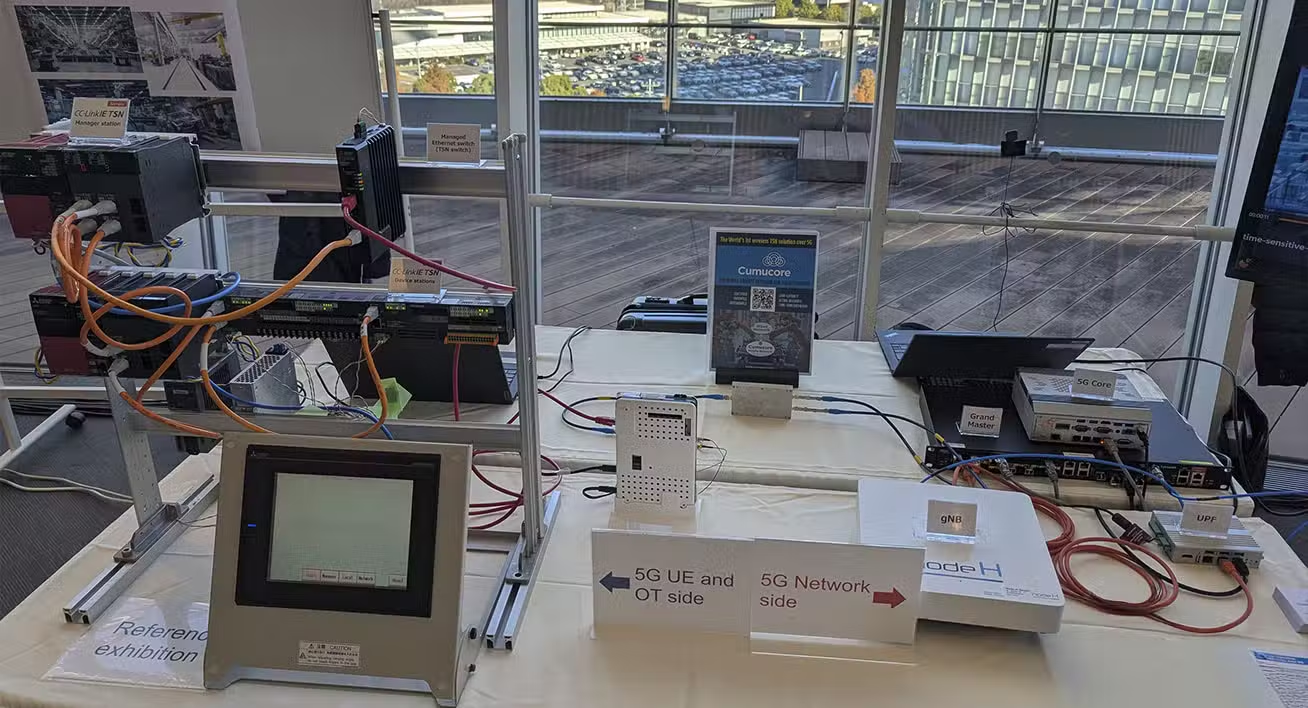
In 2025, the project integrated with Qualcomm, Node-H, Askey, and Mitsubishi Electric to build a complete end-to-end industrial ecosystem, demonstrating interoperability using only open industry standards. That work led to two public milestones: a live demonstration at the 5G-ACIA PlugFest in Helsinki on June 26, 2025, the first public demonstration of deterministic synchronization of mobile industrial devices using standardized 3GPP TSN architecture, achieving 200 ns clock synchronization accuracy over a commercial private 5G network; and a consortium demonstration with Mitsubishi Electric in Tokyo on December 4, 2025, validating interoperability between industrial TSN infrastructure and private 5G in an international, multi-vendor environment.
The solution is now transitioning from demonstration to commercial deployment, providing manufacturers with a standards-based migration path from wired Industrial Ethernet to deterministic wireless networking for the next generation of Physical AI and Industry 4.0 applications. Because the approach is based entirely on open industry standards, including 3GPP TSC, IEEE 1588 PTP, IEEE 802.1AS (gPTP), TSN, 5GLAN, and Ethernet PDU Sessions, it provides a future-proof migration path rather than requiring proprietary hardware or protocols, enabling an open ecosystem where commercial 5G infrastructure and industrial automation equipment interoperate seamlessly.
Why 5G Could Do What Wi-Fi and LTE Couldn’t
Private 5G was selected because it uses regulated frequency bands, its components are available at affordable prices, and base station output power allows covering large areas using only one radio unit. Unlike Wi-Fi or previous-generation cellular technologies, 5G has been standardized by 3GPP to support Time-Sensitive Communication, enabling industrial TSN services to operate over a wireless network. LTE provides reliable mobile broadband but was not designed to support TSN integration or the deterministic synchronization required for collaborative robotics and Physical AI.
Private 5G addresses this through standardized capabilities introduced in 3GPP Release 16 and Release 17, including Time-Sensitive Communication, 5GLAN, Ethernet PDU Sessions, NW-TT, and DS-TT, allowing the private 5G network to become an extension of the factory’s existing TSN domain rather than acting as a conventional wireless access network. A private 5G network also provides guaranteed quality of service with predictable latency, carrier-grade reliability, secure local operation with industrial data remaining on premises, seamless mobility for robots, AGVs, AMRs, drones, and humanoids, and the scalability to support thousands of connected industrial devices while maintaining predictable performance.
Cumucore, Qualcomm, Node-H, Askey, and Mitsubishi Electric: Who Built What
Cumucore developed the overall solution architecture, responsible for extending the factory’s TSN domain across the private 5G network. Cumucore designed and implemented the key software components that make deterministic wireless synchronization possible, including the NW-TT, integration with the factory’s IEEE 1588 PTP and IEEE 802.1AS timing infrastructure, support for 5GLAN and Ethernet PDU Sessions, and the timing synchronization mechanisms defined by 3GPP Release 16/17. Cumucore also developed the algorithms that compensate for jitter introduced by the 5G air interface, enabling the demonstrated 200 ns clock synchronization accuracy.
- Qualcomm. 5G device platform and chipset technology supporting Device-Side Time Synchronization (DS-TT) and advanced 5G capabilities.
- Node-H. 5G radio access network (gNB) software implementing standardized 3GPP timing functionality, including SIB9 timing distribution.
- Askey. Commercial 5G radio hardware hosting the Node-H gNB software and providing the wireless access infrastructure.
- Mitsubishi Electric. Industrial TSN switching infrastructure and automation expertise, validating interoperability between the factory TSN network and the private 5G system.
Cumucore coordinated the end-to-end integration, ensuring the private 5G Core, radio access network, industrial timing infrastructure, and factory automation systems operated as a single deterministic network, demonstrating that commercially available products from multiple vendors can interoperate using open standards rather than proprietary interfaces.