

Smart cities have a scaling problem that rarely gets discussed until it’s too late: every camera, sensor, tablet, and connected service added to public infrastructure is another endpoint that must be authenticated, governed, and secured. Add enough of them without a unified approach, and security fragments into a patchwork of one-off fixes, visibility drops, and operational risk climbs.
That is the problem the City of Brownsville, Texas set out to solve, and the solution it landed on, private 5G integrated directly with centralized identity management, is now a blueprint other municipalities and critical infrastructure operators can study.
Growth Without a Governance Model Is a Liability
As Brownsville expanded its footprint of AI-enabled cameras, public Wi-Fi, city worker devices, and operational systems, every new endpoint increased the burden of securing and governing access. Without a single, consistent identity and policy layer sitting underneath all of it, the city faced the same challenge now confronting manufacturing plants, hospitals, airports, and utilities everywhere: connectivity was expanding faster than the ability to govern it centrally, device type by device type.
The objective was straightforward to state and hard to execute: deliver the connectivity smart city services demand while giving Brownsville’s technology teams one consistent, scalable, trusted way to control who and what touches the network, regardless of whether that endpoint was a patrol vehicle tablet, a public-space camera, or a resident’s connection to municipal Wi-Fi.
One Network, One Policy Engine
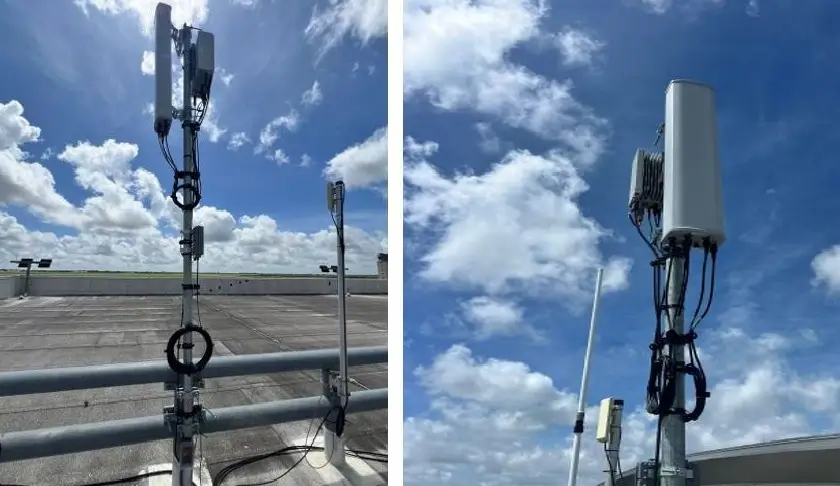
With NTT DATA’s support, Brownsville deployed a private 5G-powered smart city environment and integrated it directly with Cisco Identity Services Engine, extending the same centralized policy engine already running the city’s existing Cisco-based network into its new private 5G core.
The result is what the deployment describes as an “umbrella policy” model. Every connected device, cameras in public spaces, tablets in patrol vehicles, sensors, and public-facing systems, authenticates through one centralized system rather than a collection of siloed device-by-device controls. Access rules are defined once and applied consistently across the infrastructure, no matter what type of device is connecting or where it connects from.
Because Brownsville already ran Cisco ISE as its policy engine before this deployment, extending it into the private 5G environment let the city reuse and expand existing identity and access policies rather than standing up a parallel security architecture from scratch, a meaningfully lower-friction path than building smart city security as a bolt-on afterthought.
What Unified Identity Actually Buys a City
- Consistency. Every endpoint, regardless of type, follows the same authentication and access policy, closing the gaps that open up when security is handled inconsistently across device categories.
- Visibility. The city can see what is actually on its network and whether each endpoint complies with policy, rather than operating with blind spots across its expanding device footprint.
- Reduced operational risk. Centralizing enforcement through one policy engine removes the burden and risk of managing security device by device, and prevents unauthorized devices from reaching the network in the first place.
- Resilience under load. During high-traffic public events such as Charro Days, when public cellular networks become congested, city operations supported by private 5G continue functioning without interruption, a direct, tested advantage of dedicated infrastructure over shared public capacity.
“As Brownsville continues to grow as a prominent tech hub, the deployment of a Private 5G network is essential. This cutting-edge network will provide faster connectivity and foster the adoption of emerging technologies. By prioritizing Private 5G, we’re positioning Brownsville to stay ahead in technological innovation and economic progress.” – Jorge Cardenas, Chief Information Officer, City of Brownsville

A Blueprint Beyond City Limits
What makes Brownsville’s deployment relevant well outside municipal government is the underlying design principle: connectivity, security, and operations were built as one integrated system rather than layered on top of each other after the fact. That same challenge, expanding endpoints, AI-powered systems, and edge computing outpacing traditional security models, shows up across manufacturing, transportation, healthcare, logistics, utilities, and airports. Any organization adding large numbers of connected assets to a growing operational footprint is facing a version of the same problem Brownsville solved, which is what makes this deployment a repeatable reference point rather than a municipal-only case study.
Why This Combination Was the Right Choice
Private 5G, enabled by Cisco’s P5G Core, gave Brownsville dedicated, resilient connectivity for city operations and smart city endpoints, precisely the kind of capacity that holds up when public networks are congested during major events. Cisco ISE was the natural security choice because Brownsville was already a Cisco environment with ISE in place as its policy engine. Extending that existing engine into the private 5G core, rather than introducing a separate security architecture, meant the city could scale smart city services on infrastructure and policy it already trusted and already knew how to operate.
Company Roles
NTT DATA supported Brownsville’s smart city transformation end to end, helping deploy the private 5G-powered infrastructure and integrating Cisco ISE directly with the city’s 5G network, enabling centralized endpoint governance, consistent access policy, and stronger operational control as the city scales.
Cisco provided the technology foundation on both sides of the integration: the P5G Core powering the private 5G network itself, and Identity Services Engine, the centralized policy engine extended from Brownsville’s existing network into its new private 5G environment to unify authentication and access enforcement.