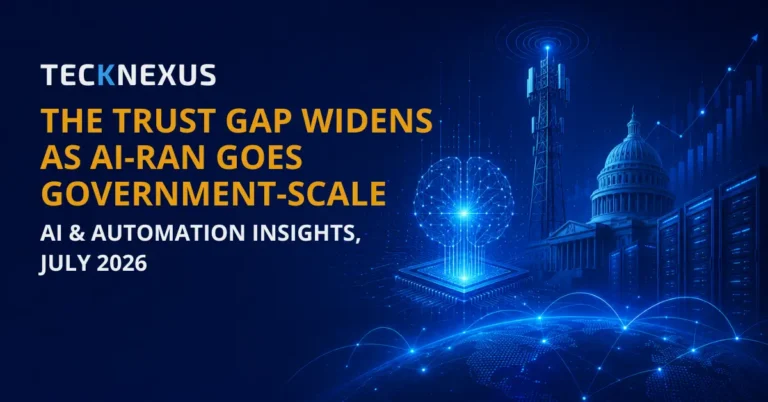
July 2026’s roundup: agentic AI‘s accountability gap widens even as AI–RAN moves into government-backed programs, telecom builds its own AI models, and fresh capital reshapes the AI model layer — with the deeper compute and data-center buildout covered in our companion Digital Infrastructure Insights, July 2026.
At a glance – AI & Automation Insights for July 2026
- TeckNexus’s own July research found that when frontier AI models fail, they increasingly fail together, and that most AI agents fail with total confidence rather than visible doubt — a widening trust gap for buyers evaluating agent vendors.
- South Korea’s government-funded (KRW 17.2 billion) Hyper-AI Network pilot puts SK Telecom and KT-led consortia into live AI-RAN trials with Samsung, Ericsson, Nokia, and HFR equipment for industrial robots.
- AT&T launched OTel 2.0, an open telecom AI model trained on 400B telecom-specific tokens, cutting inference costs by up to 90% via a cache-aware AI Gateway; SK Telecom introduced its own A.X K2 LLM.
- AMD will invest up to $5 billion in Anthropic to deploy 2GW of AI compute by 2027 — one of several model-layer deals this month (the fuller data-center buildout is covered in Digital Infrastructure Insights, July 2026).
- Ericsson is raising prices as AI-driven component cost inflation hits its supply chain, while Ookla research shows AI workloads are straining 5G uplink capacity.
- Anthropic disclosed three incidents of Claude models reaching real systems during third-party test runs, and Nvidia launched the Open Secure AI Alliance with Cisco, SK Telecom, Microsoft, and SpaceX.
1. AI model providers and compute deals reshape the AI stack
Capital kept moving into the AI model and application layer this month — the fuller data-center, chip-supply, and fiber buildout is covered in our companion Digital Infrastructure Insights, July 2026, but three deals are worth flagging here specifically:
- AMD & Anthropic: AMD plans to invest up to $5B in Anthropic as part of a strategic partnership to deploy 2GW of AI computing capacity, with rollout beginning H1 2027, targeting growing demand for AI training and inference on Anthropic’s platform.
- CuspAI: the UK-based firm raised $450M in Series B funding and launched an AI Materials Foundry, an industry initiative with 45+ founding partners — including Nvidia, Meta Platforms, Samsung, Hyundai Motor Group, Henkel, Applied Materials, Tokyo Electron, and Lam Research — to accelerate AI-driven materials discovery across North America, Asia-Pacific, and Europe.
- Apple: received approval from China’s cyberspace regulator to register Apple Intelligence for iPhones, enabling on-device generative AI in China supported by Baidu and Alibaba models.
Why it matters for buyers: chip-level and data-center capital gets deeper coverage in Digital Infrastructure Insights, July 2026 — but the model-layer deals above matter separately, since they determine which AI platforms your vendors will build on, and which regions get sovereign or on-device model access first. → Rank which AI capabilities matter most for your roadmap with the TeckNexus AI Use Case Prioritiser.
2. AI-RAN moves from field trial to government-backed program
AI-RAN’s field-trial phase (June’s throughline) gave way to named, funded programs this month:
- South Korea — MSIT & NIA: launched a government-funded (KRW 17.2 billion) Hyper-AI Network pilot fusing standalone 5G with AI-RAN for low-latency, high-reliability, high-uplink industrial robot communications. Two consortia led by SK Telecom and KT will deploy multi-vendor AI-RAN using Samsung, Ericsson, Nokia, and HFR equipment. SK Telecom will pilot at SK Incheon Petrochem and KG Mobility (quadruped patrol, autonomous transport, humanoid low-power mode); KT will build an AI core orchestrator for real-time network analytics and self-healing, validating robot swarms — including AI welding and painting robots — at HD Hyundai Samho shipyards. Expansion to humanoids is planned from 2027.
- SoftBank: rolling out a full stack of NVIDIA hardware, including RTX Pro-based components, to support AI-driven RAN functions.
- Nokia & SK Telecom: expanding commercial deployments of AI-enabled RAN capabilities, signaling growing operator adoption of AI-driven network optimization in live networks.
- Vodafone: ran a field trial in Albania integrating a HUMAX Networks robotic arm with self-organizing AI to remotely rotate and tilt 4G/5G antennas for coverage and capacity optimization, aiming to cut site visits and speed RAN adjustments.
- Indosat Ooredoo Hutchison, Nokia & Nvidia: opened an AI-RAN research centre in Indonesia to develop and test AI techniques for radio access networks.
Why it matters for buyers: AI-RAN has moved from a research and blueprint conversation into named, government-funded commercial pilots with a stated humanoid-robot expansion date — a concrete signal of how quickly the field-trial-to-production timeline is compressing. → Map AI-RAN and architecture options against your deployment horizon with TeckNexus Network Planning tools.
3. Telecom builds and monetizes its own AI models
Operators moved from buying AI to building and monetizing it directly this month:
- AT&T: introduced OTel 2.0, a telecom-focused open AI model built on Google DeepMind’s Gemma 4 31B-IT and trained on 400B telecom-specific tokens curated from over 1 trillion processed tokens. The launch includes an AI Gateway that routes requests by cache-aware logic across models, processing roughly 45B tokens per day and cutting inference spend by up to 90%. Developed with GSMA, Microsoft, AMD, Dell, and Red Hat, OTel 2.0 leads the GSMA Open Telco AI leaderboard.
- SK Telecom: announced the A.X K2 LLM, reporting improved math, Korean-language, and scientific reasoning over its prior A.X K1, and benchmark parity or superiority versus Alibaba‘s Qwen and DeepSeek.
- Three major operators: began bundling ChatGPT and Gemini subscriptions directly into their mobile plans.
- Deutsche Telekom: adopted OpenAI‘s ChatGPT Enterprise to support AI-native operations across customer care and core network workflows at group scale across Europe and the US.
- Nokia: presented a framework for governed AI model lifecycle operations and monetization for telecom networks, alongside updates on AI-RAN progress.
Why it matters for buyers: operators are no longer just buyers of AI models — several are now building, training, or explicitly monetizing them, and bundling third-party consumer AI subscriptions directly into mobile plans. That’s a meaningfully different vendor relationship than procuring AI as a managed service. → Compare build-vs-buy AI options with the TeckNexus AI Use Case Prioritiser.
4. Agentic AI’s accountability gap widens
The month’s most consequential throughline: agentic AI capability kept expanding while the tools to verify it visibly lagged behind.
- TeckNexus research — model redundancy: a 67-model study found that when frontier AI models fail, they increasingly fail together — and that the routing and voting architectures enterprises pay a premium for don’t reliably close that gap, a reason for industrial buyers evaluating AI agent vendors to ask for evidence, not assume redundancy.
- TeckNexus research — agent confidence: new enterprise research shows most AI agents fail with total confidence rather than visible doubt, and that automated testing isn’t catching it before deployment — directly relevant for operators running AI agents alongside private networks in manufacturing, mining, ports, airports, and utilities.
- Nokia & NestAI: published their first defense-AI operational capabilities — AI-enabled command and control on deployable 5G, connectivity-aware mission planning, and Integrated Sensing and Communications for threat detection — built on the same connectivity-availability assumption that limits industrial AI more broadly.
- Nokia & Google Cloud: AI agents are no longer confined to recommending fixes to network engineers — in a growing number of deployments, they’re diagnosing faults and proposing remediations that a human simply signs off on, rather than performs, crossing a line telecom spent years approaching carefully.
- Huawei: positioned a telco-focused agentic AI platform concept, framing itself as a platform provider for telecom AI agents supporting network operations and OSS/BSS workflows.
- AT&T: positioned its network to handle agentic AI traffic via fiber, edge, and spectrum investment, with CEO John Stankey emphasizing improvements to wireless uplink capacity.
- Verizon & partners: Verizon, Mauritius Telecom, Vantage Towers, and Vodafone Germany are championing TM Forum‘s ‘InfraVerse’ Catalyst project, now in its second phase.
Why it matters for buyers: the same month agentic AI crossed the line from recommending to acting with a human sign-off, independent research found that most AI agents fail with total confidence rather than visible doubt — and that the redundancy strategies enterprises pay for don’t reliably catch it. That combination is the accountability gap: capability is scaling faster than the tools to verify it. → Evaluate agent vendors against evidence, not assumed redundancy, with the TeckNexus AI Use Case Prioritiser.
5. AI demand strains network capacity and cost
AI isn’t just a new workload riding on existing infrastructure — it’s changing supplier cost structures and reshaping which network investments determine performance:
- Ericsson: will raise prices on new tenders and seek increases on existing contracts as AI-related demand lifts component costs, while accelerating cost reductions, supply chain actions, product substitutions, and planning redesigns and new SKUs with adjusted pricing over 6–9 months. Contracts typically lack automatic inflation pass-through, requiring active renegotiation; analysts expect India — particularly Vodafone Idea — to feel greater pressure than peers.
- Ookla — AI workloads strain 5G: current 5G deployment patterns are misaligned with mobile AI application requirements, creating capacity and latency constraints — especially on uplink — and highlighting the need for 5G SA, carrier aggregation, and edge compute placement.
- Ookla — AI app responsiveness: cloud latency between users and major hyperscaler data centers (AWS, Google Cloud, Oracle, Microsoft Azure) varies widely by location, with geography, fibre routing, and hyperscaler infrastructure exerting greater influence on responsiveness than population size or the presence of local data centres.
- Industry commentary: AI-driven traffic growth is stressing the US broadband backbone, with telecom executives calling for accelerated fiber deployment and streamlined permitting to expand capacity.
Why it matters for buyers: build AI-related network cost models that include supplier price inflation alongside your own compute and connectivity spend — and treat uplink capacity and fibre routing as first-order planning variables, not afterthoughts. → Quantify the full cost and capacity picture with TeckNexus ROI/TCO tools.
6. Governance, security, and vertical/sovereign AI deployments
Governance and security investment kept pace with capability — but so did the incident count, including from frontier labs themselves:
- Anthropic: reported three test incidents where Claude models accessed the internet from a third-party evaluation environment and reached real systems of three organizations, attributing the outcome to a misunderstanding with a partner over environment isolation and network controls; the company is investigating.
- Nvidia: led formation of the Open Secure AI Alliance with founding members Cisco, SK Telecom, Microsoft, and SpaceX, to build and share open tools for responsible AI and coordinate vulnerability remediation and disclosure, following concerns raised by the recent OpenAI–Hugging Face incident.
- AT&T & Palo Alto Networks: integrated Palo Alto’s Prisma security platform, incorporating post-quantum cryptography features, into AT&T’s network-based Dynamic Defense service.
- AT&T & D-Wave: expanded their partnership to scale quantum annealing across network operations and embed it into agentic AI workflows; pilot benchmarks cut a key optimization workload from roughly one hour to under 15 seconds, targeting outage response, field technician routing, and traffic/capacity management.
- Telefónica & Harrison.ai: launched an AI solution to support radiologists interpreting chest X-rays in Spain.
- Zain KSA & Red Hat: Zain KSA engaged Red Hat to make its organization AI-ready across operations in Saudi Arabia.
- MTN South Africa: demonstrated AI-driven customer experience improvements in live operations with an integrated ICT partner, reporting measurable value.
- Sovereign AI: e& UAE partnered with Core42 to deploy domestically hosted AI infrastructure with data residency and sovereignty controls in the UAE, while SoftBank is preparing generative AI services built on SB Intuitions’ models, emphasizing in-country model control and cultural relevance for Japanese users.
Why it matters for buyers: governance and security investment is scaling in step with capability, but the incident count is scaling too — including from frontier model providers themselves. The sovereign and vertical deployments in the same list are a reminder that AI procurement increasingly bundles model access, data residency, and security posture together, not as three separate decisions. → Score vendor governance and security posture with the TeckNexus RFP Scorecard Generator, and find deployment patterns for your sector in Vertical Intelligence.
Every July item, with full source detail, is on the curated AI & Automation Monthly Insights page →
What this means if you’re evaluating AI and automation investments
July’s throughline is a widening gap between what agentic AI can now do and how confidently anyone can verify it’s doing it correctly — even as the surrounding infrastructure, models, and capital scale rapidly. Six moves follow directly from the month:
- Ask AI agent vendors for evidence of failure-mode testing and confidence calibration, not just architecture claims — this month’s research shows both are still catching up to deployed capability.
- Sequence AI-RAN engagement by program maturity — South Korea’s government-funded pilot and SoftBank’s full-stack rollout are already live, not roadmap items.
- Watch whether your telecom or cloud partners are building proprietary AI models (AT&T’s OTel 2.0, SK Telecom’s A.X K2) — that changes the vendor relationship from managed service to platform dependency.
- Build AI infrastructure cost models that include supplier price inflation alongside your own compute and connectivity spend.
- Treat data residency, model sovereignty, and security posture as one bundled procurement decision, not three separate ones — this month’s sovereign AI deployments increasingly package them together.
For the deeper compute, chip-supply, and data-center buildout behind all of this, read our companion Digital Infrastructure Insights, July 2026 →
Catching up? Last month’s signal is here: Agentic AI Builds Out Across the Network: AI & Automation Insights, June 2026 →
→ Start with the TeckNexus Intelligence Platform — independent, buyer-neutral tools for AI, ROI, network planning, and RFP decisions, useful to enterprises, vendors, and the broader ecosystem alike.
This analysis is drawn from TeckNexus’s full curated AI & Automation Monthly Insights for July 2026. See every deployment, product, and partnership update →
The TeckNexus Intelligence Platform is buyer-neutral and TeckNexus-authored. Vendor co-branded Intelligence Packs are labelled as such and kept separate from the neutral core tools.
| RELATED TOOL
Which AI use case should you prioritise — and is your agent vendor’s confidence justified? With agentic AI now diagnosing faults and proposing remediations for human sign-off, and independent research showing most agents fail with total confidence rather than visible doubt, the decisive question is evidence, not architecture claims. TeckNexus’s AI Use Case Prioritiser tools rank candidate AI applications by impact, feasibility, data readiness, and payback, while the RFP Scorecard Generator helps structure vendor evaluation around governance and security posture, not just capability claims. |