Robotic

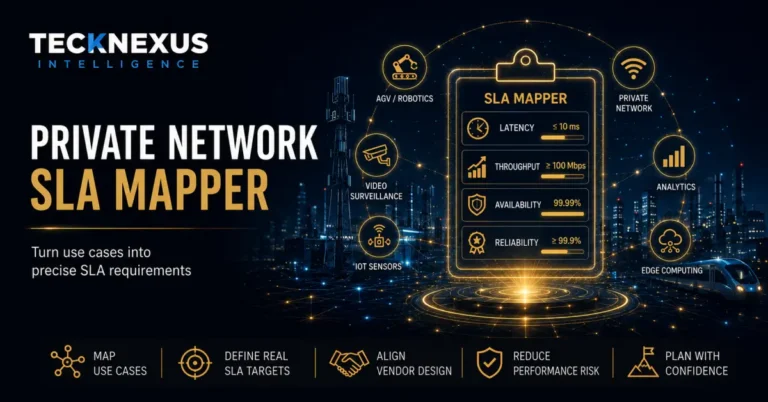
A 99.99% uptime SLA means nothing if it does not reflect what your critical use cases actually require. The TeckNexus Private Network SLA Mapper translates your operational requirements — AGV control, video surveillance, IoT sensing - into the precise latency, throughput, and reliability parameters your vendor must design to.
T-Mobile Czech Republic's Technology Innovations Day 2026 delivered live operational proof that 5G Standalone architecture is no longer a roadmap item. Running entirely on 5G SA infrastructure at the Magenta Experience Center in Prague, demonstrations spanned autonomous robotics, tele-surgery with military hospitals, AI-powered AR wearables, live field broadcasting, and quantum state transfer over existing fiber. For enterprise decision-makers evaluating private network investments or industrial automation strategies, the event confirmed that 5G SA now meets the reliability, latency, and isolation requirements of mission-critical operations across multiple verticals.
NTT DATA’s private 5G rollout across 50 Cargill facilities signals that industrial connectivity is moving from pilot projects to standardized, multi-site execution. NTT DATA has deployed private 5G at Cargill manufacturing and processing locations worldwide—mostly in the United States with live sites in Europe—enabling a connected workforce, robotics, and edge AI across plants that are often too large and complex for conventional Wi‑Fi or wired networks to cover reliably. Manufacturers are consolidating on common digital platforms and need predictable, low-latency wireless for operational data, mobile human–machine interfaces, and autonomous systems; private 5G—built on 3GPP standards with SIM-based security and policy-based QoS—offers deterministic performance at scale where legacy networks struggle.
A new collaboration between GSMA Foundry and Singapore’s National University Health System (NUHS) aims to operationalize connected health at scale, with Ericsson and Singtel anchoring the 5G foundation. Healthcare digitization has moved from pilots to production, but most sites still struggle with deterministic connectivity, secure data exchange and workflow integration. The program combines private 5G with digital twin, XR, IoT and ambient AI to improve outcomes and operational resilience across care pathways. Early focus areas include 5G-enabled remote surgical assistance with ultra-reliable, low-latency links; immersive XR training and simulation that compress learning curves; autonomous and semi-autonomous robotics for logistics and point-of-care tasks; and AI-guided imaging such as vein visualization.
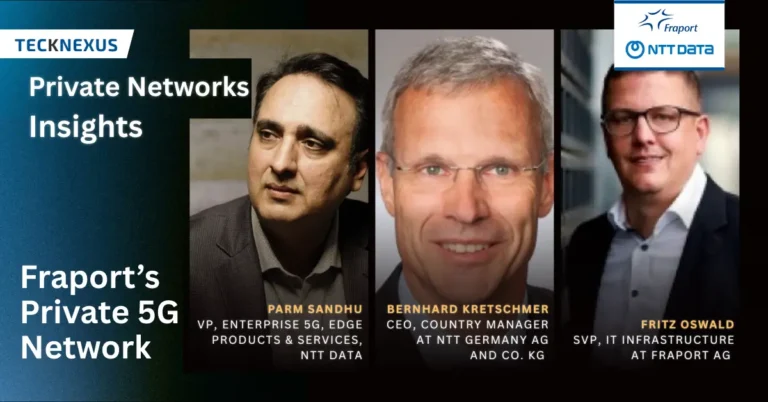
Winner – Private Network Excellence in Airports, NTT DATA, in partnership with Fraport and Nokia is transforming Frankfurt Airport with one of the world’s largest private 5G networks. By integrating AI and edge computing, the network supports real-time communication, autonomous systems, predictive maintenance, and smart ground operations. Fraport is laying the groundwork for a scalable, future-ready airport infrastructure that benefits airlines, partners, and passengers.
Hyundai Motor Group and NVIDIA are expanding their partnership to build a large-scale “physical AI” stack that fuses autonomous driving, smart factories, and robotics with national-scale infrastructure in Korea. The companies plan to stand up an AI factory built on 50,000 NVIDIA Blackwell GPUs to unify model training, validation, and deployment across vehicles and plants. Backed by an approximately $3 billion public–private investment, the effort includes a Physical AI Application Center, an NVIDIA AI Technology Center, and regional data centers developed in concert with Korea’s Ministry of Science and ICT.
Amazon is piloting AI-enabled smart glasses for delivery associates to streamline last‑mile workflows, adding a hands‑free heads‑up display that blends navigation, scanning, and proof‑of‑delivery into the driver’s field of view. The company is testing delivery‑specific smart glasses that use on‑device computer vision and AI to identify packages, surface hazards, and guide walking routes from the vehicle to the doorstep without requiring a phone in hand. When a van is parked, the device activates and shows the next task: find the right parcel in the vehicle, traverse complex environments like multi‑unit buildings, and confirm delivery with visual capture.
Arm has expanded its Flexible Access licensing model to include its Armv9 edge AI platform, lowering the cost and friction for OEMs and startups to develop on-device AI at scale. The platform combines the ultra‑efficient Arm Cortex‑A320 CPU with the Arm Ethos‑U85 NPU, enabling on‑device inference for models with roughly billion‑parameter complexity while maintaining tight power budgets. Security is a first‑class feature set, with architectural protections such as Pointer Authentication, Branch Target Identification, and Memory Tagging to harden critical software at the edge. Availability is staged: Cortex‑A320 will enter Flexible Access in November 2025, followed by Ethos‑U85 in early 2026.
Qualcomm is acquiring Arduino to anchor an end-to-end developer funnel from hobbyist prototypes to commercial robots and industrial IoT systems. As part of the announcement, Arduino introduced the Uno Q, a new board priced around $45–$55 featuring Qualcomm’s Dragonwing QRB2210 processor that runs Linux alongside Arduino tooling and supports vision workloads. By meeting developers at the prototyping bench and offering an upgrade path to production-grade SoCs and modules, Qualcomm aims to convert experimentation into long-term silicon design wins. The Arduino tie-up broadens access to Qualcomm compute for small teams while reinforcing an ecosystem play that spans on-device AI, connectivity, and lifecycle operations at the edge.
Meril Life Sciences, headquartered in Vapi, Gujarat, has introduced the Mizzo Endo 4000, a soft tissue robotic platform engineered for general, urology, gynecology, thoracic, colorectal, bariatric, hepatobiliary, ENT, gastrointestinal, and oncology procedures. Built and designed in India, the system targets precision, access, and cost barriers that have historically limited adoption. It pairs AI-powered 3D anatomical mapping with an open console design and immersive visualization, while enabling remote collaboration and telesurgery over high-performance 5G networks. Strategically, this positions India to compete with incumbent systems from Intuitive Surgical, Medtronic, and CMR Surgical, while appealing to price-sensitive markets across Asia and Africa.
Beijing's first World Humanoid Robot Games is more than a spectacle. It is a live systems trial for embodied AI, connectivity, and edge operations at scale. Over three days at the Beijing National Speed Skating Oval, more than 500 humanoid robots from roughly 280 teams representing 16 countries are competing in 26 events that span athletics and applied tasks, from soccer and boxing to medicine sorting and venue cleanup. The games double as a staging ground for 5G-Advanced (5G-A) capabilities designed for uplink-intensive, low-latency, high-reliability robotics traffic. Indoors, a digital system with 300 MHz of spectrum delivers multi-Gbps peaks and sustains uplink above 100 Mbps.
At SIGGRAPH 2025, NVIDIA unveiled Omniverse NuRec libraries for high-fidelity 3D world reconstruction, Cosmos AI foundation models for reasoning and synthetic data generation, and powerful RTX PRO Blackwell Servers with DGX Cloud integration. Together, these tools aim to speed the creation of digital twins, enhance AI robotics training, and enable scalable autonomous system deployment.

Your Brand. Our Intelligence Tools.

Capture leads at the point of evaluation. Talk to Us →

Sponsored by Palo Alto Networks
⚡ Utilities ⏱ 8 min ✓ Free
This tool is built and hosted by TeckNexus.
Launch Tool →
Whitepaper
This whitepaper explains how utilities can use secure AI-enabled private mobile networks to modernize operations, support distributed intelligence, improve resilience, and strengthen cybersecurity across critical infrastructure. It covers AI applications, private network advantages, zero trust principles, multilayered security architecture, and governance considerations for AI-ready utility environments....
Whitepaper
Non-terrestrial networks are rapidly evolving from experimental satellite systems into an increasingly important part of the global 5G connectivity landscape. This eBook, developed by Radisys in collaboration with TeckNexus, explores how 3GPP standardization, satellite architecture innovation, and software-driven network design are reshaping NTN deployment models. It examines the transition from...
Whitepaper
Private cellular networks are transforming industrial operations, but securing private 5G, LTE, and CBRS infrastructure requires more than legacy IT/OT tools. This whitepaper by TeckNexus and sponsored by OneLayer outlines a 4-pillar framework to protect critical systems, offering clear guidance for evaluating security vendors, deploying zero trust, and integrating IT,...
Scroll to Top

Map your security gaps to real threat scenarios – including Salt Typhoon, Volt Typhoon, AI data poisoning, rogue devices, and unencrypted OT traffic.

Take the free 8-minute assessment built for utility operators evaluating AI-enabled private mobile networks. Get a readiness score across five critical domains, see where your gaps are, and receive a prioritized action plan for what to fix first.

Free • 8 minutes • Built for private network security