Alibaba

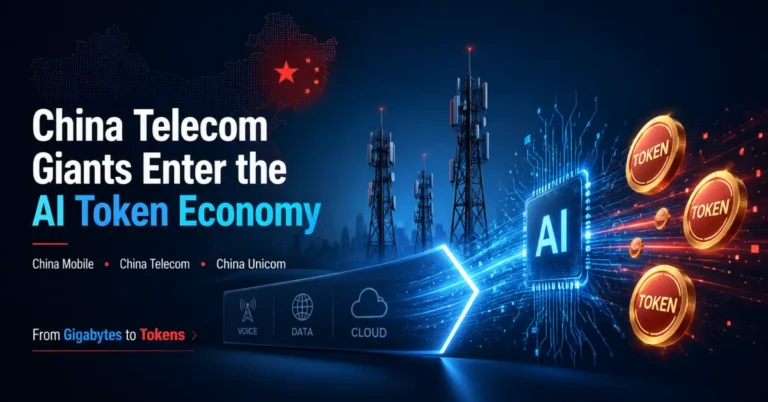
China Telecom, China Mobile, and China Unicom have each unveiled token-based service plans, ecosystem alliances, and commercial pricing structures that reframe what it means to be a telecom provider in the AI era. This is not a pilot program or a speculative roadmap. It is a structural shift in how network operators intend to generate revenue, compete for enterprise customers, and position themselves at the center of the AI economy — driven by a greater than 1,000-fold surge in daily token consumption across China between early 2024 and March 2026.
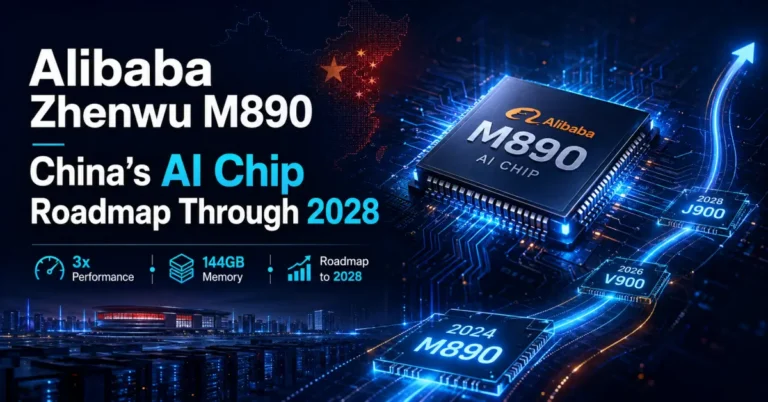
Alibaba's Zhenwu M890 AI accelerator, developed by chip unit T-Head, delivers approximately three times the performance of its predecessor and features 144GB of on-chip memory purpose-built for agentic AI workloads. Backed by a $53 billion infrastructure commitment and a published roadmap extending to the J900 chip in 2028, Alibaba is building sovereign AI infrastructure from silicon to software. With over 560,000 chips shipped to 400-plus customers across 20 industries, this is a commercially validated platform — not a prototype — signaling a maturing Chinese AI hardware ecosystem.
South Korea is funding a national AI stack to reduce dependence on foreign models, protect data, and tune AI to its language and industries. The government has committed ₩530 billion (about $390 million) to five companies building large-scale foundation models: LG AI Research, SK Telecom, Naver Cloud, NC AI, and Upstage. Progress will be reviewed every six months, with underperformers cut and resources concentrated on the strongest until two leaders remain. The policy goal is clear: build world-class, Korean-first AI capability that supports national security, economic competitiveness, and data sovereignty. For telecoms and enterprise IT, this is a shift from “consume global models” to “operate domestic AI platforms” integrated with local data, compliance, and services.
Alibaba Cloud is integrating Nvidia’s Physical AI toolchain into its Cloud Platform for AI, bringing robotics-grade simulation, training, and deployment capabilities to customers. Alibaba and Nvidia unveiled a partnership that embeds Nvidia’s embodied AI development tools directly into Alibaba’s machine learning platform. The integration targets robotics, autonomous driving, and “connected spaces” such as warehouses and factories. Physical AI refers to software that models the real world in 3D, generates synthetic data, and trains control policies with reinforcement learning before deploying to physical systems. Developers on Alibaba Cloud gain access to toolchains for data processing, simulation-based training, and real-world reinforcement learning.
African AI Compute Is Moving Local. Telecom operators and digital infrastructure players are racing to stand up AI-grade capacity on the continent as demand, latency, and data-sovereignty pressures converge. MTN Group is negotiating with US and European partners to co-invest in AI-ready facilities and offer capacity to enterprises across multiple African markets. Cassava Technologies is accelerating its sovereign cloud strategy with five AI-focused facilities slated across key African markets in the next 12 months. Earlier this year, Cassava partnered with Nvidia to launch an AI data centre in South Africa powered by the chipmaker’s GPUs, establishing a reference for accelerated infrastructure on the continent.
Nvidia has reportedly paused production activities tied to its H20 data center AI GPUs for China as Beijing intensifies national-security scrutiny, clouding a long-anticipated reentry into the market. Multiple suppliers have been asked to suspend work related to the H20, Nvidia's made-for-China accelerator designed to meet U.S. export rules. The pause arrives shortly after Washington signaled it would grant export licenses for the H20, reversing an earlier halt that triggered unsold inventory write downs at Nvidia. The H20 is Nvidia's linchpin for retaining a foothold in the worlds second-largest AI market; any prolonged disruption has material revenue and ecosystem consequences.
Alibaba Cloud’s Qwen2.5-Max is the latest AI model shaking up the industry, competing directly with GPT-4o, DeepSeek-V3, and Llama-3.1-405B. Featuring a cost-efficient Mixture-of-Experts (MoE) architecture, Qwen2.5-Max lowers AI infrastructure costs by up to 60% while excelling in reasoning, coding, and mathematical tasks. As China’s AI sector accelerates, this release highlights a shift from brute-force computing to efficiency-driven AI innovation, challenging U.S. and Chinese tech giants alike.
DeepSeek AI has emerged as a major competitor to OpenAI, offering a low-cost, efficient AI chatbot that has soared to the top of the Apple App Store. Founded in China, DeepSeek’s compute-efficient AI models, aggressive pricing, and open-source approach have disrupted the industry. With AI advancements like DeepSeek-R1 for reasoning tasks and Janus Pro for AI image generation, the startup is reshaping the global AI race—but also raising concerns about cybersecurity, U.S. AI leadership, and regulatory oversight.

Your Brand. Our Intelligence Tools.

Capture leads at the point of evaluation. Talk to Us →

Sponsored by Palo Alto Networks
⚡ Utilities ⏱ 8 min ✓ Free
This tool is built and hosted by TeckNexus.
Launch Tool →
Whitepaper
This whitepaper explains how utilities can use secure AI-enabled private mobile networks to modernize operations, support distributed intelligence, improve resilience, and strengthen cybersecurity across critical infrastructure. It covers AI applications, private network advantages, zero trust principles, multilayered security architecture, and governance considerations for AI-ready utility environments....
Whitepaper
Non-terrestrial networks are rapidly evolving from experimental satellite systems into an increasingly important part of the global 5G connectivity landscape. This eBook, developed by Radisys in collaboration with TeckNexus, explores how 3GPP standardization, satellite architecture innovation, and software-driven network design are reshaping NTN deployment models. It examines the transition from...
Whitepaper
Private cellular networks are transforming industrial operations, but securing private 5G, LTE, and CBRS infrastructure requires more than legacy IT/OT tools. This whitepaper by TeckNexus and sponsored by OneLayer outlines a 4-pillar framework to protect critical systems, offering clear guidance for evaluating security vendors, deploying zero trust, and integrating IT,...
Scroll to Top

Map your security gaps to real threat scenarios – including Salt Typhoon, Volt Typhoon, AI data poisoning, rogue devices, and unencrypted OT traffic.

Take the free 8-minute assessment built for utility operators evaluating AI-enabled private mobile networks. Get a readiness score across five critical domains, see where your gaps are, and receive a prioritized action plan for what to fix first.

Free • 8 minutes • Built for private network security