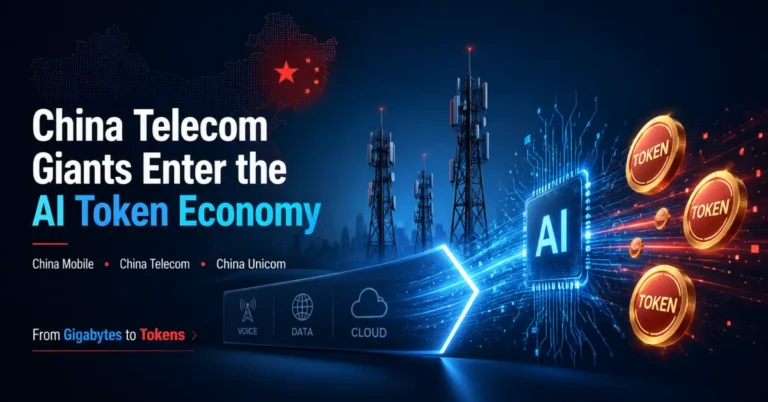
China’s three state-owned telecom giants — China Telecom, China Mobile, and China Unicom — have made a coordinated and consequential pivot. Within the span of a single week, all three operators unveiled token-based service plans, ecosystem alliances, and commercial pricing structures that reframe what it means to be a telecom provider in the AI era. This is not a pilot program or a speculative roadmap. It is a structural shift in how network operators intend to generate revenue, compete for enterprise customers, and position themselves at the center of the AI economy.

From Gigabytes to Tokens: How Telecoms Are Redefining Their Billing Unit
The strategic logic behind the token economy mirrors the industry’s last major monetization transition, and understanding that parallel is essential for anyone tracking where telecom revenue is headed.
Why Telecoms Are Positioned to Lead the Token Economy
Two decades ago, voice and SMS revenues were being eroded by over-the-top players. Operators responded by pivoting to mobile data, packaging megabytes and gigabytes as the new billable unit. That transition sustained the industry for a generation. Now, with data commoditized and pricing pressure intense, operators face the same structural threat from AI platforms that could bypass them entirely. Selling AI tokens — the basic units of text, code, or data that a model processes or generates — is the industry’s answer. As one academic framing puts it, operators are already experts at metering usage, and extending that competency to tokenized AI consumption is a natural and defensible move.
The Demand Surge Making Token Monetization Commercially Urgent
The scale of token consumption in China makes the commercial case urgent. According to data from China’s National Data Administration, average daily token usage surged from 100 billion at the start of 2024 to 140 trillion by March 2026 — a greater than 1,000-fold increase in roughly two years. That kind of demand curve demands infrastructure, distribution, and billing architecture that hyperscalers alone cannot efficiently serve at a national scale. Telcos, with their existing compute assets, broadband networks, and billing relationships, are well-positioned to fill that gap — if they move fast enough.
China Telecom, Mobile, and Unicom: Three Distinct AI Token Strategies
While the strategic direction is shared, each operator is deploying a distinct go-to-market posture that reflects their infrastructure strengths and customer base priorities.
China Telecom’s Token Alliance and Tiered AI Subscription Model
China Telecom has moved most aggressively, launching a national commercial trial with tiered subscription plans spanning individual consumers, developers, and small businesses. Consumer packages start at 9.9 yuan per month for 10 million tokens, scaling to 49.9 yuan for 80 million tokens. Enterprise and developer tiers reach up to 299.9 yuan monthly for 250 million tokens, with optional add-ons including enhanced broadband uplink speeds and security services. Critically, China Telecom is not just selling token access — it is bundling its own AI model, Telechat, alongside third-party models including DeepSeek, and has launched a Token Ecosystem Alliance to anchor its position across the full token value chain, from production to distribution. With 440 million mobile subscribers and 202 million fixed broadband customers, the operator has the distribution footprint to make this more than a niche offering.
How China Mobile Is Cutting Per-Token Costs Through Platform Consolidation
China Mobile is pursuing a regional pilot strategy backed by significant group-level coordination. In Shanghai, it partnered with Tencent to launch an AI-native workspace platform offering tokens at roughly 0.14 USD per 400,000 units, billed directly through mobile accounts. In Beijing, entry-level compute packages start at 5.99 yuan. More strategically, at its 2026 Mobile Cloud Conference, China Mobile unveiled a token operations ecosystem alliance with seven partners including Alibaba, Tencent, and Huawei, integrating approximately 300 AI models into a centralized platform. The operator claims this centralized approach can reduce per-token costs by around 30% — a meaningful competitive lever as pricing pressure in AI services intensifies.
China Unicom’s Focus on Micro-Enterprises and AI-Native Workflows
China Unicom is taking a more targeted approach, focusing on emerging AI-driven usage scenarios and underserved business segments. In Shanghai, it is offering one-person company users a free trial allocation of 30 million tokens, bundled with AI cloud desktop access and its Uniclaw platform. In Hubei, tiered packages range from 6 million to 18 million tokens, priced between 7.5 yuan and 359 yuan monthly. The strategy signals an intent to capture the growing segment of micro-enterprises and solo operators who need AI tooling but lack the procurement infrastructure of larger organizations.
What the Token Economy Means for Global Operators and Enterprise Buyers
What is unfolding in China is not an isolated market experiment — it is a preview of the competitive and architectural decisions that operators worldwide will face within the next 12 to 24 months.
Beyond Connectivity: Telecoms as AI Service and Metering Platforms
The token economy positions telecom operators not merely as connectivity pipes but as AI service platforms — entities that meter, manage, and monetize intelligence at scale. Reliance Jio‘s leadership has already signaled a similar ambition, with a stated goal of becoming one of the first scalable token service providers globally. T-Mobile‘s CTO has gone further, articulating a vision for “kinetic tokens” that will power physical AI systems — autonomous machines, robots, and intelligent infrastructure — requiring the low-latency, high-bandwidth capabilities that only AI-native networks can deliver. These are not distant concepts; they are near-term architectural requirements.
Token Bundles and Model Governance: Key Considerations for Enterprise IT
For enterprise IT buyers and solution architects, the emergence of operator-grade token plans introduces a new procurement category. Token bundles tied to connectivity, security, and compute create integrated service packages that could simplify AI deployment for mid-market and SME customers who currently navigate a fragmented vendor landscape. The bundling of models like DeepSeek into telco-managed plans also raises questions about model governance, data residency, and enterprise control that procurement teams will need to address. For those building AI-native applications or agent-based workflows, the cost-per-token economics offered through telco channels — especially at the scale China Mobile is targeting — may become a legitimate alternative to direct API consumption from AI platform providers.
The Hyperscaler Risk: Will Telecoms Own the Token Value Chain or Distribute It
The most significant strategic risk for operators entering the token economy is the same one they faced with cloud: the AI companies they are distributing may ultimately compete with them directly. Operators bring metering expertise, trusted billing relationships, and network integration — but AI model providers bring the core intelligence layer. How that value chain divides over time will define whether telcos become central players in the token economy or revert to being distribution infrastructure for someone else’s margin.
China’s operators have placed their bets. The rest of the industry is watching closely.