Discovery

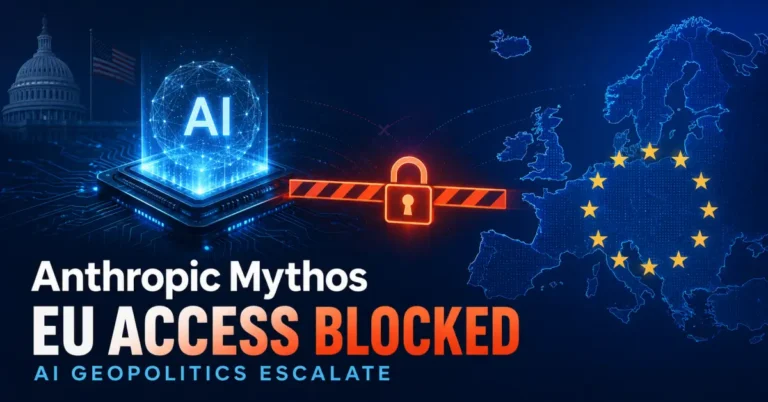
Anthropic's Mythos model, launched under Project Glasswing in April 2026, has exposed critical fault lines in how allied governments coordinate on AI safety and access. The White House controls who receives access beyond U.S. borders, with the European Commission told it must seek U.S. permission before any access is granted. For European enterprises and telecom operators, this creates a structural challenge: holding regulatory authority over AI through the EU AI Act while lacking direct visibility into the frontier models they are tasked with overseeing.
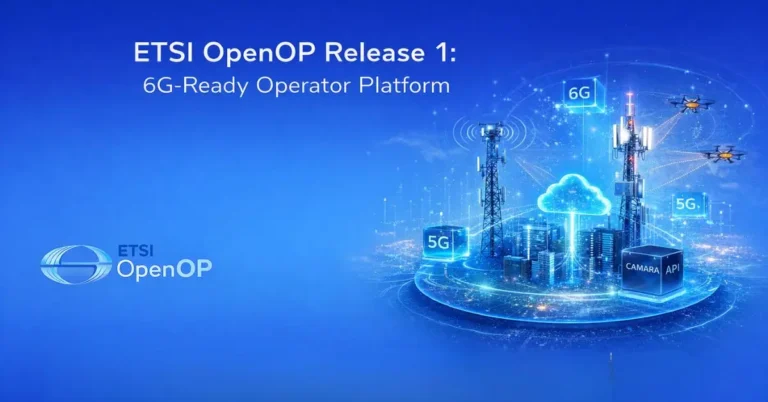
ETSI has introduced OpenOP Release 1 as an open-source operator platform for telco cloud, designed to standardize capability exposure and federation at the edge while creating a practical bridge from 5G-Advanced to early 6G experimentation. Networks are becoming software-first and distributed, but operators still face fragmented exposure of network capabilities and inconsistent approaches to multi-operator edge. OpenOP targets this gap with a standards-aligned, open implementation that lets developers consume telecom capabilities via CAMARA APIs and deploy applications across federated edge zones. Release 1 provides a working, end-to-end baseline with integrated components for exposure, orchestration, federation, and AI-assisted intent, suitable for hands-on testing and integration.
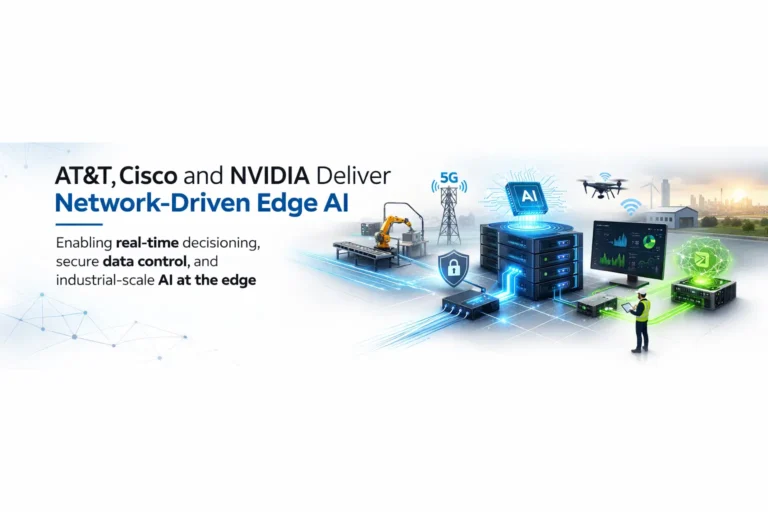
AT&T’s new collaboration with Cisco and NVIDIA signals a decisive shift from cloud-centric AI to network-driven edge intelligence for enterprise operations. Enterprises want real-time decisioning without shipping sensitive data to distant clouds, and operators need a scalable way to deliver it. By combining AT&T’s dedicated IoT core with Cisco’s mobility services platform and NVIDIA-powered AI infrastructure, the trio is packaging deterministic connectivity, near-device inference, and policy enforcement into a single, operator-grade platform. The promise: lower latency, tighter data control, and a path to production for AI at industrial scale.
Deutsche Telekom, Orange, Telefónica, TIM, and Vodafone unveiled a live, pan‑European edge federation at MWC 2026, marking a practical step toward an interoperable edge cloud that spans national borders. The five largest European operators demonstrated the European Edge Continuum, a federated edge capability now running in lab and pre‑production environments. The initiative provides a single entry point to deploy and manage applications across multiple operators’ edge nodes, with automated placement, security controls, and mobility‑aware continuity. The platform draws on components developed under the IPCEI‑CIS program backed by the EU’s NextGenerationEU funds, and is positioned for industrialization and commercial rollout next.
Anthropic has introduced Claude Code Security, an AI capability that reviews codebases, flags complex vulnerabilities, and proposes patches with human oversight, and its early results should change how security leaders plan for AI on both offense and defense. Anthropic reports that its latest Claude Opus 4.6 model helped uncover more than 500 vulnerabilities in production open-source projects, including issues that had persisted for years. The product centers on high-signal findings, structured triage, and human-in-the-loop remediation so it can slot into existing DevSecOps workflows.
Cognizant is expanding its partnership with Google Cloud around Gemini Enterprise and Google Workspace, and it is putting real skin in the game by rolling out this stack internally to boost productivity and delivery velocity. The company is forming a dedicated Gemini Enterprise Center of Excellence and codifying repeatable delivery with an Agent Development Lifecycle that embeds AI across design, build, validation, and production. It is also packaging accelerators—Cognizant Ignition for discovery and data readiness and Cognizant Agent Foundry for no-code, pre-configured agents targeting use cases like AI-powered contact centers and intelligent order management.
Liberty Global and Google Cloud have signed a five-year agreement to deploy AI at scale across Liberty Global’s European footprint and to advance hybrid cloud, autonomous networks, and new go-to-market plays. The partnership spans roughly 80 million fixed and mobile connections across Liberty Global’s operating companies, including Virgin Media O2 in the UK, Telenet in Belgium, VodafoneZiggo in the Netherlands, Virgin Media in Ireland, and Sunrise in Switzerland. On the network side, the companies will co-develop AI-first programs aimed at reliability, security, scalability, and cost efficiency. Commercially, the parties will target SMEs with a joint portfolio that combines connectivity with cloud, cybersecurity, and AI services.
A long-term partnership between NVIDIA and Dassault Systèmes aims to make physics-grounded “world models” and virtual twins a mission-critical system of record for engineering, manufacturing, and the sciences. This collaboration moves beyond today’s project-level twin pilots toward industry-scale models that capture both geometry and behavior, validated against real physics and trusted industrial knowledge. The goal: use virtual environments not just to visualize, but to design, verify, and operate products and factories before steel is cut or code is deployed. The companies outlined a shared architecture spanning design, simulation, and operations.
GlobalGPT’s new mobile app signals a step change in how multimodal AI is consumed—shifting advanced reasoning, image and video generation, and research assistance into a pocketable, enterprise-ready workflow. With app availability on Google Play and support for both Android and iOS ecosystems, enterprises can plan for cross-device continuity, enabling employees to start a task on desktop and continue on mobile with minimal friction. GlobalGPT routes user prompts to advanced models such as GPT-5.2, Claude Opus 4.5, and Gemini 3 Pro to tackle analysis, explanations, and decision support beyond basic Q&A.
Comcast is recasting how it engages consumers by rolling out Xfinity Membership, a loyalty experience that ties perks and rewards to broadband, mobile, and media usage while expanding its retail footprint with new Xfinity Stores in South DeKalb, Georgia, and Chehalis, Washington. The strategy is straightforward: keep customers longer by making Xfinity more valuable the more services they use. Xfinity Membership packages ongoing perks and periodic rewards across Comcast’s portfolio, aligning incentives to broadband, Xfinity Mobile (MVNO on Verizon’s network), and NBCUniversal’s media assets such as Peacock.
A European 6G-XR consortium led by Capgemini, Ericsson, i2CAT and Vicomtech demonstrated holographic calling and edge-anchored XR services on live standalone 5G, signaling how networks will evolve to support immersive collaboration at 6G scale. The team executed end-to-end trials of real-time holographic communication and distributed XR experiences spanning edge nodes across Barcelona and Madrid. To keep spatial media stable under cell load, the partners implemented proactive congestion detection and an on-demand quality mechanism that prioritizes holographic traffic. Notably, the consortium has referenced IMS Data Channel as a vehicle to anchor real-time holographic streams within operator service frameworks.
Paramount Skydance launched a hostile, board-bypassing tender offer to acquire all of Warner Bros. Discovery (WBD) at $30 per share, valuing the company at about $108 billion on an enterprise basis. The bid arrives days after WBD agreed to sell its studio and streaming assets—including Warner Bros. studios, HBO, and Max—to Netflix in a cash-and-stock deal valued at roughly $72 billion. Paramount’s pitch: more cash, full-company certainty, and a quicker path to close. The outcome will determine control of premium U.S. content, set the pace of streaming consolidation, and ripple into network traffic, advertising markets, and device and distribution partnerships.

Your Brand. Our Intelligence Tools.

Capture leads at the point of evaluation. Talk to Us →

Sponsored by Palo Alto Networks
⚡ Utilities ⏱ 8 min ✓ Free
This tool is built and hosted by TeckNexus.
Launch Tool →
Whitepaper
This whitepaper explains how utilities can use secure AI-enabled private mobile networks to modernize operations, support distributed intelligence, improve resilience, and strengthen cybersecurity across critical infrastructure. It covers AI applications, private network advantages, zero trust principles, multilayered security architecture, and governance considerations for AI-ready utility environments....
Whitepaper
Non-terrestrial networks are rapidly evolving from experimental satellite systems into an increasingly important part of the global 5G connectivity landscape. This eBook, developed by Radisys in collaboration with TeckNexus, explores how 3GPP standardization, satellite architecture innovation, and software-driven network design are reshaping NTN deployment models. It examines the transition from...
Whitepaper
Private cellular networks are transforming industrial operations, but securing private 5G, LTE, and CBRS infrastructure requires more than legacy IT/OT tools. This whitepaper by TeckNexus and sponsored by OneLayer outlines a 4-pillar framework to protect critical systems, offering clear guidance for evaluating security vendors, deploying zero trust, and integrating IT,...
Scroll to Top

Map your security gaps to real threat scenarios – including Salt Typhoon, Volt Typhoon, AI data poisoning, rogue devices, and unencrypted OT traffic.

Take the free 8-minute assessment built for utility operators evaluating AI-enabled private mobile networks. Get a readiness score across five critical domains, see where your gaps are, and receive a prioritized action plan for what to fix first.

Free • 8 minutes • Built for private network security