ETSI OpenOP Release 1: Standardizing Edge Federation for 5G-Advanced to 6G
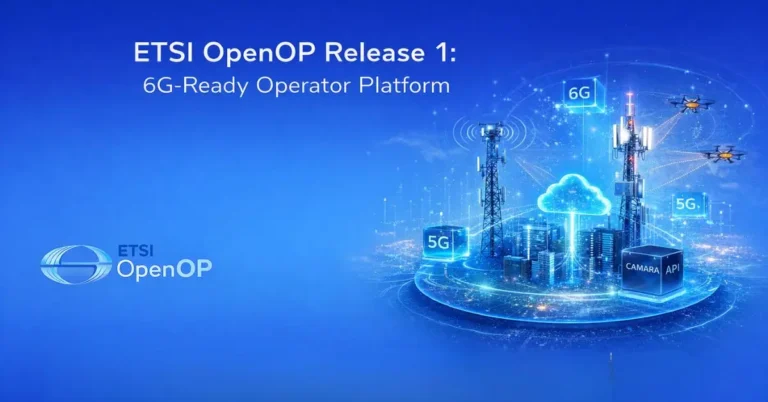
ETSI has introduced OpenOP Release 1 as an open-source operator platform for telco cloud, designed to standardize capability exposure and federation at the edge while creating a practical bridge from 5G-Advanced to early 6G experimentation.

Telco Cloud and Edge: Bridging 5G-Advanced to 6G
Networks are becoming software-first and distributed, but operators still face fragmented exposure of network capabilities and inconsistent approaches to multi-operator edge. OpenOP targets this gap with a standards-aligned, open implementation that lets developers consume telecom capabilities via CAMARA APIs and deploy applications across federated edge zones. It gives the industry a shared baseline to test cross-domain orchestration, exposure, and AI-assisted operations before moving to production-grade rollouts.
Business and Developer Impact of a Federated Operator Platform
By aligning with GSMA Operator Platform Group (OPG) specifications and integrating with Network Exposure Function (NEF) mechanisms, OpenOP helps operators standardize how they expose value-added network features. For application providers, it offers a consistent surface to build network-aware apps that leverage location, quality-on-demand, and edge proximity. This is critical to scaling new revenue models beyond connectivity and preparing for 6G-era services where federation and programmability are table stakes.
OpenOP R1 Capabilities: Exposure, Orchestration, Federation, AI
Release 1 provides a working, end-to-end baseline with integrated components for exposure, orchestration, federation, and AI-assisted intent, suitable for hands-on testing and integration.
Key Components: OEG, SRM, Federation Manager, TF-SDK, Portal, AI²
The Open Exposure Gateway (OEG) unifies access to telecom capabilities via CAMARA APIs so developers can call network and edge functions through a consistent API layer. The Service Resource Manager (SRM) handles application lifecycle and orchestrates deployments across edge cloud zones, interworking with southbound network exposure such as NEF. The Federation Manager (FM) supports multi-operator coordination, resource discovery, and cross-domain service deployment aligned with GSMA OPG East/West interfaces. A Transformation Functions SDK (TF-SDK) provides the tools and runtime to implement adapters that translate platform requests to underlying infrastructure primitives, including Kubernetes and NEF. A Portal offers a live API catalog and UI for onboarding, deployment, and monitoring. An AI module (AI²) exposes a Model Context Protocol (MCP) server and agent, enabling natural-language intents that map to CAMARA calls and southbound operations.
Standards Alignment: GSMA OPG, CAMARA APIs, 3GPP NEF
OpenOP explicitly lines up with GSMA OPG for federation and orchestration semantics, uses CAMARA for capability exposure, and integrates with 3GPP concepts through NEF. This architecture is designed to minimize lock-in, accelerate interoperability across operator domains, and give developers a predictable contract as they span multiple networks and edge locations. AI² adds intent-based operations while keeping the same standards-based control points.
Early Integrations and End-to-End Validation
Release 1 has been validated through end-to-end flows that connect all components, including integration with EURECOM’s open-source NEF and a core simulator. Initial CAMARA API coverage centers on Location and Quality on Demand (QoD), making it possible to test network-aware behaviors and verify effects through documented workflows without a full production network deployment.
Getting Started with OpenOP R1: Trials and Integration
The initial release is built for experimentation, local trials, and integration testing to collect feedback and harden the platform.
Local Deployment and Experimentation Workflows
You can deploy the entire stack locally on KIND via Helm, run quick-start onboarding, discover edge zones, register application profiles, and instantiate workloads. API users can create, query, and delete QoD sessions through the OEG and confirm network responses. The AI² interface supports natural-language prompts for selected operations, demonstrating how intent can drive CAMARA and southbound actions.
Multi-Operator Federation Trials and Resource Discovery
Where prerequisites exist, you can test early federation workflows including partner creation and accepted availability zones to validate resource discovery and cross-domain coordination. These workflows help teams evaluate inter-operator scenarios and prepare for marketplace-style distribution of edge applications.
Monetization and Near-Term Opportunities with OpenOP
OpenOP gives operators, vendors, and enterprises a standards-based path to productize network and edge capabilities while reducing integration friction.
Operator Use Cases: API Monetization, Federation, SLA Readiness
Use OpenOP to prototype network capability exposure and define monetization tiers for CAMARA APIs such as QoD and Location. Establish a federation playbook aligned with GSMA OPG to support edge marketplaces and roaming-like experiences for application workloads. Treat this as a vehicle to stress-test API governance, observability, and SLA mapping across multi-operator paths before committing to production SLAs.
Vendor and SI Opportunities: Adapters, Security, Tooling
The TF-SDK enables creation of adapters for diverse infrastructures, from Kubernetes distributions to specific NEF implementations. This opens opportunities to package hardened integration blueprints, security add-ons, and operations tooling that accelerate operator adoption, while ensuring compatibility with CAMARA and OPG-aligned interfaces.
Enterprise Developer Value: Network-Aware Edge Apps
OpenOP reduces fragmentation by giving a consistent API model for network-aware services. Start with edge-enhanced use cases that benefit from deterministic latency, localized processing, or dynamic QoS, such as computer vision at retail sites, industrial control, and logistics tracking, then iterate with real network feedback.
Risks, Gaps, and Maturity Considerations
Release 1 is an early milestone, so teams should evaluate maturity, security, and operational alignment before piloting at scale.
Production Hardening and API Security
Multi-tenant isolation, rate limiting, identity, and API security will need rigorous validation. Operators should align OpenOP with existing CI/CD pipelines, SIEM/SOAR tooling, and policy enforcement to ensure auditability and resilience.
Federation Policy, SLA Alignment, and Settlement
Commercial constructs—policy portability, SLA alignment, and settlement across domains—remain open areas. Watch for progress on OPG profiles, SLA templates, telemetry harmonization, and chargeback models that make inter-operator services repeatable.
AI Interface Maturity and Governance
Intent-driven operations via MCP and LLMs are promising, but governance and guardrails are essential. Track advances in policy-bound agents, change windows, and human-in-the-loop workflows to safely operationalize AI in production networks.
Ecosystem Momentum and How to Participate
The initiative is drawing a broad community across operators, vendors, academia, and EU research programs that can accelerate real-world adoption and feedback cycles.
Community and Project Participants
Participants span operators and technology leaders such as BT Group, Orange Romania, OTE, and MEO, alongside research and industry contributors including EURECOM, Fraunhofer, FORTH, i2CAT, University of Bristol, Motorola, Intracom Telecom, and others. Eight EU-funded projects—among them SUNRISE-6G, FLECON-6G, 6G-DALI, 6G-INTENSE, 6G-BRICKS, ADROIT6G, ENVELOPE, and COALESCE-6G—are providing inputs that tie 6G research to implementation.
Next Steps: Sandbox, CAMARA Testing, Community Engagement
Stand up a sandbox using the documented KIND and Kubernetes flow, run the onboarding quick start, and validate CAMARA QoD and Location APIs against the integrated NEF simulator. Engage with the community via the OpenOP site for documentation, source code, tutorials, and upcoming webinars, and contribute feedback to shape interoperability, security, and operational features on the path to production readiness.