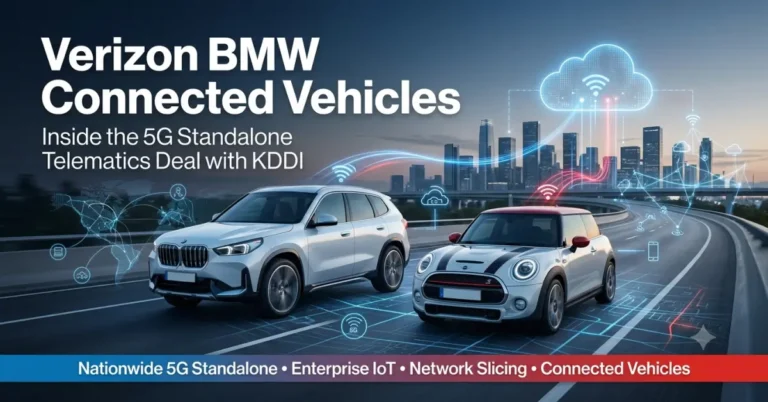
Inside the Verizon BMW Connected Vehicles Deal: What Was Announced
Verizon Business and KDDI announced a collaboration with BMW Group to deliver connected-vehicle services for newly manufactured BMW, MINI, and other BMW Group vehicles built for the US market. Verizon now provides cellular connectivity directly to these vehicles, enabling BMW’s Connected Drive system along with digital infotainment, remote services, app connectivity, and telematics — including firmware and map updates, subscription services, and the vehicle-health and driver-experience data BMW tracks.

Verizon Business CEO Kyle Malady framed the announcement around continuity of experience: the collaboration is designed to “advance the connected experience for drivers across the U.S.” The service is available across newly manufactured BMW Group vehicles in the United States, and the coverage extends to “nearly” all new production vehicles today and is expected to reach all of them as the relationship grows.
How KDDI‘s Platform Powers the Verizon BMW Connected Vehicles Partnership
The Verizon BMW connected vehicles deal runs through KDDI’s Global Communications Platform, the IoT connectivity-management layer KDDI supplies to BMW Group and to other original equipment manufacturers across multiple industries. KDDI’s platform gives BMW Group centralized, programmable control over how its vehicles’ connectivity and data packets are managed, while Verizon supplies the underlying 5G and LTE network the platform runs on. KDDI America President and CEO Satoshi Oishi pointed to the company’s two-decade track record in connected-car telecommunications as the basis for the arrangement, describing the goal as delivering “an exceptional connected driving experience.” The structure is a familiar one in enterprise IoT: an OEM works with a connectivity-management platform provider, who in turn aggregates network capacity from one or more mobile operators — rather than the OEM negotiating and integrating with carriers directly in every market.
Verizon BMW Connected Vehicles Marks the First Deployment on Nationwide 5G Standalone
The BMW Group vehicles connected under this deal are the first to run on Verizon’s nationwide 5G Standalone for Connected Vehicles offering, built on Verizon’s 5G core and 3GPP Release 16 standards for 5G SA. That distinction matters beyond the headline: 5G Standalone architecture is what enables capabilities like network slicing, which can dedicate guaranteed network performance to specific applications rather than sharing best-effort capacity. Lawson told Light Reading that Verizon is not deploying network slicing for BMW today, but that the option exists as the companies develop further use cases: “As we work with KDDI and with BMW to create interesting use cases that are either a value for BMW or their customers, we can leverage slicing.” He also framed 5G SA as a longevity and support consideration for OEMs specifically — protecting how long a given vehicle’s connectivity will be supported on the network, which matters for a product with a service life measured in years rather than months.
Why it matters for buyers: 5G Standalone and network slicing aren’t automotive-specific — the same architecture underpins SLA-differentiated connectivity for any enterprise IoT fleet, from industrial sensors to logistics assets. Deals like this are a useful real-world reference point for what’s actually deployable today versus still roadmap. → Map SLA and network-slicing requirements for your own IoT use cases with [TeckNexus SLA Mapping tools] (tecknexus.com/tool_category/sla/).
Verizon BMW Connected Vehicles vs. T-Mobile‘s Earlier BMW Deal: Telematics vs. In-Car Connectivity
BMW’s connectivity history in the US isn’t starting from zero. T-Mobile claimed the first 5G-connected cars in the US back in 2022 through Magenta Drive for BMW, rolled out with the automaker’s iX and i4 electric vehicles. The distinction is in what each deal actually covers: T-Mobile’s arrangement provided in-car connectivity — essentially a mobile hotspot experience for occupants — while the new Verizon BMW connected vehicles deal covers telematics, the vehicle-to-cloud data layer that supports Connected Drive, remote services, firmware updates, and the operational data BMW uses to track vehicle health. It’s a reminder that “connected car” announcements from different carriers aren’t always describing the same underlying service, and buyers evaluating similar OEM or fleet connectivity deals should look closely at which layer — in-cabin, telematics, or both — is actually being delivered.
What Verizon BMW Connected Vehicles Signals for Enterprise IoT and Network Slicing
Verizon’s largest existing connected-car relationship is with Volkswagen Group, spanning multiple VW brands with the deepest integration in its Audi range; the BMW Group deal through KDDI adds a second major automotive anchor customer, alongside Verizon’s other automotive-adjacent work, including a recently announced connectivity partnership supporting Kodiak AI‘s driverless trucking operations. Lawson pointed to broader automotive-industry trends driving the deal’s timing: rising levels of vehicle autonomy, more software-defined features delivered via subscription, and connectivity’s role as what he called a “critical enabler” for the sensors and cameras autonomous-driving systems depend on — even though 5G itself isn’t the technology operating the vehicle. For enterprise buyers outside automotive, the deal is a concrete, in-production example of 5G Standalone and OEM-grade IoT connectivity management at scale — useful evidence when evaluating what’s actually deployable today versus still theoretical for your own connected-asset strategy.
Why it matters for buyers
This deal is a real-world proof point for 5G SA-based IoT connectivity management at OEM scale — worth referencing when building the case for similar architecture in industrial, logistics, or fleet deployments. → Compare connectivity management and network architecture options with TeckNexus Network Planning tools and evaluate vendor and platform options with the RFP Scorecard Generator.
| RELATED TOOL
Does your IoT or fleet connectivity strategy need SLA-differentiated network slicing? The Verizon BMW connected vehicles deal shows 5G Standalone network slicing moving from roadmap toward real optionality for large-scale IoT deployments. TeckNexus’s SLA Mapping tools help translate application requirements into the network SLAs and slicing configurations that support them, and Network Planning tools help evaluate the underlying architecture choices. Explore SLA Mapping tools, Network Planning tools, and the wider Intelligence Platform. |