Inside the Apple Broadcom Chip Deal: Scale, Scope and Timeline
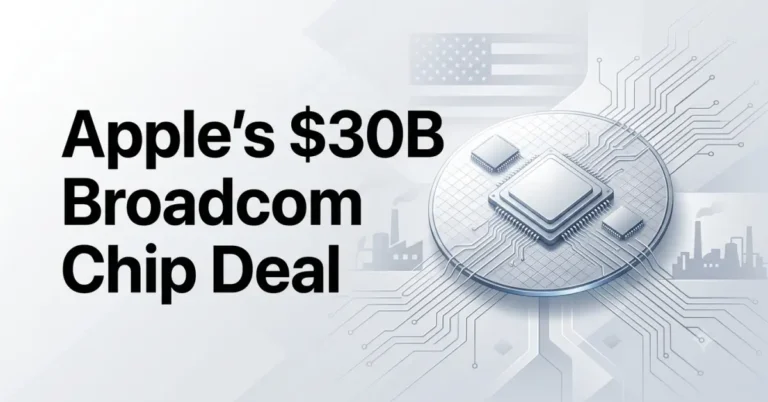
Broadcom disclosed the extended agreement in a regulatory filing to the US Securities and Exchange Commission on July 6, 2026; Apple confirmed the financial scale two days later. The multi-year Apple Broadcom chip deal is expected to exceed $30 billion and covers the development and supply of custom ASIC silicon across multiple future generations of Apple products, running through 2031. Apple has described it as the largest single commitment made under its American Manufacturing Program (AMP) to date — a program the company launched to expand its US manufacturing footprint. The agreement builds directly on a partnership dating back to at least 2023, when Apple and Broadcom first struck a multi-billion-dollar deal to develop 5G radio-frequency components at the same Fort Collins site; Broadcom has supplied Apple with related wireless components since the iPhone 3GS in 2009.

What the Apple Broadcom Chip Deal Covers: FBAR Filters, ASICs and Wireless Connectivity
The Apple Broadcom chip deal centers on two categories of silicon that serve distinct purposes inside Apple devices. The first is custom ASIC (application-specific integrated circuit) chips, developed and supplied across multiple future generations of Apple hardware. The second is FBAR (Film Bulk Acoustic Resonator) filters — radio-frequency components that manage wireless signal traffic across 5G, Wi-Fi and Bluetooth inside a single device, effectively determining which frequencies get priority when multiple wireless protocols are active simultaneously. Together, the agreement is expected to result in the production of more than 15 billion US-made chips, alongside broader wireless connectivity technologies for Apple’s device lineup.
Fort Collins and the Apple Broadcom Chip Deal’s Manufacturing Footprint
Broadcom will invest $1.5 billion to expand and modernise its Fort Collins, Colorado facility, which becomes the production hub for the RF components and wireless connectivity technology covered by the deal. Broadcom already employs close to 1,600 workers in Fort Collins, making it one of the city’s largest technology employers, alongside smaller R&D-focused operations from AMD, Intel, NVIDIA and Hewlett Packard Enterprise/HP in the same region. Apple said the expanded investment could support hundreds of additional US jobs, though the company has not provided a specific timeline for when the new capacity comes online. Apple CEO Tim Cook framed the announcement as a deepening of a long-standing supplier relationship: “The cutting-edge components built in Fort Collins are essential to delivering the incredible performance and connectivity our customers expect, and we’re proud to deepen our investments in US-based suppliers that share our commitment to excellence and innovation.” Broadcom CEO Hock Tan said Apple’s financial commitment is what enables the company to grow its Fort Collins footprint.
The Apple Broadcom Chip Deal in Context: Onshoring and Apple’s $600 Billion US Investment Pledge
The Apple Broadcom chip deal sits inside a much larger commitment: Apple’s pledge, announced in August 2025, to invest $600 billion in the US economy over four years, spanning manufacturing, jobs and technology development alongside initiatives such as AI server manufacturing in Houston. Broadcom is one of several suppliers Apple has tied to that pledge through its American Manufacturing Program. Market reaction was immediate — Broadcom shares climbed nearly 5% following the announcement — reflecting the scale of a multi-year, multi-billion-dollar commitment from one of Broadcom’s largest customers.
What the Apple Broadcom Chip Deal Signals for Wireless and Telecom Supply Chains
For buyers and vendors across the wireless and telecom ecosystem, the Apple Broadcom chip deal is a useful data point beyond the consumer electronics headlines. FBAR filters and RF front-end components are foundational to any device or infrastructure that needs to manage multiple wireless protocols simultaneously — the same underlying category of component that shows up in private network equipment, small cells, and enterprise wireless gear. A commitment of this scale, tied to a specific US manufacturing site and a multi-year horizon through 2031, adds a data point to the broader industry conversation about onshoring critical RF and semiconductor manufacturing capacity — a conversation already playing out in telecom infrastructure procurement, not just consumer devices. It’s also a reminder that large anchor customers can materially de-risk expansion decisions for component suppliers, a dynamic worth watching for any organisation dependent on the same tier of RF and connectivity silicon suppliers.
Why it matters for buyers: supply chain concentration and onshoring trends in RF and wireless silicon manufacturing directly affect lead times, pricing and resilience for private network, small cell and enterprise wireless deployments — not just consumer devices. Vendor commitments of this scale are worth tracking as a leading indicator of where component capacity (and risk) is heading. → Evaluate vendor and supply-chain resilience as part of procurement with the TeckNexus RFP Scorecard Generator] and explore the broader TeckNexus Intelligence Platform.
This analysis draws on Apple’s and Broadcom’s public statements and SEC filings, together with reporting from the outlets listed in Sources below.
| RELATED TOOL
How resilient is your wireless and RF component supply chain? Large anchor commitments like the Apple Broadcom chip deal are a reminder that component supply chains carry real strategic weight for any wireless deployment. TeckNexus’s RFP Scorecard Generator helps buyers build supply-chain resilience and vendor concentration risk directly into procurement scoring, rather than treating it as an afterthought. Explore the RFP Scorecard Generator → tecknexus.com/tool_category/rfp/ Explore the full Intelligence Platform → tecknexus.com/intelligence/ |