Fraunhofer

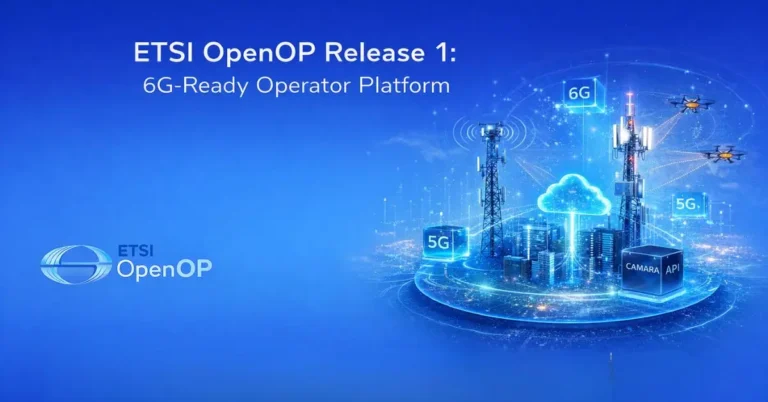
ETSI has introduced OpenOP Release 1 as an open-source operator platform for telco cloud, designed to standardize capability exposure and federation at the edge while creating a practical bridge from 5G-Advanced to early 6G experimentation. Networks are becoming software-first and distributed, but operators still face fragmented exposure of network capabilities and inconsistent approaches to multi-operator edge. OpenOP targets this gap with a standards-aligned, open implementation that lets developers consume telecom capabilities via CAMARA APIs and deploy applications across federated edge zones. Release 1 provides a working, end-to-end baseline with integrated components for exposure, orchestration, federation, and AI-assisted intent, suitable for hands-on testing and integration.
Deutsche Telekom’s T-Systems has secured a multi-million-euro contract from Leibniz University Hannover to power SOOFI, a flagship initiative to build a 100-billion-parameter, European-operated large language model. The SOOFI (Sovereign Open Source Foundation Models) project will train a next-generation, open-source LLM focused on European languages and industrial requirements, replacing the current 7-billion-parameter Teuken7B with a model two orders of magnitude larger. T-Systems will host and operate the training environment in its new Industrial AI Cloud—an NVIDIA-powered facility that DT and NVIDIA unveiled as part of a €1 billion partnership.
Ericsson, Nokia, and Fraunhofer HHI jointly demonstrated a proof‑of‑concept codec that delivers meaningfully higher compression than today’s widely deployed standards—H.264/AVC, H.265/HEVC, and H.266/VVC—without a notable rise in complexity. The partners emphasize energy efficiency and scalability, which are critical for battery‑powered devices, edge compute, and large streaming workloads. Their submission was positively received by the ITU‑T Video Coding Experts Group and ISO/IEC MPEG, the bodies that jointly steward the H.26x/MPEG lineage. The work is positioned as an on‑ramp to the next standardization phase, targeting readiness to support commercial deployment around 2029–2030, in step with 6G timelines.
Private 5G networks are transforming digital transformation by providing tailored, secure connectivity for various industries. Unlike public networks, private 5G offers dedicated solutions for sectors like manufacturing, transport, and healthcare. This article explores the benefits, key adopters, and strategic partnerships driving the implementation of private 5G, highlighting its role in enhancing productivity, safety, and sustainability.
This edition dives into the evolving world of satellite technology and its synergy with modern communication networks, highlighting key developments and challenges. Seraphim opens the discussion with a detailed look at the global race in satellite connectivity, emphasizing its impact on the mobile phone industry. Astrocast then explores the economic aspects of Satellite IoT, underlining its growing importance in global connectivity.

Partner Hubs

Download content, access intelligence tools, and hear from executives.

Partner Events

  • M360 ASEAN
  • FutureNet Asia 2026
  • Network X Vienna 2026
Scroll to Top