Edge AI shifts from cloud to network edge
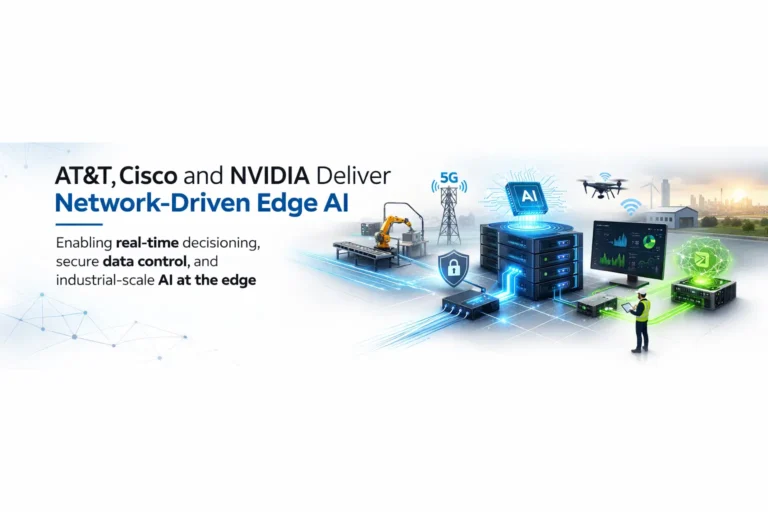
AT&T’s new collaboration with Cisco and NVIDIA signals a decisive shift from cloud-centric AI to network-driven edge intelligence for enterprise operations.

Why enterprises need network-edge AI now
Enterprises want real-time decisioning without shipping sensitive data to distant clouds, and operators need a scalable way to deliver it. By combining AT&T’s dedicated IoT core with Cisco’s mobility services platform and NVIDIA-powered AI infrastructure, the trio is packaging deterministic connectivity, near-device inference, and policy enforcement into a single, operator-grade platform. The promise: lower latency, tighter data control, and a path to production for AI at industrial scale.

Industry momentum and competitive landscape
Momentum is building across the ecosystem. T-Mobile, Nokia, and NVIDIA are piloting “physical AI” over distributed edge networks, enabling computer vision agents using NVIDIA Metropolis for smart cities, utilities, and industrial sites. Comcast is testing GPU acceleration in regional facilities close to customers to cut inference latency, power, and cost using DOCSIS 4.0 FDX infrastructure. At the RAN layer, NVIDIA and Nokia report live progress with operators including T-Mobile US, SoftBank, and Indosat Ooredoo Hutchison on software-defined, AI-enabled RAN—evidence that AI workloads are moving into telecom domains from core to edge to radio.
AT&T–Cisco–NVIDIA edge AI architecture explained
The partners are building an integrated stack that keeps data local, secures it end to end, and scales AI inference across millions of connected devices.
Deterministic connectivity and data sovereignty
AT&T’s IoT core provides global, policy-driven connectivity designed for predictable performance across distributed enterprise sites. Tied to Cisco’s Mobility Services Platform, the solution enables localized data routing to confine traffic to the nearest network edge when real-time processing is required. This approach reduces backhaul dependence, supports deterministic latency targets, and helps with data residency and governance requirements common in industrial and public sector deployments.
GPU edge compute and developer toolchain
Cisco’s AI Grid, built on NVIDIA AI infrastructure, delivers GPU-accelerated inference at the network edge. Enterprises can deploy and orchestrate models closer to where data is created—cameras, sensors, and machines—while using NVIDIA’s toolchains to manage lifecycle tasks like model updates and optimization. The design targets repeatable patterns for vision AI and sensor fusion, and it supports distributed topologies from on-prem nodes to operator edge sites.
End-to-end zero trust for edge AI
The platform extends zero-trust principles from device to edge to cloud with private, policy-enforced pathways. Security policies apply consistently across endpoints, network connections, and applications to mitigate lateral movement, protect telemetry, and preserve operational integrity in mixed IT/OT environments.
Early pilots and priority enterprise use cases
Initial deployments showcase real-time video analytics and industrial monitoring that benefit most from low latency, local processing, and strict data controls.
Public safety video analytics at the edge
In Dallas, a demonstration at AT&T’s Discovery District applied camera feeds to edge AI for situational awareness. The goal is to detect events faster, reduce manual review, and keep sensitive footage local while only sharing insights upstream.
Edge AI for industrial monitoring and automation
With TanMar Companies in Louisiana, the partners are testing edge-based video systems for site monitoring and operational visibility. This supports safety compliance, equipment anomaly detection, and workflow optimization without congesting backhaul or sending proprietary visuals to centralized clouds.
Target industries and workloads
Beyond pilots, the architecture is aimed at transportation systems, video security, manufacturing, and industrial automation—settings where milliseconds matter, networks are harsh, and compliance, uptime, and auditability are non-negotiable.
AT&T’s AI-ready network and cloud strategy
The collaboration aligns with AT&T’s multi-year capital plan and cloud adjacency moves to prepare the network for AI-heavy workloads.
Fiber investments and network capacity buildout
AT&T outlined plans to invest more than $250 billion over the next five years, including fiber expansion targeting 1.6 Tbps across key metro and long-haul routes. This capacity is essential to sustaining training pipelines, model distribution, and hybrid cloud/edge architectures at enterprise scale.
AWS adjacency and low-latency interconnect
AT&T previewed an enterprise AI connectivity offering with AWS that brings 5G fixed wireless access and fiber directly into AWS environments via an interconnect service. The objective is to reduce network complexity and latency for real-time analytics, ML, and emerging agentic AI, and to give enterprises a clean site-to-cloud path that complements edge inference.
Enterprise benefits and adoption guidance
Operators are starting to productize edge AI as a network service, offering clearer ROI paths for mission-critical use cases.
ROI levers and business outcomes
Key benefits include faster detection-to-action loops, lower backhaul and storage costs by processing locally, improved data sovereignty, and simplified security posture via end-to-end policy control. Savings often come from avoided truck rolls, reduced manual inspection, and lower cloud egress for high-volume video and sensor data.
Edge AI adoption checklist
Enterprises should map data governance zones, define latency and jitter SLAs per use case, and plan model lifecycle management (versioning, retraining, A/B testing) at the edge. Integration with existing OT systems, role-based access control, and incident response runbooks are critical, as is benchmarking on cost per inference and power per inference before scaling.
How to start with edge AI pilots
Begin with constrained pilots such as facility safety analytics or line-side quality inspection where edge gains are clear. Use standardized data schemas, containerized inference microservices, and CI/CD pipelines for models to enable repeatability across sites and vendors.
Risks, standards, and what to watch
Success depends on operational simplicity, ecosystem maturity, and credible performance gains from core to edge to RAN.
Orchestration complexity and open standards
Multi-domain orchestration remains hard. Favor architectures aligned to established frameworks like ETSI MEC for edge hosting and API exposure, and watch GSMA’s Open Gateway for network APIs that could simplify developer onboarding. Expect procurement scrutiny around lock-in across connectivity, compute, and toolchains.
AI-enabled RAN toward 5G/6G
Live trials with Nokia and NVIDIA suggest AI-infused RAN is moving from lab to field. As 5G evolves toward AI-native 5G/early 6G concepts, monitor how inference at cell sites and switching offices changes capacity planning, site power budgets, and capex/opex trade-offs; industry surveys indicate that a strong majority of operators expect faster deployment cycles for AI-native architectures.
KPIs to validate edge AI performance
Measure end-to-end latency under load, cost and power per inference, model accuracy drift across sites, time-to-patch for CVEs, and developer ecosystem adoption (e.g., Metropolis-aligned apps). If these trend in the right direction, network-driven edge AI will move from pilots to standard operating procedure.