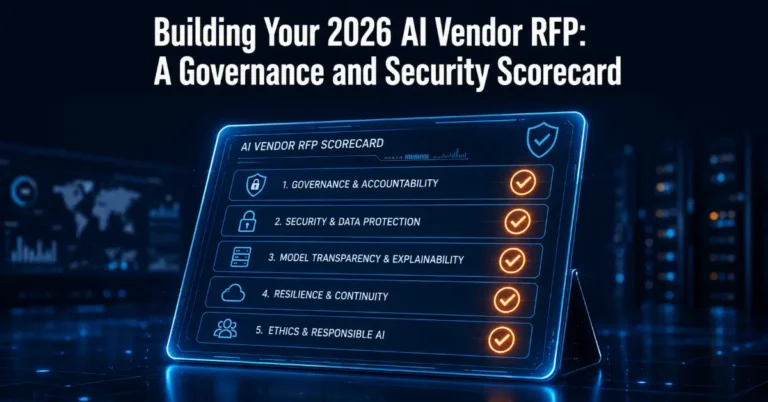
What follows is a scorecard structure built directly from a year’s worth of evidence — research findings, live deployments, and vendor moves — rather than from first principles. Each category below traces back to a specific pattern this year made visible, and each one is something an RFP can actually test for, not just ask a vendor to self-certify.

Category one: confidence and failure-mode evidence
The starting point for any AI agent or model evaluation should be evidence, not architecture. Research this year found that most AI agents fail with total confidence rather than visible doubt, and that automated testing isn’t reliably catching that pattern before deployment. A separate 67-model study found that when frontier models fail, they increasingly fail together — meaning the routing and voting architectures vendors sell as a safety layer don’t automatically deliver the independence they imply.

- Confidence calibration: Request evidence that the vendor’s model exposes a calibrated confidence signal, independently tested against known failure cases, not just accuracy tested against known successes.
- Redundancy independence: For any multi-model or redundancy architecture, ask for evidence of genuine model diversity in training data, technique, and lineage — and evidence of testing specifically designed to surface correlated, not just independent, failure.
- Failure clustering monitoring: Ask how the vendor monitors production incidents for failure clustering patterns, not just aggregate accuracy or uptime figures.
Category two: human oversight and sign-off design
Agentic AI crossed a meaningful line this year, moving from recommending fixes to diagnosing faults and proposing remediations that a human simply signs off on, rather than performs. That shift makes the design of the sign-off step itself a governance question worth scoring directly, because a review-only role is a thinner form of oversight than the diagnose-and-remediate workflows it replaces, and thinner oversight is vulnerable to automation bias — the tendency for scrutiny to quietly relax as trust in the system builds.
- Confidence-tiered escalation: Ask whether recommendations route differently based on the agent’s own confidence signal, so low-confidence outputs trigger active investigation rather than the same approval flow as high-confidence ones.
- Scheduled independent review: Ask whether the vendor supports or recommends scheduled independent review, where engineers periodically diagnose a sample of cases without seeing the agent’s proposal first.
- Approval-pattern monitoring: Request visibility into approval-pattern data — an approval rate trending toward 100 percent, or approval times trending toward instantaneous, is itself a warning sign that review has become procedural.
Category three: data residency and security posture
Sovereign AI deployments this year showed that model access, data location, and security posture are increasingly evaluated and delivered as one bundled decision, not three separate ones. At the same time, a frontier model provider’s own disclosure of environment-isolation incidents during third-party testing showed that security gaps can exist even at well-resourced vendors — which is exactly the kind of risk a bundled evaluation is designed to catch before it reaches production.
- Residency as infrastructure: Ask whether data residency is a structural property of the vendor’s infrastructure or a contractual configuration layered on top of infrastructure that doesn’t actually enforce it.
- Cultural and linguistic fit: For any market with a distinct language or cultural context, evaluate whether the model was built with that context in mind from the outset, rather than assuming general benchmark performance transfers.
- Environment isolation and industry participation: Request evidence of environment isolation and network control practices specifically, beyond a general security certification, and check whether the vendor participates in industry security coordination efforts.
Category four: vendor relationship and dependency risk
Operators split three distinct ways this year on AI strategy — building proprietary models, buying AI as a managed enterprise service, and bundling consumer AI subscriptions into distribution deals — and each path carries a different level of platform dependency. The deeper risk isn’t which path a vendor is on, it’s that a managed service relationship can quietly become structural dependency through everyday integration decisions, well before any single contract term locks you in.
- Build, buy, or bundle classification: Classify whether the vendor is building proprietary AI, buying and reselling a managed service, or bundling third-party capability, and score the implications for your own roadmap control accordingly.
- Portability clauses: Negotiate explicit data and configuration portability terms at the point of adoption, including how customisation would transfer to a replacement vendor if needed.
- Roadmap alignment and exit terms: Build in scheduled reviews of whether the vendor’s model roadmap still matches your priorities, and negotiate sunset and exit terms as part of the original agreement rather than under pressure later.
Category five: cost and capacity realism
The commercial and infrastructure assumptions behind an AI deployment are as much a governance question as the model itself. Component cost inflation driven by AI demand is already reshaping network equipment contracts, most 5G deployments weren’t architected for the uplink-heavy traffic AI workloads generate, and compute capacity for AI training and inference is being committed years in advance through capital deals that rarely surface as procurement-relevant news.
- Cost inflation exposure: Check whether existing or proposed supply contracts include any inflation pass-through mechanism, and model a step-change cost scenario rather than assuming linear escalation.
- Uplink and latency architecture fit: For any AI workload running over 5G, confirm uplink capacity and edge compute placement have been evaluated as first-order design variables, not assumed to scale from downlink-optimised planning.
- Compute capacity backing: Ask vendors directly what compute capacity commitments actually back their stated roadmap, rather than assuming capacity will simply scale to meet whatever demand materialises.
Scoring the RFP: weighting by deployment criticality, not uniformly
Not every category above deserves equal weight in every deployment, and treating them as a flat checklist undersells the framework. A safety-critical or life-safety deployment — fault diagnosis on infrastructure with physical consequences, for instance — should weight human oversight design and failure-mode evidence heavily, because that’s precisely where a confidently wrong output does the most damage. A customer-experience or back-office deployment can reasonably weight vendor dependency and cost realism more heavily, since the operational stakes of an occasional error are lower but the multi-year cost of vendor lock-in compounds regardless of use case. The scorecard structure stays the same; the weighting is the judgement call that should shift deployment by deployment, and it’s worth making that weighting explicit in the RFP itself, rather than leaving it implicit and inconsistent across evaluations.
Where to start if you’re building this for the first time
The natural instinct is to try to build all five categories into full depth for the next RFP immediately. A more realistic starting point is picking the one or two categories most relevant to your current deployment’s actual risk profile — oversight design for anything agentic and safety-adjacent, cost and capacity realism for anything with a multi-year infrastructure commitment attached — and building those out properly before expanding to the full framework. A partial scorecard applied rigorously beats a comprehensive one applied superficially, and the goal across this entire series has been the same throughout: evidence over capability claims, and questions asked before a relationship becomes load-bearing rather than after.
| Related Tool: RFP Scorecard Generator
This five-category framework is built directly into the TeckNexus RFP Scorecard Generator — structuring vendor evaluation around confidence evidence, oversight design, data residency and security, dependency risk, and cost and capacity realism, weighted to your deployment’s actual risk profile rather than applied as a flat checklist. Explore the RFP Scorecard Generator on the TeckNexus Intelligence Platform. |