Mobility

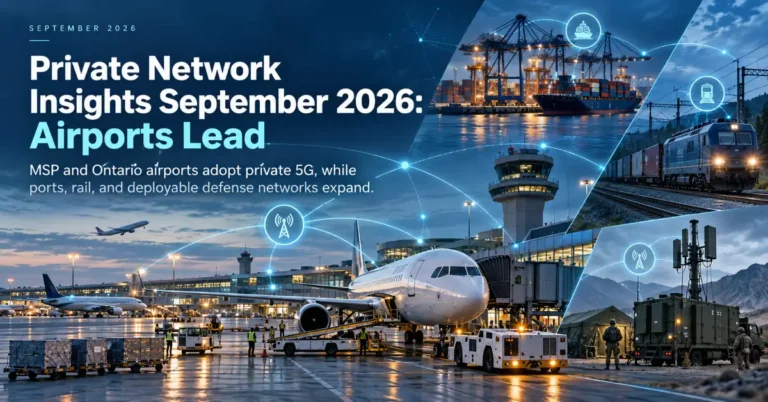
HHLA has activated a private 5G campus network at Container Terminal Altenwerder with Deutsche Telekom and Ericsson. The deployment is explicitly framed as a live digital test field rather than a finished solution — a platform for validating applications under real operating conditions before committing to production deployment. That sequencing is the most instructive element of the project for port operators evaluating similar investments.
A 99.99% uptime SLA means nothing if it does not reflect what your critical use cases actually require. The TeckNexus Private Network SLA Mapper translates your operational requirements — AGV control, video surveillance, IoT sensing - into the precise latency, throughput, and reliability parameters your vendor must design to.
Washington and industry have synchronized timelines and targets to identify, clear, and harmonize the mid-band spectrum that will underpin commercial 6G deployments in the early 2030s. The Administration’s National Security Presidential Memorandum on 6G directs NTIA to reallocate 7.125–7.4 GHz for full‑power, licensed commercial use and to study federal relocation to 7.4–8.4 GHz where feasible; it also orders immediate feasibility studies in 2.69–2.9 GHz and 4.4–4.94 GHz. The 7.125–7.4 GHz range is the U.S. front‑runner for high‑power licensed 6G, with NTIA studying federal relocation to clear contiguous bandwidth and enable 400–750 MHz per operator in a single swath.
Verizon posted 55,000 postpaid phone net additions, a modest beat that underscores stabilizing consumer trends and stronger execution in premium plans and broadband cross-sell. The net add beat is small in absolute terms, but strategically important: it points to improving churn and a healthier mix of high-value subscribers after several quarters of intense promotional pressure. Management coupled the result with a constructive outlook characterized by service revenue resilience and disciplined capital intensity, hinting at a tighter or modestly raised full‑year guide. For a market still digesting 5G investment cycles, this steady footing matters more than splashy net‑add gains.
P‑CAL’s secure mesh provided resilient communications across a complex yard, validating control loops and telemetry in the presence of interference, variable traffic density and human activity. As deployments scale, many terminals will adopt hybrid connectivity: private 5G for wide‑area mobility and interference resilience, Wi‑Fi/Wi‑Fi 6E/7 for indoor assets, and mesh for redundancy in hard‑to‑reach zones. This mirrors global port trends, where operators are rolling out private 5G to support autonomous trucks, AI‑driven analytics, drones and mobile cranes. Expect edge compute (MEC) on‑premises to host perception, fleet orchestration and video intelligence with strict latency and data‑sovereignty requirements.
Deutsche Telekom is weighing a structural overhaul that would collapse its 53% ownership of T-Mobile US into a single, unified company spanning both sides of the Atlantic. Reports indicate Deutsche Telekom is exploring an all-stock transaction in which a new holding company would acquire both Deutsche Telekom and T-Mobile US, with current shareholders of each ending up as owners of the combined entity. The new group could pursue dual listings in the U.S. and Europe, eliminating today’s parent–subsidiary setup and aligning governance, strategy, and capital allocation under one roof.
Vodafone Business has introduced 5G+ Local Slicing and a new Network Boost service, marking the first commercial, contract-backed 5G slicing offer for UK enterprises and a priority option for business traffic in high-demand areas. Enterprises are moving real-time operations, AI inference, and critical transactions onto mobile networks and need deterministic performance, not best-effort connectivity. By offering a dedicated, assured “lane” on its 5G Standalone (SA) network within defined local areas, Vodafone Business is addressing a long-standing performance and assurance gap that previously pushed many organizations toward private 4G/5G. Slices can be permanent or temporary and scaled as needs change.
Enterprises need indoor mobile coverage that works like the macro, integrates with private wireless, and sets a path to 5G and AI without ripping-and-replacing infrastructure. InfiniG’s Neutral Host as a Service turns a CBRS shared-spectrum deployment into an extension of public mobile networks using a 3GPP MOCN architecture. Employees, contractors, and visitors get native service from AT&T, T-Mobile, and Verizon on their existing SIMs—no apps, no plan changes. The Nokia RAN is 5G-ready out of the box, protecting investments as operators certify 5G Standalone and VoNR on neutral host. Radios and gateways are software-upgradable, so enterprises can deploy today for LTE and move to 5G without swapping hardware.
Amazon will acquire Globalstar to accelerate Amazon Leo’s direct-to-device (D2D) roadmap, secure midband MSS spectrum, and extend satellite coverage to smartphones and IoT beyond terrestrial reach. Amazon is acquiring Globalstar in a cash-and-stock deal valued at roughly $11.5 billion, with Globalstar shareholders able to elect $90 per share in cash or Amazon stock subject to a cash cap and proration. Closing is targeted after regulatory approvals and satellite milestones, with Amazon guiding to 2027. Amazon plans to deploy a next-generation D2D system starting in 2028, delivering voice, messaging, and data to unmodified mobile devices.
AT&T’s new collaboration with Cisco and NVIDIA signals a decisive shift from cloud-centric AI to network-driven edge intelligence for enterprise operations. Enterprises want real-time decisioning without shipping sensitive data to distant clouds, and operators need a scalable way to deliver it. By combining AT&T’s dedicated IoT core with Cisco’s mobility services platform and NVIDIA-powered AI infrastructure, the trio is packaging deterministic connectivity, near-device inference, and policy enforcement into a single, operator-grade platform. The promise: lower latency, tighter data control, and a path to production for AI at industrial scale.
NTT DOCOMO and Keio University have validated that commercial 5G Standalone (SA) can stably support haptic-grade robot teleoperation using network slicing and configured grant—turning years of URLLC theory into practical results. By pairing 3GPP-configured grant scheduling with a low-latency slice and Keio’s Real Haptics technology, DOCOMO showed that public 5G SA can carry force and tactile feedback with the determinism required for safe, precise manipulation. The KPIs demonstrate material improvements in latency stability, force fidelity, and motion smoothness—indicators that the control loop is resilient enough for practical tasks.

Your Brand. Our Intelligence Tools.

Capture leads at the point of evaluation. Talk to Us →

Sponsored by Palo Alto Networks
⚡ Utilities ⏱ 8 min ✓ Free
This tool is built and hosted by TeckNexus.
Launch Tool →
Whitepaper
This whitepaper explains how utilities can use secure AI-enabled private mobile networks to modernize operations, support distributed intelligence, improve resilience, and strengthen cybersecurity across critical infrastructure. It covers AI applications, private network advantages, zero trust principles, multilayered security architecture, and governance considerations for AI-ready utility environments....
Whitepaper
Non-terrestrial networks are rapidly evolving from experimental satellite systems into an increasingly important part of the global 5G connectivity landscape. This eBook, developed by Radisys in collaboration with TeckNexus, explores how 3GPP standardization, satellite architecture innovation, and software-driven network design are reshaping NTN deployment models. It examines the transition from...
Whitepaper
Private cellular networks are transforming industrial operations, but securing private 5G, LTE, and CBRS infrastructure requires more than legacy IT/OT tools. This whitepaper by TeckNexus and sponsored by OneLayer outlines a 4-pillar framework to protect critical systems, offering clear guidance for evaluating security vendors, deploying zero trust, and integrating IT,...
Scroll to Top