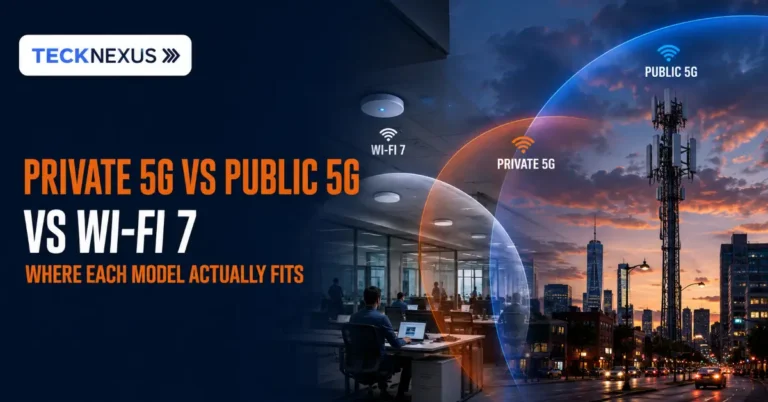
Enterprise connectivity decisions increasingly involve a genuine three-way choice: public 5G, private 5G, or Wi-Fi 7, each of which has advanced enough in recent years that the old default assumptions, Wi-Fi for indoor, cellular for outdoor or mobile, no longer hold cleanly. Understanding where each model’s strengths actually apply, rather than defaulting to whichever an organisation has used before, produces materially better connectivity decisions.

|
Dimension |
Public 5G | Private 5G |
Wi-Fi 7 |
|---|---|---|---|
| Coverage scope | Wide-area, national | Bounded physical site | Dense, fixed environments |
| Mobility support | Strongest | Strong within site | Weaker at scale/density |
| Latency/reliability guarantee | Shared, best-effort (slicing improves this) | Deterministic, dedicated | Improved with Wi-Fi 7, still not deterministic |
| Control over network | Limited | Full | Full, but no cellular-grade mobility handling |
| Typical cost driver | Per-device / per-gigabyte at scale | Upfront infrastructure investment | Lowest raw cost, but workaround costs at high density |
Public 5G: Reach Without Ownership
Public 5G, delivered by a mobile network operator over shared national infrastructure, is the right fit where an application needs connectivity across a wide, distributed geography that a private network could never economically cover — field service technicians, delivery fleets, or any use case spanning multiple sites and public roads. Its core limitation for industrial applications is that performance, capacity, and prioritisation are shared with the operator’s entire public subscriber base; even with network slicing increasingly available for guaranteed performance tiers, an enterprise using public 5G doesn’t get the same degree of control over coverage, capacity planning, or security policy that a dedicated network provides.

Private 5G: Control for a Defined Physical Footprint
Private 5G is the right fit for a bounded physical site, a factory floor, a port terminal, a mine, a campus, where an enterprise needs guaranteed coverage, predictable low-latency performance, and full control over which devices connect and how traffic is prioritised. Its core strength over both public 5G and Wi-Fi is deterministic performance for mission-critical applications: automated equipment control, real-time video analytics feeding safety systems, and autonomous vehicle coordination all depend on latency and reliability guarantees that shared or best-effort networks can’t consistently deliver. The trade-off is scope, private 5G covers a defined footprint, not a distributed geography, and building it out requires the spectrum, architecture, and vendor decisions covered elsewhere in this series.
Wi-Fi 7: Speed and Cost-Efficiency for Dense, Fixed Environments
Wi-Fi 7 brings substantially higher throughput, lower latency, and multi-link operation, using multiple frequency bands simultaneously for improved reliability, compared to previous Wi-Fi generations, closing much of the performance gap that used to clearly favour cellular for demanding applications. It remains the more cost-efficient and operationally familiar choice for dense, largely fixed environments, offices, warehouses with primarily stationary equipment, retail floors, where devices don’t need to move across a large physical area and where an organisation already has deep in-house Wi-Fi operational expertise. Its limitation relative to private 5G is mobility and device density at scale: Wi-Fi’s handoff between access points and its performance under very high device density in large, open industrial environments still generally lag cellular architecture, even with Wi-Fi 7’s improvements.
A Decision Framework by Application, Not by Habit
The clearest way to choose is by application requirement rather than by which technology an organisation has historically defaulted to. Applications requiring wide-area mobility and no fixed site boundary point toward public 5G. Applications requiring deterministic, mission-critical performance within a bounded, often harsh or high-density physical environment point toward private 5G. Applications that are latency-tolerant, largely fixed in location, and within an environment already well-served by existing Wi-Fi infrastructure point toward Wi-Fi 7. Many real deployments end up using all three in combination, private 5G for the industrial floor, Wi-Fi 7 for offices and administrative areas, and public 5G for field staff and vehicles leaving the site, which is precisely the kind of mixed-technology environment that converged wireless management platforms are increasingly being built to handle as a single, unified operational model rather than three separately managed systems.
Where Each Model Shows Up in Practice, by Vertical
The three-way choice plays out differently by industry.
|
Vertical |
Private 5G Role | Wi-Fi 7 Role |
Public 5G Role |
|---|---|---|---|
| Manufacturing | Production floor — automated equipment, AGVs | Offices, quality control stations | Rare, mainly field service visits |
| Ports | Terminal and yard — cranes, container handling | Limited | Trucks and drivers on public roads |
| Airports | Airside operations, baggage systems | Terminal passenger connectivity, retail | Passengers’ own devices throughout |
Recognising which pattern applies to a given site helps set realistic expectations early about how many of the three technologies a deployment will actually need to plan for, rather than assuming a single-technology answer will cover every use case on site.
Network Slicing Is Narrowing the Gap, But Not Closing It
5G network slicing, the ability to carve a shared network into logically separate segments with guaranteed performance characteristics, is increasingly marketed as a way for public 5G to deliver private-network-grade guarantees without dedicated infrastructure. Where mature, slicing genuinely improves what public 5G can offer an enterprise customer, and regulatory developments requiring measured, disclosed slice performance are pushing that maturity forward. But a slice still operates over shared physical infrastructure, and its performance guarantees are only as strong as the operator’s own network capacity and prioritisation policy during a real congestion event, a materially different guarantee than the physically dedicated capacity a private 5G network provides. For applications where a guarantee genuinely needs to hold under all conditions, not just typical ones, private 5G remains the stronger choice even as slicing narrows the practical gap for less extreme requirements.
The Cost Comparison Isn’t as Simple as It First Looks
A common early assumption is that Wi-Fi 7 is simply cheaper than private 5G and public 5G is cheaper still, since it requires no dedicated infrastructure investment at all. That holds at the level of raw connectivity cost, but it misses the cost of the operational gaps each technology leaves unaddressed. A Wi-Fi 7 deployment that can’t reliably support a high-density industrial floor may require expensive workarounds, additional access points, manual intervention to manage interference, or accepting a lower-reliability outcome that carries its own operational cost. Public 5G’s per-device or per-gigabyte costs can scale unfavourably for a large fleet of connected industrial devices generating continuous telemetry, compared to a private network’s more predictable cost structure at scale. A fair cost comparison has to account for these operational and scaling factors alongside headline connectivity pricing, not just the upfront cost of each option in isolation.
Making the Comparison Concrete for Your Own Site
The most reliable way to apply this framework is to map an enterprise’s actual application list against the three technologies’ core strengths, rather than trying to select a single winning technology in the abstract. For each priority application, ask whether it needs wide-area mobility beyond a single site, whether it needs a hard latency or reliability guarantee that must hold even under network congestion, and whether it’s largely fixed in a location already well served by existing infrastructure. The pattern that emerges from answering those three questions for each application, rather than for the site as a whole, is usually a more accurate guide to which technology, or combination of technologies, actually fits than starting from an assumption about which single technology the whole site should standardise on.
See how converged platforms are starting to unify private 5G, Wi-Fi, and cellular under one management layer — https://tecknexus.com/intelligence/private-5g-lte-networks/