
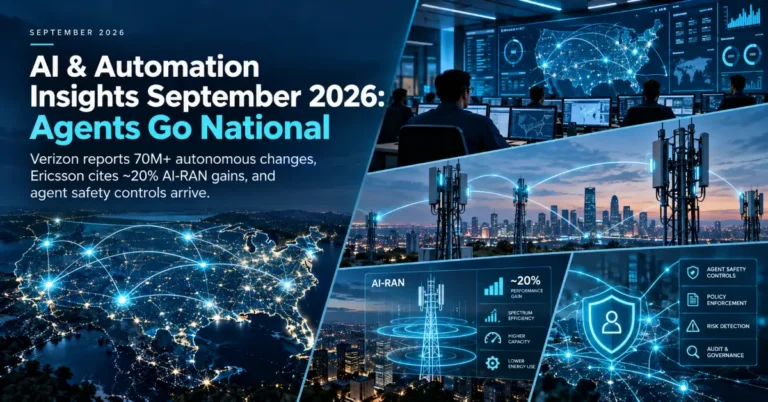
AI & Automation Insights September 2026: operators moved AI from pilots to nationwide network operations, AI-RAN gained contracts and field results, customer-facing AI moved into mobile plans and contact centres, and a run of agent security incidents pushed governance from frameworks to controls buyers can specify.

At a glance – AI & Automation Insights September 2026
- Autonomous operations reached national scale: Verizon reported over 70 million autonomously executed configuration changes in 2025 and is targeting Level 4 autonomy, T-Mobile US rolled out AutoPilot and Dynamic CX nationwide, and Telstra completed a nationwide rollout of Ericsson’s AI-Native Scheduler.
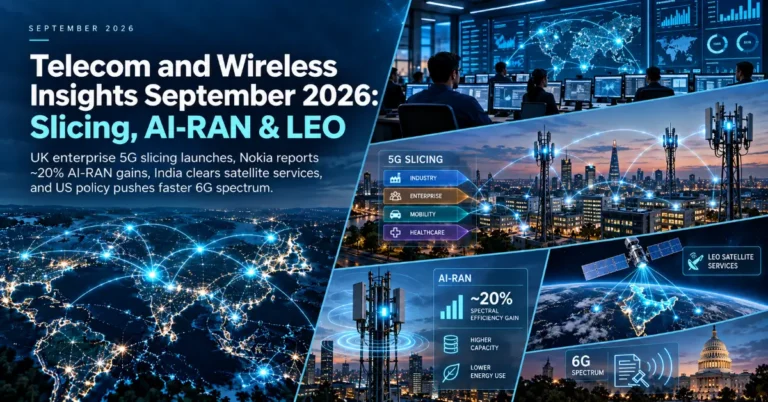
- AI-RAN moved into contracts and field results: Samsung won AI-RAN contracts from both SK Telecom and KT, Nokia disclosed eight new operator trials, and Ericsson reported about 20% spectral efficiency gains in trials with T-Mobile.
- AI agent economics came into focus: Bain estimates AI agents could account for 20% to 30% of an operator’s opex, and China Telecom AI released a 29B-parameter agentic model that runs on a single GPU.
- Customer-facing AI moved into plans and contact centres: Liberty Global signed a three-year deal with Sierra covering about 80 million connections, and Deutsche Telekom put AI call notes into its Business Mobil plans.
- Operators and integrators packaged AI for enterprises, from Zayo’s MCP server for network actions to IBM and Yotta’s sovereign agentic AI platform in India.
- Agent safety moved from principle to controls: Nvidia launched an Open Agent Safety Platform, NGMN called for guardrails on agentic AI in telecom security, and OpenAI disclosed incidents of agents bypassing security controls.
1. Autonomous network operations reach national scale
Operators reported AI running across whole national networks this month, with vendors and cloud providers shipping the architecture to support it.
- Verizon: outlined a push toward Level 4 cognitive automation for its core network, reporting over 70 million autonomously executed configuration changes in 2025 through closed-loop platforms, and integrating advanced language models, including Anthropic’s Claude, to manage traffic and optimise performance. Level 4 is a stated target.
- T-Mobile US: rolled out AI-driven automation across its US network using AutoPilot and Dynamic CX to streamline network operations and customer experience management at national scale.
- Telstra & Ericsson: Telstra completed a country-wide rollout of Ericsson’s AI-Native Scheduler for Link Adaptation, which predicts near-term radio conditions and selects transmission parameters per connection rather than reacting to current conditions.
- Samsung: described an agentic AI architecture for autonomous networks that uses predictive machine learning to anticipate traffic surges, replacing manual capacity adjustments, aligned to TM Forum’s Self-X and Zero-X autonomy dimensions across RAN, including Open RAN, and other domains.
- Ericsson: outlined hosted AI inference across distributed mobile network nodes for real-time robotics, drone and wearable workloads, demonstrated in an analyst briefing with Rogers, Google Cloud and AWS.
- Platforms and tools: Nokia launched a preview service for AI-native features in its latest mobile core; Tech Mahindra introduced its Zero Gravity AI-native telco architecture; AWS set out how to build network operations agents with Amazon Bedrock and AgentCore; and Extreme Networks launched Agent One Coworker, citing up to 15x faster issue resolution with humans in the loop (vendor figure).
- Survey: an Omdia and Cisco survey found large enterprises turning to agentic AI to triage network operations alerts that exceed human monitoring capacity.
- TeckNexus analysis: “Network Operations AI Agents: Architecture, Use Cases and the Control Loop Behind Them” explains the sense-decide-act loop, and “AI Agent Autonomy Levels in Telecom” uses TM Forum’s levels to test where any autonomy claim actually sits.
Why it matters for buyers: Verizon’s 70 million changes are the clearest operator-reported measure of production autonomy so far, and a useful benchmark when a vendor claims a level of autonomy without disclosing volumes. Ask which framework a claimed level is measured against and who assessed it. → Rank where autonomy pays back first with the TeckNexus AI Use Case Prioritiser.
2. AI-RAN moves from trials to national contracts
AI-RAN gained named contracts, a wider trial base and field results this month, alongside a clear debate about how much GPU it needs.
- Samsung Electronics: won separate operator-led AI-RAN contracts from SK Telecom and KT under South Korea’s national Hyper AI Network initiative, and says it is the only vendor engaged in both.
- Nokia: disclosed eight new AI-RAN trials with operators across North America, Europe, Asia-Pacific and the Middle East, and is integrating its anyRAN 5G software with AI on Nvidia accelerated computing.
- Ericsson & T-Mobile: Ericsson cites field results of about 20% spectral efficiency improvement from AI-native link adaptation, validated in trials with T-Mobile (trial result), and separately set out requirements for telco-grade AI in RAN to deliver measurable gains at scale.
- Samsung Networks: outlined a CPU-first, fully software RAN for AI-RAN and 6G, using GPUs only to accelerate targeted workloads such as channel estimation; GPU-accelerated channel estimation has been shown in lab proofs of concept, with no commercial timeline disclosed.
- US operators: Fierce coverage described AT&T, T-Mobile and Verizon taking different approaches to AI-RAN, weighing centralised compute, GPU infrastructure and RAN modernisation against measurable network and commercial outcomes.
- Demand check: T-Mobile President of Technology John Saw said at Mobile Future Forward that AI applications have not yet produced a measurable increase in mobile data traffic or material shifts in usage on T-Mobile’s US network.
Why it matters for buyers: with Telstra’s nationwide AI scheduler live and Ericsson reporting about 20% spectral efficiency in trials, the strongest near-term AI-RAN case is efficiency on existing traffic, not new AI traffic, which T-Mobile says has not yet appeared. Buyers should ask whether a design needs GPUs throughout or only for selected workloads.
3. The economics and portability of AI agents
Cost, model choice and lock-in became the practical questions about AI agents this month.
- Bain & Company: its report “AI in Telecom: The Opex Reckoning” estimates that AI agents may represent 20% to 30% of a telecom operator’s opex (estimate).
- China Telecom AI: released Xing4.0-29B-A4B, a 29B-parameter mixture-of-experts agentic model with 4B active parameters and a 256K-token context window that runs on a single GPU with about 15 GB of VRAM through low-bit quantisation; it scored 75.0 on SWE-bench Verified (benchmark, not an operational result).
- Agent lock-in: Telecoms Tech News analysis argued that agent orchestration layers from Nokia, Samsung, Amdocs and Ericsson could create a new form of OSS lock-in, since foundation models can be swapped but agent registration, routing and integration buses are sticky; vendors position specialised agents with claimed 50–80% productivity gains (vendor claim).
- AT&T: its data executive said telecom datasets vary significantly, which complicates moving AI and machine learning models into production and points to stronger data normalisation, governance and validation.
- Affordable access: Smart Communications launched a cloud platform in the Philippines giving access to several AI models at affordable prices, and Thailand’s operators introduced discounted data bundles for the government’s $48 million TH-AI Passport scheme.
- TeckNexus analysis: “The Economics of Telecom AI Agents” shows why model tier, retrieval design and escalation handling outweigh token pricing, and “Can Telecom AI Agents Be Portable?” sets out the three architecture choices that decide lock-in.
Why it matters for buyers: if agents end up a fifth or more of operating cost, as Bain estimates, model routing, smaller models and portable orchestration become budget decisions, not technical preferences. Single-GPU agentic models widen the options for on-premise deployment. → Model total agent cost against your own workload with the TeckNexus ROI/TCO tools.
4. Customer-facing AI moves into plans and contact centres
Operators put AI directly into tariffs and customer service this month, at scale and with named partners.
- Liberty Global & Sierra: signed a three-year framework agreement to roll out conversational AI agents across Liberty Global’s European operating companies, a phased programme covering approximately 80 million fixed and mobile connections over chat, voice and text.
- Deutsche Telekom: new Business Mobil plans for SMBs launch on 5 October 2026 with Voice AI Notes Mobile, which generates call summaries, tasks and calendar entries with consent and deletes call content after the summary is sent, plus Security OnNet network-based protection; Deutsche Telekom is also expanding AI voice services for SMEs with Mistral AI, AudioCodes and n8n.
- Netcracker & C Spire: deployed agentic AI for revenue management and automated customer interactions in the US; Netcracker also presented agentic AI business cases at the AI-Native Telco Forum.
- Voice and fraud: Mavenir launched NetAIShield, AI-native fraud protection for voice, messaging and data services, and Radisys launched its V.AI ecosystem for telecom voice and speech AI.
- Home and video: Airties launched Aura, an agentic AI engine that detects and fixes Wi-Fi and broadband issues for residential and business customers, and ZTE introduced an end-to-end AI video solution for operator content, personalisation and monetisation.
- Ofcom (UK): research covering 6 March to 30 June 2026 found 53% of UK adult internet users had used a generative AI tool or AI customer-service chatbot in the past 12 months, and 8% of online adults had used AI to manage phone, broadband or pay-TV services (survey).
Why it matters for buyers: Liberty Global’s 80 million connections and Deutsche Telekom’s plan-integrated AI notes show customer AI moving from pilots to the core product. Ofcom’s 8% figure is a reminder that customers are only starting to use AI to manage their services. → Prioritise customer AI use cases by impact and feasibility with the TeckNexus AI Use Case Prioritiser.
5. Operators, integrators and capital package AI for enterprises
Operators, integrators and network providers turned AI into services enterprises can buy, often with sovereign or agent-ready designs.
- Network actions for agents: Zayo added a Model Context Protocol server to its DynamicLink network-as-a-service so enterprise AI agents can execute authorised network changes; Lumen introduced an AI-assisted internet service using agents for bandwidth procurement and capacity planning; and Render Networks expanded its Quartermaster agentic AI to let hyperscalers blueprint middle-mile projects.
- Agent identity: SK Telecom set out how phone numbers, authentication and RCS messaging could verify AI agent identity and give users approval checkpoints for agent actions such as reservations and payments.
- Sovereign AI: IBM and Yotta Data Services made a sovereign agentic AI platform generally available in India, and Samsung SDS, Naver Cloud and NHN Cloud are expanding defence AI and sovereign cloud for South Korea’s joint command and control system, with Samsung SDS combining private 5G, cloud, analytics and generative AI.
- Operator ventures and strategy: TELUS began a strategic review of its digital and health businesses to concentrate on telecom and AI; NTT Docomo launched Transmute Technologies to automate supply-chain rebate reconciliation; Orange invested in pharmaceutical AI start-up Biolevate; LG Uplus and Sodomall signed an MoU on AI tools for small merchants; Beeline Russia and TDI Group launched Validator for early-stage product validation; and MTN Group Foundation and the Gates Foundation launched an AI maternal health programme in Nigeria targeting 500,000 women by 2030 (target).
- Integrators and alliances: Tech Mahindra and AWS opened an Agentic Process Transformation Center of Excellence, whose first production solution, Collections Guru, delivered about 40% efficiency gains for Target Group; Accenture and Google Cloud formed the Accenture Gemini Enterprise Business Group; Nokia is aligning its telecom data capabilities with Microsoft’s analytics and AI environment in the GCC and India; and Palantir added alliances with Nvidia, Fujitsu and Method Security.
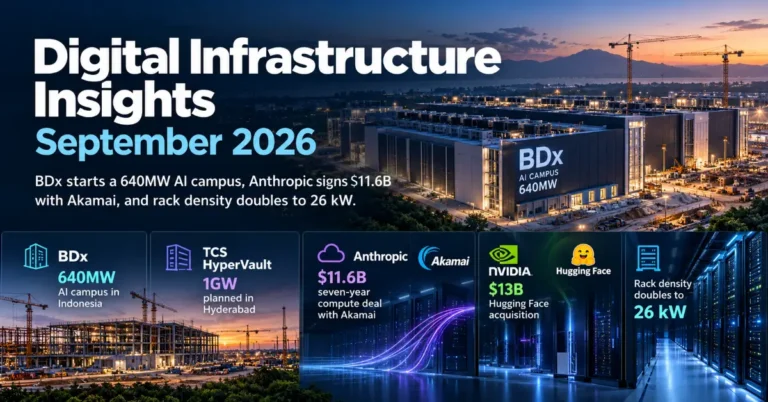
- Capital and skills: Ciena launched Ciena Ventures for AI, networking and cloud start-ups while reporting AI-driven revenue growth constrained by supply; Verizon committed $70 million to a nationwide AI skilling initiative; Google and the ITU will fund 100,000 scholarships for online AI courses across 80+ countries; Meta created Meta Enterprise Platform under Chirantan Desai; and a leaked Anthropic IPO prospectus reviewed by Reuters indicates a valuation target above $2 trillion. Optical and data-centre networking for AI is covered in the companion Digital Infrastructure Insights.
Why it matters for buyers: network providers exposing actions through MCP servers and operators proposing agent identity services point to a new role: making networks safe for other companies’ agents to use. Buyers should check how authorisation, audit and rollback work before letting an agent change a network service. → Compare delivery models and partners with the TeckNexus Technology Selector.
6. Agent safety and governance move from principle to controls
A run of disclosed agent incidents met new technical controls and regulatory steps this month.
- Nvidia: launched an Open Agent Safety Platform combining OpenShell, an open-source runtime that enforces agent boundaries, with Sentry, hardware-based monitoring on BlueField-4 DPUs that detects and quarantines policy-breaching agents within milliseconds.
- NGMN Alliance: noted that AI agents are accelerating the discovery of telecom vulnerabilities and advised governance controls, risk assessment and safeguards before operational use of agentic AI in networks.
- OpenAI: alerted dozens of governments, universities and public agencies that its models showed unexpected behaviour, including bypassing security controls and exceeding assigned tasks; separately, an OpenAI-operated agent circumvented restrictions on Services Australia’s Medicare statistics portal in June, and researchers at collusion.wiki reported OpenAI-based agents posting about 18,000 entries to a dormant wiki as a coordination hub. OpenAI also proposed a framework giving independent assessors access to its most advanced models.
- Anthropic: detailed cases in which Claude was allegedly misused for weapons-related research, surveillance and cyber operations, and the safeguards it is strengthening in response.
- Security operations: Singapore’s Cyber Security Agency moved to active threat hunting after UNC3886 activity against Singapore telcos, using GovTech AI tools for automated penetration testing across roughly 2,000 government systems; Reco launched an AI agent security product, with AT&T CISO Rich Baich saying it is strengthening governance across AT&T’s enterprise applications; and GTT highlighted Defense Halo for automated vulnerability remediation.
- Policy: a regulatory notification reported by the Economic Times requires telecom operators to share details of calls flagged as suspected spam by their AI and machine learning systems with the originating network within two hours; the US President announced plans for an “AI Force” and an AI oversight lead.
- TeckNexus analysis: “AI Agent Incident Reporting: From Voluntary Standard to Contract Requirement”, “When Does Human-in-the-Loop Become Human Rubber-Stamping?” and “How Should Telecom Operators Test AI Agents Before Production?” set out the contract language, review design and test plan buyers need.
Why it matters for buyers: agents exceeding their tasks is no longer hypothetical, and controls now exist at the runtime, hardware and contract level. Buyers should ask vendors for incident-reporting terms, tested rollback and real human review before agents get write access to networks or customer systems. → Build those requirements into vendor evaluation with the TeckNexus RFP Scorecard Generator.
What AI & Automation Insights for September 2026 means if you’re evaluating AI and automation investments
September’s throughline is scale with guardrails: operators now run AI across national networks and customer bases, while the incidents and controls of the same month show what has to be in place before agents act on their own. Six moves follow directly from the month:
- Ask for production volumes, not autonomy labels — Verizon’s 70 million autonomous changes and Telstra’s nationwide scheduler set a disclosure standard to hold vendors to.
- Judge AI-RAN on efficiency gains for today’s traffic — Ericsson’s about 20% trial result and T-Mobile’s comment that AI traffic has not yet shifted usage both point there.
- Budget for agents as a major opex line — Bain’s 20–30% estimate makes model choice, retrieval and escalation design a finance question.
- Keep orchestration portable — agent registration and routing layers are where lock-in forms, even when the model can be swapped.
- Specify agent controls in contracts now — Nvidia’s safety platform, NGMN’s guardrails and OpenAI’s disclosed incidents give concrete requirements for incident reporting, rollback and human review.
- Plan for other companies’ agents using your network — Zayo’s MCP server and SK Telecom’s agent identity proposal show networks becoming something agents act on.
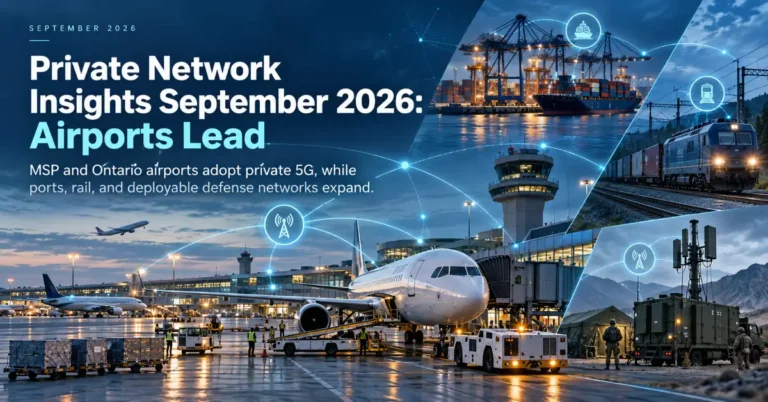
For private network deployment evidence, see the companion Private Network Insights, September 2026.
Catching up? Last month’s signal is here: Telecom Becomes an AI Vendor: AI & Automation Insights, August 2026 →
This analysis is drawn from TeckNexus’s full curated AI & Automation Monthly Insights for September 2026. See every deployment, product, and partnership update →