
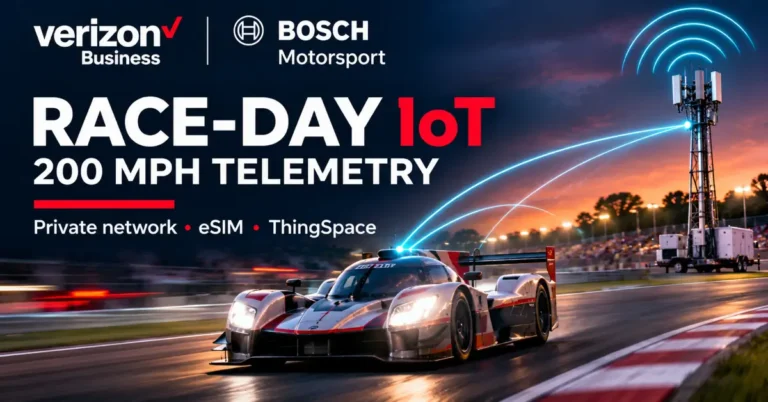
What is the Verizon Business and Bosch Motorsport IoT deal?
Bosch Motorsport now uses Verizon IoT connectivity, Verizon Global IoT Orchestration and the Verizon ThingSpace platform to move race-day data from cars to the cloud at events around the world. Bosch’s RaceConnect sensors collect operating and condition data from cars travelling at more than 200 mph and send it to Bosch’s private cloud, where race authorities use it for rules compliance, performance tracking and safety.

Announced on 18 November 2026, the agreement follows two completed race deployments in the US: the Detroit Grand Prix, where Verizon deployed a mobile private network and temporary cellular infrastructure, and the Motul Petit Le Mans. Bosch now plans to use the solution at further domestic and international races where it acts as scrutineering provider, including the Rolex 24 at Daytona and the Mobil 1 Twelve Hours of Sebring.
Why the Verizon and Bosch Motorsport IoT deal matters
Motorsport is an extreme test of IoT connectivity. The devices move at very high speed, the venues fill with tens of thousands of spectators competing for the same networks, and the data is not optional. When race officials rely on live telemetry to enforce rules and support safety decisions, a dropped connection is an operational failure, not an inconvenience.
Jacob Bergenske, Director of Bosch Motorsport North America, put it simply: in professional racing, where vehicles move at 200 mph, Bosch cannot afford a single second of downtime.
The deal is significant beyond racing for three reasons:
- Mission-critical data at crowded venues. The Detroit deployment shows how a mobile private network can keep operational data separate from public traffic at a large event.
- Global IoT without local reconfiguration. Bosch can ship the same device to any track in the world and have it connect to a local network without changing its settings.
- Lifecycle management at scale. Devices are activated, managed and suspended through APIs, with one dashboard for teams and race authorities.
How the Verizon and Bosch Motorsport IoT solution works
The solution combines Bosch’s in-car hardware and cloud with Verizon’s connectivity and device management layers. Each part has a defined role:
| Layer | Provider | Role |
| RaceConnect sensors | Bosch Motorsport | Collect vehicle operating and condition data inside each race car |
| Connected gateway | Bosch Motorsport | Devices such as the Bosch Connected Gateway 3.2 send data over the cellular network |
| IoT connectivity | Verizon Business | Carries telemetry from cars travelling at more than 200 mph |
| Global IoT Orchestration | Verizon Business | One static, private custom APN across markets, with remote eSIM profiles to connect to local networks in more than 140 countries |
| ThingSpace | Verizon Business | APIs to manage each device from activation to suspension, plus a single dashboard for performance and compliance data |
| RaceConnect private cloud | Bosch Motorsport | Receives real-time telemetry for race marshalling, rules enforcement and safety |
The global orchestration layer solves a practical headache for any company moving connected equipment between countries. Without it, devices typically need a different access point name (APN) for each local operator, which adds configuration work, testing and the risk that a device arrives at a venue and fails to connect. Using one private APN everywhere, with remote eSIM profiles handling the local network, means Bosch can manufacture and test devices once.
Shamik Basu, Vice President of Strategic Connectivity and IoT at Verizon Business, described Verizon’s role as an integrated engineering collaborator for Bosch rather than just a connectivity provider, and highlighted ThingSpace as giving Bosch a single view of its connected device fleet.
What the Detroit Grand Prix deployment showed about Verizon’s race-day network
The first deployment, at the Detroit Grand Prix, is the most interesting part of the story for network specialists. To guarantee the telemetry link at a street circuit packed with spectators, Verizon deployed a layered set of temporary and permanent assets:
- Cells on Wheels (COWs) and Cells on Light Trucks (COLTs) to add temporary capacity around the circuit.
- A Distributed Antenna System (DAS) to extend coverage across the venue.
- A Mobile Private Network to keep race telemetry separate from spectator traffic.
The result, according to Verizon and Bosch, was that race authorities could enforce rules in real time and engineering teams could make live mechanical adjustments. The solution was then deployed at the Motul Petit Le Mans, giving the partners two completed events before signing the broader agreement.
This is the same principle behind private networks at ports, airports and factories: critical operations should not depend on a network shared with the public. The difference in motorsport is that the network has to be built, used and removed within a race weekend, often on public streets.
Verizon and Bosch Motorsport: completed and planned
The announcement draws a clear line between what has already happened and what comes next:
| Status | Event or item |
| Completed | Detroit Grand Prix: first deployment, with COWs, COLTs, DAS and a Mobile Private Network |
| Completed | Motul Petit Le Mans: second deployment of the solution |
| Agreed | Bosch Motorsport adopts Verizon IoT connectivity, Global IoT Orchestration and ThingSpace for race-day data worldwide |
| Planned | IMSA WeatherTech SportsCar Championship: Rolex 24 at Daytona and Mobil 1 Twelve Hours of Sebring |
| Planned | Further domestic and international races where Bosch is the scrutineering provider |
| Not disclosed | Contract value, duration, number of connected devices and data volumes |
What the Verizon and Bosch Motorsport deal means for enterprise IoT
Racing makes a vivid case study, but the requirements are familiar to many industries. Logistics companies, equipment rental firms, event organisers, broadcasters and field service businesses all move connected assets between sites and countries, and all need those assets to connect reliably on arrival.
Three lessons carry across:
- Separate critical traffic. Temporary or permanent private networks protect operational data when public networks are congested, whether at a stadium, a port or a disaster site.
- Standardise the device, localise the network. A single APN and remote eSIM profiles reduce the cost of building and testing devices for many markets.
- Manage the whole lifecycle. API-driven activation and suspension matter when devices are switched on for an event and off again afterwards.
For Verizon, the deal adds a high-visibility reference for its managed IoT business, which was named a Leader in the Gartner Magic Quadrant for Managed IoT Connectivity Services, Worldwide, in May 2026. It also builds on Verizon’s long experience with temporary network deployments at major sporting events, now applied to operational data rather than fan connectivity.
For Bosch Motorsport, the arrangement turns its RaceConnect service into something it can run consistently at any track where it provides scrutineering, without rebuilding connectivity for each event or each country.
What comes next for Verizon and Bosch Motorsport
The next milestones are on the IMSA calendar. Daytona and Sebring, which traditionally open the season in January and March, will show how the solution performs at two of the longest and most demanding endurance races in North America. Beyond that, the key questions are:
- Which international races Bosch adds first, and how the Global IoT Orchestration layer performs across different local operators.
- Whether Verizon repeats the mobile private network approach at other venues, or relies on public networks with orchestration where coverage allows.
- Whether Verizon and Bosch publish performance data, such as latency, uptime or data volumes, from future events.
Motorsport has long been a proving ground for automotive technology. This deal suggests it is becoming one for mission-critical IoT connectivity as well. For deeper coverage of private networks at venues, events and critical sites, explore TeckNexus Private Network Intelligence.
For more analysis like this, subscribe to the TeckNexus Newsletter, explore our 2027 programs, or partner with us to share your perspective and generate leads.