

What is AT&T Flexible SIM?
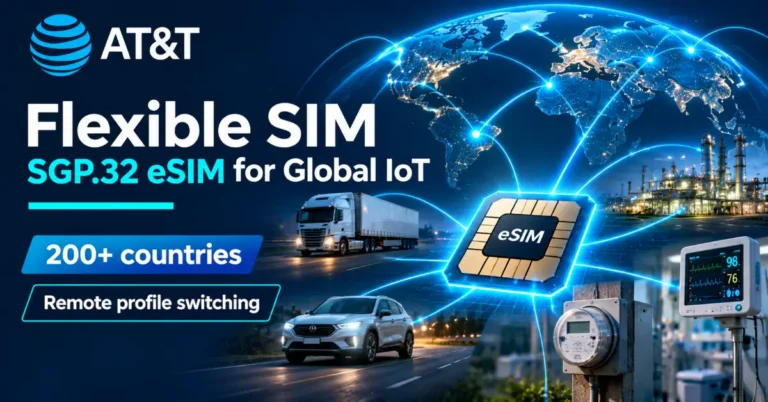
AT&T Flexible SIM is an eSIM service built on the GSMA SGP.32 specification. It lets enterprises remotely provision, activate, switch and manage eSIM profiles on IoT devices over the air. Devices with a preloaded AT&T profile can connect in more than 200 countries and territories, and customers can manage them through AT&T’s IoT Console, APIs or an AT&T-managed service.

AT&T announced general availability on 17 November 2026. The launch gives the operator two distinct eSIM models for global IoT: Flexible SIM, which hands more control to the enterprise, and Global SIM Advanced, a more managed service introduced in 2025 that automates network selection on the customer’s behalf.
Why AT&T Flexible SIM matters for enterprise IoT
For companies running large IoT fleets, connectivity is often locked in at the factory. A smart meter, a vehicle telematics unit or a medical monitor may stay in the field for ten years or more, often in places that are expensive or unsafe to visit. If the SIM inside it is tied to one operator’s profile, changing networks can mean sending a technician, swapping hardware or accepting poor coverage.
Remote SIM provisioning was designed to solve that problem, but the earlier standards did not fit IoT well. SGP.32 is the GSMA’s answer, and AT&T Flexible SIM is a sign that major operators now see it as ready for commercial enterprise services. Three aspects stand out:
- Control moves to the enterprise. Under SGP.32, a remote manager that the customer or its chosen provider operates can push profile changes to devices, rather than depending on the operator that issued the original profile.
- Resilience becomes a design feature. AT&T highlights the ability to switch profiles during network disruption or as devices move between regions, which matters for fleets, logistics and critical services.
- Lifecycle management gets simpler. The service covers everything from first activation to ongoing connectivity management, reducing the operational cost of long-lived devices.
How SGP.32 changes eSIM for IoT
The GSMA has published three generations of eSIM specifications, each aimed at a different type of device. The differences explain why SGP.32 has become the focus for IoT connectivity providers:
| Specification | Designed for | How profiles are managed | Fit for IoT fleets |
| SGP.02 (eSIM for M2M) | Machine-to-machine devices | Operator-controlled platform pushes profiles to devices | Works, but switching operators is complex and tied to platform integrations |
| SGP.22 (consumer eSIM) | Phones, tablets, wearables | User downloads profiles through an on-device assistant with a screen | Poor fit: assumes a user and an interface |
| SGP.32 (eSIM for IoT) | Headless and constrained IoT devices | Remote eSIM IoT Manager (eIM) directs an IoT Profile Assistant (IPA) on the device | Designed for fleets: remote, scalable, no user needed |
The GSMA released version 1.0 of SGP.32 in May 2023, and the ecosystem of compliant chips, modules and management platforms has been maturing since. One practical point for enterprises is that SGP.32 is not backward compatible with SGP.02 devices. Existing fleets generally cannot be moved to the new standard through a software update, so the benefits apply mainly to new device generations.
AT&T Flexible SIM features and management options
AT&T describes Flexible SIM as compliant with SGP.32 and generally available now. Its main capabilities are:
- Over-the-air profile management. Secure storage, installation and switching of carrier profiles without manual SIM swaps.
- Remote profile switching. Businesses can change connectivity as devices move between regions or as network conditions change.
- Global reach. A preloaded AT&T profile connects in more than 200 countries and territories, on hundreds of networks worldwide.
- Full lifecycle support. From initial activation through ongoing connectivity management, with a commercial model designed to scale as deployments grow.
Enterprises can choose how much of the work they take on. They can manage devices through the AT&T IoT Console, integrate directly with their own systems through APIs, or use AT&T Engineering Support Services, where AT&T manages remote SIM provisioning for them.
Cameron Coursey, vice president of Connected Solutions at AT&T, said businesses need the flexibility to manage devices without friction and respond quickly as conditions change, and that the product gives customers more control over how their devices connect, operate and evolve.
AT&T Flexible SIM compared with Global SIM Advanced
AT&T now positions two eSIM services for global IoT. They are designed for different operating models rather than as a basic and premium tier:
| Attribute | AT&T Flexible SIM | AT&T Global SIM Advanced |
| Approach | Customer-directed control over profiles | Managed, rules-based orchestration across profiles |
| Standard | GSMA SGP.32 | Multi-profile eSIM with an AT&T bootstrap profile |
| Who makes connectivity decisions | The enterprise, or AT&T if Engineering Support Services is chosen | Built-in automation and orchestration rules |
| Best suited to | Enterprises that want to set their own network strategy | Enterprises that want AT&T to handle more connectivity decisions |
| Launched | November 2026 | March 2025 |
Offering both reflects how varied enterprise IoT has become. A connected car maker with its own connectivity team may want direct control over which network every vehicle uses in each country. A medical device company may prefer a managed service that keeps devices online without in-house telecom expertise. AT&T’s own recent deployments show the managed model in action: connected healthcare specialist Smart Meter expanded its use of Global SIM Advanced for remote patient monitoring in October 2026.
Flexible SIM also builds on AT&T’s earlier SGP.32 groundwork. In October 2025, AT&T and Thales introduced an eSIM platform powered by SGP.32 to simplify remote provisioning for IoT. AT&T’s announcement links to that work but does not set out the specific role of each technology partner in Flexible SIM.
Which industries AT&T Flexible SIM targets
AT&T lists a broad set of target sectors, which together cover most of the long-lived, distributed device categories in enterprise IoT:
- Automotive and connected cars
- Healthcare and medical devices
- Manufacturing and industrial IoT
- Transportation, logistics and fleet
- Retail, public sector and government
- Smart cities and public infrastructure
Utilities, public sector and smart city deployments are particularly relevant because their devices often stay in service for a decade or longer and sit in hard-to-reach locations. For these customers, the ability to change connectivity remotely is less about cost and more about keeping critical services connected when coverage, commercial terms or regulations change.
What AT&T Flexible SIM means for operators and the IoT market
SGP.32 changes the competitive dynamics of IoT connectivity. When enterprises can switch profiles remotely, the operator that issues the first profile no longer locks in the customer for the life of the device. Operators have to compete on coverage, service quality, management tools and commercial flexibility instead.
AT&T’s response is to compete on both sides of that shift. Flexible SIM gives control-oriented customers the openness SGP.32 promises, while Global SIM Advanced offers a managed alternative. Its large footprint is a strong anchor for either model: a preloaded profile that works in more than 200 countries gives enterprises a reliable starting point before any switching takes place.
For device makers, the launch adds to the commercial pull for SGP.32-ready modules and chips. As more tier-one operators bring SGP.32 services to market, OEMs gain more confidence to standardise on the specification in new product lines.
What comes next for AT&T Flexible SIM
Several questions will shape how quickly Flexible SIM is adopted:
- Which enterprise customers announce Flexible SIM deployments first, and in which sectors.
- How AT&T structures pricing and commercial terms for profile switching at scale, which the announcement does not detail.
- Which eSIM IoT Manager options AT&T supports alongside its own IoT Console and APIs.
- How quickly SGP.32-ready devices reach the market in the volumes needed for large fleet rollouts.
Existing AT&T IoT customers can start by contacting their account representative to choose a setup. For enterprises planning their next device generation, the more important decision may be architectural: choosing SGP.32-capable hardware now keeps connectivity choices open for the full life of the fleet.
For more analysis like this, subscribe to the TeckNexus Newsletter, explore our 2027 programs, or partner with us to share your perspective and generate leads.