





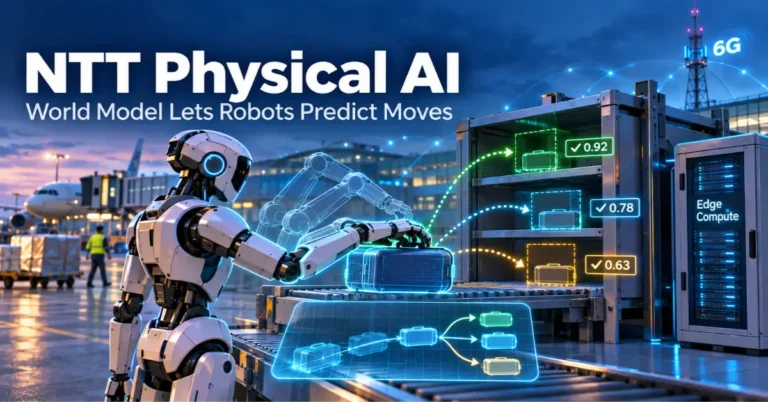
NTT has developed a physical AI technology that lets a robot see the likely future before it moves. Faced with several possible actions, the robot can predict which ones would cause a load to collapse or an item to fall, score each option, and choose the one most likely to succeed. In a shelf-loading test, the technology lifted the task success rate from 73.1% to 92.3%. Field trials with robotics company Mujin are next, starting with automated airport baggage handling.

The announcement goes to the heart of one of the hardest problems in physical AI: getting machines to act reliably when the objects in front of them are unpredictable. NTT’s answer is a world model that reasons with physics rather than relying on training data alone, and it is a meaningful step for one of the world’s largest operator groups as it builds out its physical AI capabilities.

Why world models matter for NTT physical AI
Physical AI refers to AI that lets machines such as robots perceive the physical world through cameras and sensors, make decisions and act autonomously. A key building block is the world model: a system that represents the state of the environment and predicts how it will change as a result of the robot’s own actions. If a robot can foresee the consequences of a move, it can avoid the ones that end badly.
Conventional world models have three limitations that matter in practice:
- No explicit physics: they do not represent physical quantities such as mass or velocity internally, so generated predictions can show objects disappearing or deforming in implausible ways.
- Missed interactions: collisions and contact between objects may not be predicted correctly, which is exactly where loads collapse and items fall.
- Heavy data dependence: because they learn from large volumes of training data, they are more likely to fail in situations the data did not cover.
These weaknesses are most visible in loading and unloading tasks. Airport baggage and small delivery parcels come in endless combinations of shape, weight and arrangement. Conventional robot control alone cannot easily judge in advance whether a placement will topple a stack, and collecting training data for every possible item is impractical. That is the gap NTT set out to close.

How the NTT physical AI world model works
At the core of the technology is a proprietary physics control adapter. It combines a mechanism for predicting the future from video with calculations based on physical laws. From video, the adapter estimates each object’s position, orientation, velocity and mass, then uses equations of motion to calculate how each object will move next.
NTT says it is the first in the world to integrate this kind of adapter into the video generation model that underpins a world model. The adapter’s calculations are fed into video generation, so the predicted video follows physical laws. That reduces objects vanishing or deforming and makes collisions and load collapse far easier to predict accurately.
In operation, the technology fits into a robot’s decision process in five steps:
- The robot’s existing control software proposes several candidate actions, using a vision-language-action (VLA) model, which turns camera video and language instructions directly into robot actions, or a motion planner, which calculates the controls needed to reach a goal.
- The physics control adapter estimates the physical properties of each object in the scene from camera and sensor data.
- For each candidate action, the world model generates a video of the predicted outcome, guided by those physics calculations.
- Each predicted outcome is evaluated for failures such as object drops, collisions and load collapse, and given a likelihood of success.
- The robot selects and executes the action most likely to succeed.
Importantly, NTT designed the model to run at high speed while keeping its accuracy, so it can sit directly inside a robot’s control flow rather than acting as an offline planning tool.
Four capabilities behind NTT physical AI
NTT highlights four features that distinguish the technology from conventional world models:
| Capability | What it does | Why it matters |
|---|---|---|
| Works with existing robot control | Evaluates action plans from VLA models, motion planners or other systems before execution | Adds a safety check to current robots without replacing their control software |
| Compares multiple futures | Generates a predicted video for each candidate action and scores its chance of success | Turns robot decisions into a choice between tested options rather than a single attempt |
| Physics-based prediction | Represents position, orientation, velocity and mass for each object and applies equations of motion | Produces physically plausible predictions of collisions and load collapse |
| Handles unseen situations | Uses physical laws to predict scenes and motions not included in training data | Suits environments where comprehensive training data cannot realistically be collected |
Two further advantages are worth noting. Because predictions are produced as natural-looking video, the outcome of a robot action can be reviewed before it happens. And because the model outputs the physical quantities behind each prediction, the basis for its decisions is easier to understand, which matters for operators who need to trust and troubleshoot automated systems.
What the NTT physical AI test results show
NTT tested the technology in a shelf-loading task, using a small robot to simulate the stacking of items. Without the technology, the robot succeeded 73.1% of the time; with it, 92.3%. Put another way, the failure rate fell from 26.9% to 7.7%, cutting failed attempts by roughly 70%. In loading and unloading operations, where every failure means a damaged item, a stoppage or human intervention, a reduction of that size is significant.
NTT also measured prediction accuracy on OBJ3D, a public video prediction benchmark built around collisions between multiple objects. Using LPIPS, a metric that compares predicted and actual video in a way aligned with human perception, the NTT world model outperformed conventional methods. In collision scenes where a conventional model failed to predict the impact, NTT’s model predicted it correctly.
The release also shows the model handling a scene that was not in its training data, in which objects were partly hidden by the robot’s own arm. Occlusion of this kind is routine in real handling work, so performance in that scenario is an encouraging sign for deployment.
The shelf-loading result comes from a small robot in a simulated stacking task, and NTT has not published trial counts. The Mujin field trials will therefore be the first indication of how well the gains carry over to full-scale baggage handling.
From airport baggage to warehouses: NTT physical AI applications
Airport baggage is a natural first target. Bags vary widely in size, shape, weight and rigidity, and loading them into containers is physically demanding work that airports have long found hard to automate. NTT plans to advance implementation with Mujin and will also consider working with robot service providers and logistics and warehousing companies.
From baggage and parcel handling, NTT intends to expand into other fields that deal with diverse objects, including manufacturing, construction and retail. The common thread is labour: these are sectors facing persistent workforce shortages, where robots that fail less often can raise productivity without constant human supervision. The technology will be exhibited at NTT R&D Forum 2026 this month.
NTT physical AI across the group
The world model is one of several physical AI initiatives across NTT, each at a different stage:
| Initiative | NTT entity | Status |
|---|---|---|
| Physics-based world model for robot action selection | NTT laboratories | Announced November 2026; field trials with Mujin to follow |
| Physical AI quality assurance in assembly, using vision sensors and on-site edge AI | NTT DATA, with Archetype AI and Hyster-Yale Materials Handling | Deployed at Hyster-Yale’s Berea, Kentucky plant, announced July 2026 |
| In-Network Computing for low-latency AI video analysis with remote GPUs | NTT and DOCOMO | Demonstrated March 2026 and shown at MWC Barcelona 2026 |
The DOCOMO and NTT work is where the group explicitly connects AI, robots and networks. Its demonstration linked remote GPU resources to DOCOMO’s commercial 5G standalone core over the IOWN All-Photonics Network and kept combined communication and AI video analysis latency within the thresholds for robots working near people under the ISO/TS 15066 safety specification. The companies describe the goal as a network that enables AI and robots to fully unlock their potential in the 6G era. NTT has not presented the world model and In-Network Computing as a combined system, but together with NTT DATA’s factory deployment they show a group active in physical AI from fundamental research through to enterprise delivery and network design.
What to watch next for NTT physical AI
Three milestones will show how far the technology travels. The first is the outcome of the Mujin field trials and whether the reduction in failures holds with full-size baggage and real airport conditions. The second is how quickly NTT extends the model into logistics, warehousing and manufacturing partnerships. The third is whether physics-based world models become a standard layer in robot control stacks, sitting between the systems that propose actions and the robots that carry them out.
If the field results match the lab, NTT will have made a strong case that the next leap in robot reliability comes not only from more data, but from teaching machines the laws of physics.
For more insights, read the latest TeckNexus Monthly Insights newsletters. Want to share your perspective with the TeckNexus community and generate qualified leads? Partner with TeckNexus.