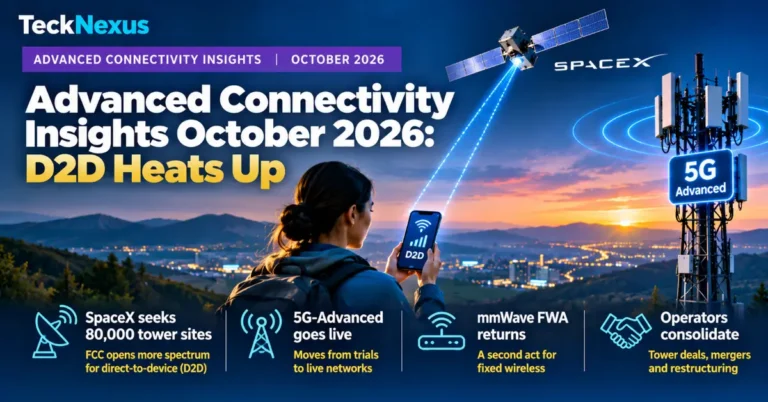
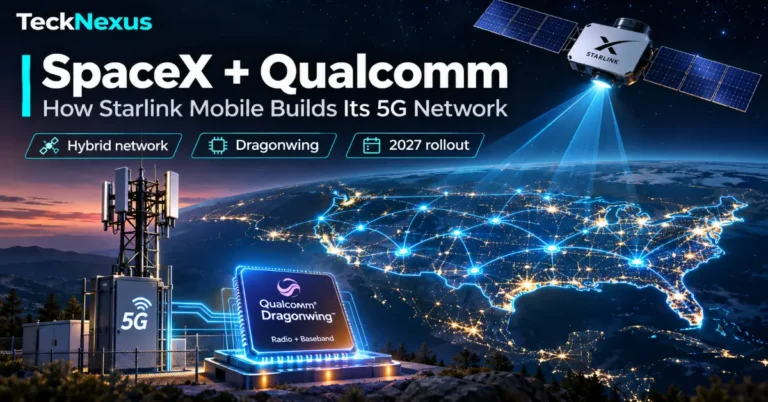
SpaceX has selected Qualcomm to supply the radio and baseband technology for Starlink Mobile’s nationwide terrestrial 5G network in the United States. Under a multi-year agreement announced on 4 November 2026, SpaceX will deploy Qualcomm Dragonwing QRU100 radio unit and QDU100 distributed unit platforms, together with Qualcomm’s commercial-grade Layer 1 software, in 64T64R Massive MIMO base stations. Rollout is planned to begin in 2027, with tens of thousands of sites deployed over the life of the agreement. Qualcomm has described it as the largest 5G infrastructure deal in its history.

The announcement arrived only days after reports that SpaceX had held talks with EchoStar about Boost Mobile, which prompted a wider debate about whether SpaceX would buy, partner or build its way into terrestrial mobile. This deal settles one part of that question. Whatever happens with Boost, SpaceX is building its own ground network, and it has now chosen the silicon that will power it.

Read quickly, this is a large equipment order. Read in context, it reveals how SpaceX intends to build and run a mobile network. Rather than buying a complete radio system from a traditional network equipment vendor, it is starting from merchant silicon and software components, much as it built its satellites and user terminals. Combined with a satellite constellation that already covers the country, that makes Starlink Mobile a genuinely different kind of entrant from any the US market has seen.
The SpaceX Qualcomm Deal at a Glance
| Item | Detail |
| Parties | SpaceX (Starlink Mobile) and Qualcomm Technologies |
| Agreement | Multi-year supply agreement for Starlink Mobile’s US nationwide terrestrial 5G network |
| Qualcomm platforms | Dragonwing QRU100 radio unit platform, Dragonwing QDU100 distributed unit platform and commercial-grade Layer 1 software |
| Radio configuration | 64T64R Massive MIMO: 64 transmit and 64 receive paths per radio |
| Scale | Tens of thousands of terrestrial sites over the course of the agreement |
| Timing | Nationwide rollout to begin in 2027; Qualcomm expects revenue recognition to start towards the end of its fiscal 2027, with meaningful revenue from fiscal 2028 |
| Network vision | A fully integrated nationwide satellite and terrestrial network, with groundwork for AI-native 6G |
| Deal value | Not disclosed |
How the SpaceX Qualcomm Deal Completes the Starlink Mobile Stack
Over the past year, SpaceX has assembled the building blocks of a mobile operator one layer at a time, committing around $19.6 billion to spectrum licences from EchoStar alone. The Qualcomm agreement fills the most visible remaining gap: the radio equipment on the ground. Each layer now has a clear role in a network designed to work from orbit down to the street:
| Layer | SpaceX asset | Role in the network |
| Satellites | Next-generation direct-to-device constellation, approved by the FCC in October 2026 | Nationwide outdoor coverage, including rural areas and dead zones |
| Mid-band spectrum | Licences acquired from EchoStar, giving around 65 MHz of mid-band capacity | High-capacity terrestrial service in towns and cities |
| Low-band spectrum | Agreement to acquire Grain Management’s 800 MHz portfolio, subject to FCC approval | Long range and stronger indoor coverage |
| Terrestrial radio | Qualcomm-powered 64T64R Massive MIMO base stations | Capacity and in-building coverage where people use their phones most |
| Backhaul | Starlink broadband constellation | A potential way to connect sites where fibre is limited |
The pairing of satellites with terrestrial radio is the central idea. Satellites can cover the whole country from day one but are limited indoors and in dense areas. Terrestrial sites deliver capacity and indoor coverage but take years to roll out nationally. A network that combines both can serve customers everywhere while the ground layer is built out, then shift traffic from space to land as the terrestrial footprint grows. Elon Musk summed up the goal on X as one network with good signal everywhere.

Inside the SpaceX Qualcomm Base Station: What Each Part Does
A modern 5G base station is no longer a single box. Its functions are split across components that can come from different suppliers, connected by open interfaces. Understanding that split shows exactly where Qualcomm fits and where SpaceX keeps control:
| Component | What it does | Supplier in this deal |
| Radio unit (RU) | Converts digital signals to radio waves and back, and forms the beams of a Massive MIMO antenna array | Qualcomm Dragonwing QRU100 platform |
| Distributed unit (DU) | Runs time-critical baseband processing, including Layer 1, the physical layer of the 5G signal | Qualcomm Dragonwing QDU100 platform and Layer 1 software |
| Centralised unit (CU) and higher layers | Manages radio resources, mobility and connections across many cells | Not specified in the announced agreement |
| 5G core | Handles subscribers, sessions, authentication and connection to the internet | Not specified in the announced agreement |
| Management and orchestration | Configures, monitors and automates the network | Not specified in the announced agreement |
Qualcomm’s scope covers the hardware-intensive, physics-heavy parts of the system, where performance per watt matters most and where specialist silicon has the biggest advantage. The layers above it, which shape how the network behaves and how it hands traffic between satellites and towers, are outside the announced agreement. Reports indicate SpaceX intends to develop much of that software itself, which would keep the most differentiating parts of the network under its own control.
The 64T64R configuration is a deliberate choice. Many macro sites today use radios with four or eight transmit paths. A radio with 64 transmit and 64 receive paths can form many narrow beams at once and serve multiple users simultaneously on the same frequencies, a technique known as multi-user MIMO. For an operator with around 65 MHz of mid-band spectrum, a smaller holding than the established national carriers, getting the maximum capacity from every megahertz is essential, and Massive MIMO is the most powerful tool available to do it.
Qualcomm on Both Ends of the SpaceX Network
One aspect of the deal has received little attention. Qualcomm is not only supplying the base stations; it is also one of the world’s largest suppliers of smartphone modems. In March 2026, it introduced the X105 5G Modem-RF, which it described as the first modem-RF system ready for 3GPP Release 19 and the first with integrated 5G NR-NTN, the standard that allows phones to connect directly to satellites using 5G.
That puts Qualcomm technology at both ends of the link Starlink Mobile is designing: in the phones that will connect to satellites and towers, and in the towers themselves. Neither company has described this as part of the agreement, but the overlap could help in three areas:
- Interoperability testing. Base stations and handset modems from the same supplier can be validated together earlier, reducing the risk of compatibility problems at launch.
- Satellite and terrestrial handover. Moving a call or data session smoothly between a satellite beam and a terrestrial cell is one of the hardest parts of a hybrid network. Deep knowledge of both the device and the network side is an asset here.
- Feature rollout. New 5G-Advanced capabilities typically need support in both phones and networks before customers benefit. Alignment on both sides can shorten that cycle.
Starlink Mobile will of course need to support phones built on many chipsets, from many manufacturers. But for a network whose defining feature is the combination of space and ground, having a supplier deeply involved in both handsets and infrastructure is a meaningful advantage.
How the SpaceX Qualcomm Build Compares With Earlier Greenfield Networks
Starlink Mobile is not the first operator in recent years to build a national mobile network from scratch. Two earlier greenfield networks offer useful reference points:
| Network | Launch period | Architecture | Outcome so far |
| Rakuten Mobile (Japan) | Commercial launch in 2020 | Fully virtualised, cloud-native RAN built largely on operator-developed software | Operating nationally; its platform is now offered to other operators through Rakuten Symphony |
| Dish Network / Boost Mobile (US) | Built from 2020 to mid-2025 | Cloud-native Open RAN with more than 30 suppliers; around 24,000 sites covering about 75% of the US population | EchoStar sold its spectrum to AT&T and SpaceX in 2025; Boost now operates as a hybrid MVNO |
| Starlink Mobile (US) | Terrestrial rollout from 2027 | Satellite-first network, with merchant-silicon Massive MIMO sites added on the ground | Spectrum, satellites and terrestrial radio supplier now in place |
Both earlier networks showed that a newcomer can deploy modern, software-driven architectures faster than incumbents can retrofit them. They also showed how much a national build demands in sites, capital, spectrum and time. Starlink Mobile’s mid-band spectrum, notably, comes from the same EchoStar portfolio originally assembled for the Dish network.
Starlink Mobile differs from both in one crucial respect. It does not need terrestrial coverage to reach customers. The satellite layer provides a nationwide baseline from the start, so the ground network can be built where it adds the most capacity and indoor coverage, rather than to meet a minimum coverage threshold before service makes sense.
What the SpaceX Qualcomm Deal Means for the RAN Supplier Landscape
For Qualcomm, the agreement is a landmark in its infrastructure business. The company has spent several years building a portfolio of base station platforms, from small cells to macro Massive MIMO radios, designed around open interfaces that let operators mix suppliers. A nationwide macro deployment of this size puts that portfolio at the centre of one of the most closely watched network builds in the world, with meaningful revenue expected from Qualcomm’s fiscal 2028.
The deal also continues a pattern in which new networks become entry points for new approaches to the radio access network. Rakuten Mobile and Dish both adopted open and cloud-native architectures that established operators were still evaluating. Starlink Mobile adds another variation: a network built from merchant silicon, designed from the outset to work alongside a satellite constellation.
For the wider ecosystem, a build of tens of thousands of sites creates demand well beyond radios and basebands. Antennas, power systems, site acquisition, tower leases, construction and backhaul will all be needed at scale. Some industry estimates put the total cost of the combined satellite and terrestrial build, including spectrum, at more than $100 billion, an indication of the opportunity across the supply chain.
What the SpaceX Qualcomm Deal Means for US Mobile Competition
Earlier this week, the debate was about how SpaceX might get a terrestrial foothold through an existing operator. The Qualcomm agreement shows SpaceX is not waiting for that question to be settled. It is committing to its own ground network, with the satellite layer providing coverage from the start and the terrestrial layer growing over several years. SpaceX has targeted the first half of 2028 for its full 5G-quality mobile service.
The established carriers have each set out their own strategies for satellite and terrestrial service, including a joint satellite venture formed in May 2026, and they continue to invest heavily in their networks. The likely result is a market in which every national provider combines satellites and towers in some form. The difference is direction: Starlink Mobile starts from the sky and builds downwards, while incumbents start from the ground and add satellites.
For customers and enterprises, that competition should accelerate services that work seamlessly across both layers, narrowing coverage gaps in rural areas and along transport routes and supporting new uses such as drones, connected vehicles and robots that move between urban and remote environments.
What to Watch Next in the SpaceX Qualcomm Rollout
- First sites. Where the first Qualcomm-powered base stations go live in 2027, and whether early deployments prioritise cities, suburbs or coverage gaps.
- Site strategy. How SpaceX balances conventional tower sites with rooftop and smaller cell deployments, and the tower lease agreements it signs.
- The rest of the stack. Which suppliers, if any, SpaceX selects for the core and management layers, and how much it builds in-house.
- Spectrum approvals. FCC approval of the 800 MHz acquisition and any further spectrum moves.
- Devices. How quickly phones with 5G NR-NTN support reach the market, and how Starlink Mobile works with handset makers.
- Retail and distribution. How Starlink Mobile reaches customers, including any outcome from the reported Boost Mobile talks.
The Bigger Picture
The SpaceX Qualcomm deal marks the point at which Starlink Mobile moved from strategy to construction. Spectrum, satellites and now terrestrial radio technology are in place or under way, and the remaining work is execution at a scale few new operators have attempted.
It also signals how the next generation of mobile networks may be built. A satellite constellation for coverage, Massive MIMO radios for capacity, merchant silicon for efficiency and in-house software for differentiation: that combination looks less like a traditional carrier build and more like the way technology companies build platforms. It is likely to influence how established operators and suppliers think about their own networks on the road to 6G.
For more analysis of satellite, non-terrestrial networks and the future of mobile connectivity, read TeckNexus Monthly Insights. Have a perspective on hybrid satellite and terrestrial networks to share? Partner with TeckNexus to put your insight in front of decision-makers and generate leads.