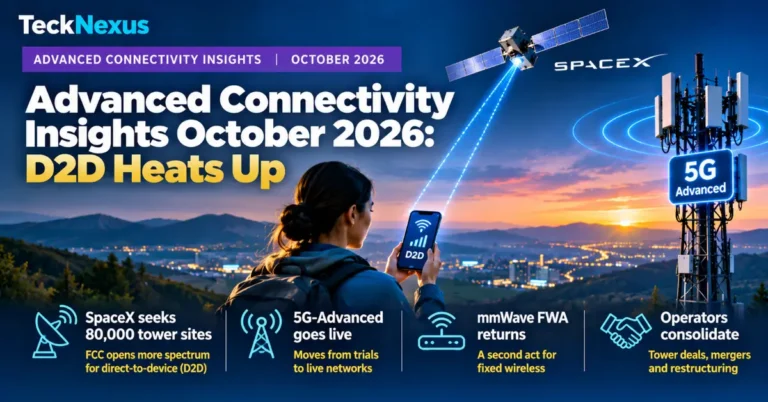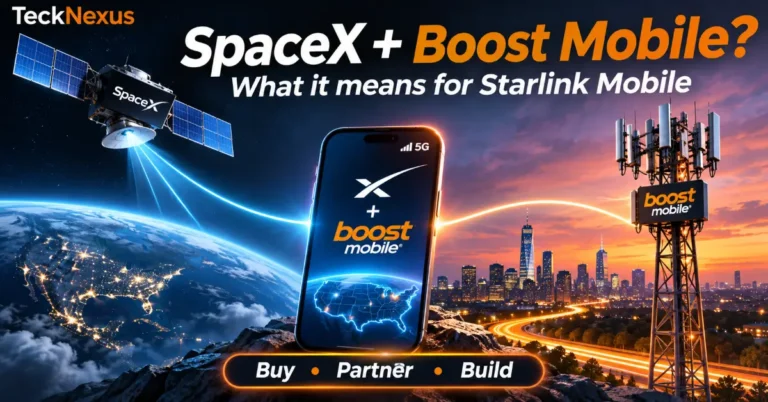
SpaceX has held talks with EchoStar about either acquiring Boost Mobile or gaining access to the network that Boost uses, according to press reports published on 2 November 2026. The reports say Elon Musk met EchoStar chairman Charlie Ergen in October to discuss a deal. Neither company has confirmed the talks or any terms, and both the structure and the outcome remain open. EchoStar shares rose on the news.

Read quickly, the story looks like another twist in Musk’s very public push to turn Starlink into a mobile carrier. Read in context, it says something more important about where satellite-to-phone services are heading. Direct-to-device connectivity is moving beyond emergency texting in dead zones towards a full consumer mobile service, and the operators building it are discovering that satellites alone are only half of that product. The other half lives on the ground, in towers, billing systems, retail stores and customer relationships.
The SpaceX Boost Mobile Talks at a Glance
| Item | Detail |
| Status | Reported, preliminary talks; not confirmed by either company |
| Parties | SpaceX and EchoStar, owner of Boost Mobile |
| Options reported | Outright acquisition of Boost Mobile, or access to the network Boost uses |
| Boost Mobile today | About 7.4 million wireless subscribers, a national retail footprint, and billing and customer care operations |
| Boost network model | Hybrid MVNO, using capacity leased from AT&T and T-Mobile after EchoStar sold most of its spectrum in 2025 |
| SpaceX spectrum | AWS-4 and H-block bought from EchoStar in 2025 for about $17 billion; agreement in October 2026 to acquire Grain Management’s nationwide 800 MHz portfolio, subject to FCC approval |
| SpaceX satellite plans | FCC approval in October 2026 for a next-generation direct-to-device constellation of up to 15,000 satellites |
| Stated mobile goal | Full 5G-quality Starlink Mobile service, targeted for the first half of 2028 |
| Price and terms | None disclosed |
Why SpaceX Wants Boost Mobile: the Ground Layer Satellites Cannot Provide
Satellite-to-phone links have improved quickly, but the physics of the task have not changed. A signal from low Earth orbit reaches a handset outdoors well enough for messaging and, increasingly, for data. It struggles to reach phones inside buildings and to serve dense crowds in cities, which is where most mobile usage actually happens. A consumer carrier that works only outdoors and only away from city centres would be a valuable complement, but it would not be a primary phone plan for most people.
That is the gap Boost could help close. SpaceX has said it intends to become a major US mobile carrier, and it has assembled the spectrum and satellite capacity to support that ambition. What it has not yet assembled is the terrestrial layer and the consumer operating machinery around it. Boost brings several pieces of that machinery at once:
- A customer base. Millions of existing subscribers who already pay a monthly mobile bill.
- Retail and distribution. A national network of stores, dealers and online channels for handsets and plans.
- Operating systems. Billing, number porting, activation, device management and customer care, the unglamorous systems every carrier depends on.
- Network experience. Years of running a 5G core and managing traffic across leased and owned capacity in a hybrid model.
Building all of this from scratch typically takes years. Acquiring it, or partnering with someone who already has it, could compress the timeline considerably.
How the SpaceX Boost Mobile Talks Fit the Starlink Mobile Strategy
The reported talks are the latest in a sequence of moves that, taken together, sketch a hybrid satellite and terrestrial carrier:
| Building block | What SpaceX has done | What it adds |
| Mid-band spectrum | Bought EchoStar’s AWS-4 and H-block licences in 2025 | Capacity licensed for both satellite and terrestrial use |
| Low-band spectrum | Agreed in October 2026 to acquire Grain Management’s 800 MHz portfolio | Coverage that travels far and penetrates buildings, supported by most existing handsets |
| Satellites | FCC approval in October 2026 for a next-generation direct-to-device constellation | Much higher throughput per satellite than today’s service |
| Service ambition | Announced in August 2026 its aim to become a major US mobile carrier | A full consumer offer rather than a carrier add-on |
| Ground network and customers | Reported talks with EchoStar over Boost Mobile | Indoor and urban coverage, subscribers and carrier operations |
SpaceX has also described a terrestrial approach of its own, placing small cellular base stations on the hardware that holds Starlink broadband dishes on homes and businesses. Seen against that plan, a Boost deal would not replace in-house building. It would sit alongside it, giving the company a working carrier while its own terrestrial and satellite layers scale up.
Buy, Partner or Build: The SpaceX Boost Mobile Options
Any deal will turn on structure as much as price. Boost does not own a nationwide tower network; its coverage today depends on wholesale agreements with AT&T and T-Mobile. Wholesale agreements of this kind usually include change-of-control and assignment provisions, so the host carriers would have a say in whether service continues under new ownership. Boost’s T-Mobile agreement is also scheduled to wind down in 2027. Industry analysts have therefore suggested that a partnership or joint venture may be more practical than a clean acquisition.
| Path | What it would deliver | What it depends on |
| Acquire Boost Mobile | Subscribers, brand, retail channels and carrier operating systems in one step | Host carrier consent for network access, or a replacement ground network |
| Partner or joint venture | Access to Boost’s customers and operations without a full change of ownership | Agreement on structure and on how existing wholesale terms apply |
| Build in-house | Full control of a hybrid satellite and small-cell network | Time, capital, site access and regulatory clearance at national scale |
These paths are not mutually exclusive. The most likely long-term outcome is a combination, with a terrestrial partner or acquired business bridging the years until SpaceX’s own infrastructure is in place.
What the SpaceX Boost Mobile Story Means for the US Wireless Market
The US market has been served by three national network operators since 2020, when the T-Mobile and Sprint merger created the opening that Boost and EchoStar were meant to fill. EchoStar’s decision in 2025 to sell its spectrum and move Boost to a hybrid MVNO model left that fourth-network role unfilled. A satellite-led entrant with a terrestrial foothold would be an entirely different kind of fourth player, one whose coverage starts from the sky and fills in from the ground, rather than the reverse.
The incumbents have already responded to the rise of direct-to-device services. AT&T, T-Mobile and Verizon formed a satellite-focused joint venture in May 2026, and all three have said they do not plan to offer SpaceX wholesale access to their networks. Each has its own view of how satellite and terrestrial networks should fit together, and each is investing in that combination.
Whatever happens with Boost, the direction of travel is clear. Mobile networks are becoming multi-layer systems that combine low-band and mid-band terrestrial spectrum, small cells and satellites. Standards work on non-terrestrial networks within 3GPP is making that blend increasingly seamless for ordinary handsets. The competitive question is no longer whether satellites will become part of mainstream mobile service, but who will own the customer relationship when they do.
What to Watch Next in the SpaceX Boost Mobile Talks
- Confirmation and structure. Whether either company confirms the talks, and whether any deal takes the form of an acquisition, a partnership or a joint venture.
- Host carrier positions. How AT&T and T-Mobile treat Boost’s wholesale agreements in any change of ownership or control.
- Regulatory reviews. FCC approval of the 800 MHz spectrum transfer and any review a Boost transaction would require.
- Satellite deployment. The pace at which next-generation direct-to-device satellites reach orbit ahead of the 2028 service target.
- Terrestrial build. Progress on SpaceX’s own small-cell approach and any further spectrum moves.
The Bigger Picture
The SpaceX Boost Mobile talks may or may not produce a deal. Either way, they mark a turning point in how the industry thinks about direct-to-device connectivity. The first phase was about proving that an ordinary phone could connect to a satellite. The next phase is about building a complete mobile service around that capability, and that requires spectrum, ground infrastructure, operating systems and customers as much as it requires satellites.
For a market that has been settled around three national network operators for most of the past decade, a well-funded entrant assembling those pieces is a significant development. How quickly it comes together will depend on partners, regulators and the pace of satellite deployment over the next two years.
For more analysis of satellite, non-terrestrial networks and the future of mobile connectivity, read TeckNexus Monthly Insights. Have a perspective on direct-to-device or satellite connectivity to share? Partner with TeckNexus to put your insight in front of decision-makers and generate leads.