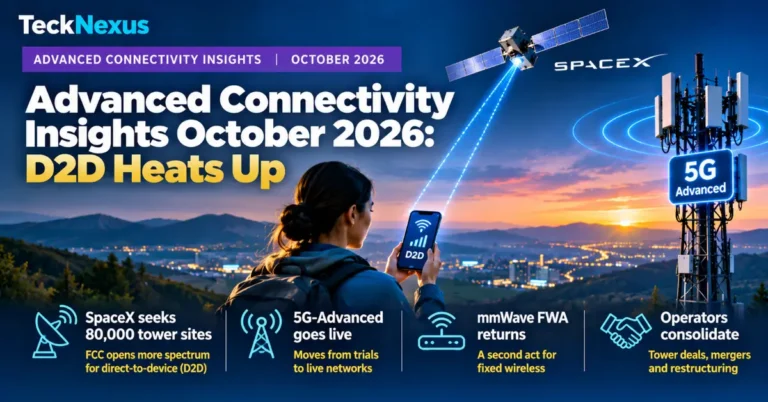
Advanced Connectivity Insights October 2026: direct-to-device turned into a contest over spectrum and tower sites, 5G-Advanced and AI-driven RAN features moved onto commercial networks while 6G plans stayed evolutionary, fixed wireless and fibre access kept expanding, operators reshaped portfolios through sales, mergers and job cuts, enterprises and venues got new connectivity options, and US policy activity focused on spectrum and supply chain security.

At a glance: Advanced Connectivity Insights October 2026
- Direct-to-device became a tower and spectrum contest: SpaceX is negotiating leases for at least 80,000 US tower sites and targets an early 2028 Starlink Mobile launch, the FCC approved Amazon‘s $11.5 billion Globalstar acquisition and proposed new D2D spectrum, and AST SpaceMobile targets initial coverage in five countries by year-end.
- 5G-Advanced reached live traffic: T-Mobile US trialled AI-managed beamforming with Ericsson on its 5G-Advanced network, Singtel and Ericsson signed a five-year 5G-Advanced pact, and VodafoneThree set out a £2 billion Nokia and Ericsson programme targeting £1 billion in annual savings.
- Fixed access kept expanding: TeckNexus examined Verizon‘s plan for gigabit mmWave fixed wireless, Jio aims to grow home broadband from about 30 million to 100 million households, Nokia added a 16-port Multi-PON line card and AT&T signed a $3 billion fibre supply deal with Corning.
- Operators reorganised: AT&T agreed to sell AT&T Mexico, BT acquired TalkTalk out of administration, Deutsche Telekom paused a T-Mobile US merger, Zain and Ooredoo combined 4,000 towers, and AT&T and Verizon cut about 8,000 jobs in Q3.
- Enterprise and venues gained options: Telefónica’s Titán Connect passed 800 customers, AT&T launched its fourth-generation arena network with the NBA and WNBA, and Inseego and Verizon launched a portable 5G router with Wi-Fi 7.
- Policy stayed busy: the FCC opened more than 1,000 MHz for satellite services, allowed drone operations in 50 MHz of the 800 MHz band and proposed new limits on Covered List entities, while Australia passed baseline voice and text coverage rules.
1. Direct-to-device becomes a spectrum and tower contest
Satellite-to-phone services stopped being a coverage add-on this month and became a question of spectrum ownership, tower access and who serves the customer.
- SpaceX (US): is negotiating leases with US tower operators, including Crown Castle, for at least 80,000 sites for a nationwide mobile network; it targets early 2028 for Starlink Mobile after deploying its second-generation constellation in 2027, holds FCC authorisation for up to 15,000 direct-to-device satellites with completion required by October 2035, and is acquiring 14 MHz of 800 MHz spectrum.
- Amazon (US): the FCC approved its $11.5 billion acquisition of Globalstar, including about 25 MHz of mobile satellite services spectrum, supporting its plan to extend into direct-to-device; separately, Globalstar received nationwide FCC authority for its C-3 system.
- FCC (US): sought comments on making nearly 500 MHz available for direct-to-device, proposed an auction of 25 MHz in 1675 to 1695 MHz and 2020 to 2025 MHz for satellite D2D and terrestrial use, and adopted its Satellite Spectrum Abundance Order opening more than 1,000 MHz in the 12 GHz and 42 GHz bands.
- US operators: T-Mobile US, Verizon and AT&T finalised a joint venture to pool spectrum and extend satellite coverage; on Q3 calls, T-Mobile US ruled out a satellite MVNO with SpaceX and Verizon’s CEO said a rival terrestrial network would take years and very large capex to build.
- AST SpaceMobile: targets initial, intermittent satellite mobile broadband coverage by year-end in the US, Canada, Japan, the UK and Saudi Arabia, and appointed Derek Peterson as SVP and CTO of Enterprise & Platforms.
- Rogers Communications (Canada): extended direct-to-device satellite messaging roaming to Australia, New Zealand and Japan, adding to existing coverage in the US through T-Mobile US.
- Terrestar Solutions, Space42 and Viasat: signed an MoU on an open framework and interoperability for shared direct-to-device satellite infrastructure.
- American Tower: said tower companies now own Dish Wireless’s abandoned 5G radios and antennas on their sites, which analysts suggest could fit SpaceX’s terrestrial plans.
- TeckNexus analysis: “SpaceX’s $8B Spectrum Play: Starlink Mobile Is Building a Network, Not Just a Satellite Service” and “Europe’s Largest Operators Bid to Shape Direct-to-Device” map the US and European approaches.
Why it matters for buyers: direct-to-device is moving from emergency messaging towards a broader service with its own spectrum and ground infrastructure. Enterprises with remote sites, fleets or field teams should track which providers will hold the spectrum and partner with their current carrier, since that will decide coverage, pricing and contract options from 2027 onwards.
→ Compare satellite, terrestrial and hybrid coverage options with the TeckNexus Technology Selector.
2. 5G-Advanced, AI in the RAN and an evolutionary path to 6G
Operators pushed 5G-Advanced and AI-driven radio features onto commercial traffic, while most voices argued for a 6G path that protects existing investment.
- T-Mobile US and Ericsson: are running AI-managed beamforming on live commercial traffic on T-Mobile’s 5G-Advanced network, using SRS-based measurements to direct beams, with the largest gains seen during peak traffic.
- Singtel and Ericsson (Singapore): signed a five-year agreement focused on scaling 5G-Advanced, network automation and AI-native applications.
- VodafoneThree (UK): set out a £2 billion agreement with Nokia and Ericsson targeting £1 billion in annual cost savings by fiscal 2032, prioritising integrated RAN to meet rollout deadlines, with C-band 5G already reaching 50 million people and 99% 5G Standalone population coverage targeted by 2030.
- O2 (UK): switched on its 5G+ network across Bristol at no extra cost to eligible customers; Ericsson was selected by Cellnex Poland for RAN modernisation and expansion.
- Energy and automation: Deutsche Telekom demonstrated up to 65% energy savings in initial 5G core trials and KDDI reduced network optimisation work time by more than 95%, while Deutsche Telekom said AI-driven uplink traffic is unlikely to require additional RAN capex in the medium term.
- GSA: reported that the move to 5G Standalone remains gradual and highlighted progress in RedCap, non-terrestrial networks and 5G-Advanced; the OCUDU Ecosystem Foundation released an update to its open-source CU/DU software.
- 6G direction: Orange advocated an evolutionary 6G strategy that maximises 5G investment, Ericsson and Nokia signalled incremental migration from 5G Core to a 6G core while Huawei argued for a redesign, a 6G Forum discussion found limited clarity on which applications will justify investment, and Reliance Jio outlined a 6G transition through software upgrades across about 360,000 towers.
- Jio (India): entered the top 20 of WIPO’s 2025 PCT patent applicant rankings, climbing 320 places, with 6,817 cumulative patent filings and 1,009 granted patents as of March 2026.
- Vietnam’s Ministry of Science and Technology: directed operators to integrate 5G into production and business, with 2027 to 2030 priorities including industrial private 5G, ports and smart cities, and preparation for 5G-Advanced and 6G.
Why it matters for buyers: 5G-Advanced features and AI-driven radio optimisation are arriving as software upgrades on existing networks, and 6G is likely to follow the same evolutionary path. Enterprise buyers should ask carriers which Standalone and 5G-Advanced capabilities are live in their areas today, rather than waiting for 6G.
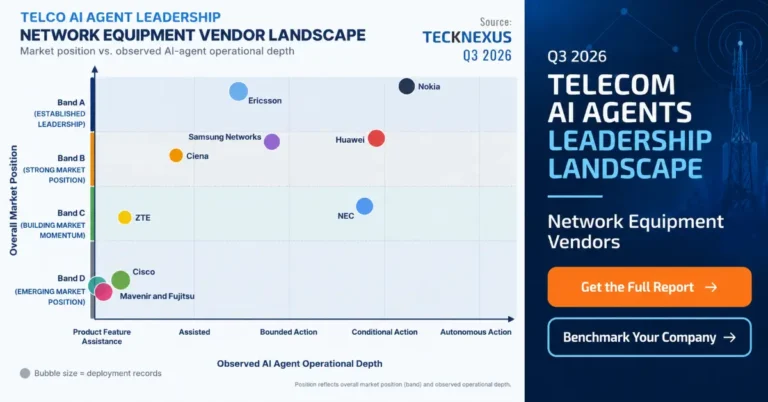
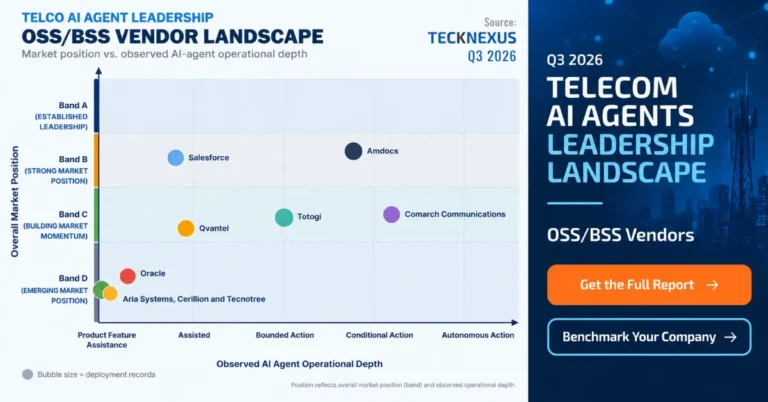
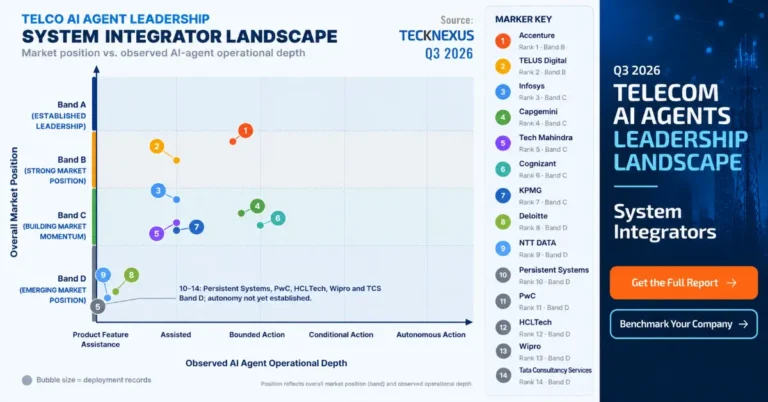
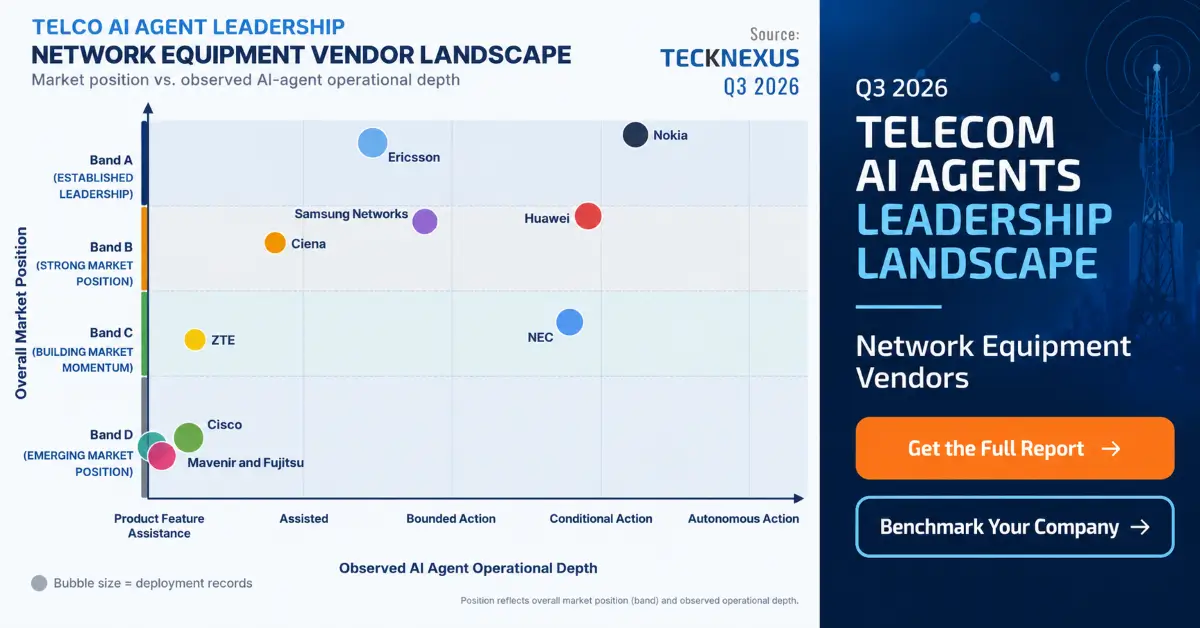
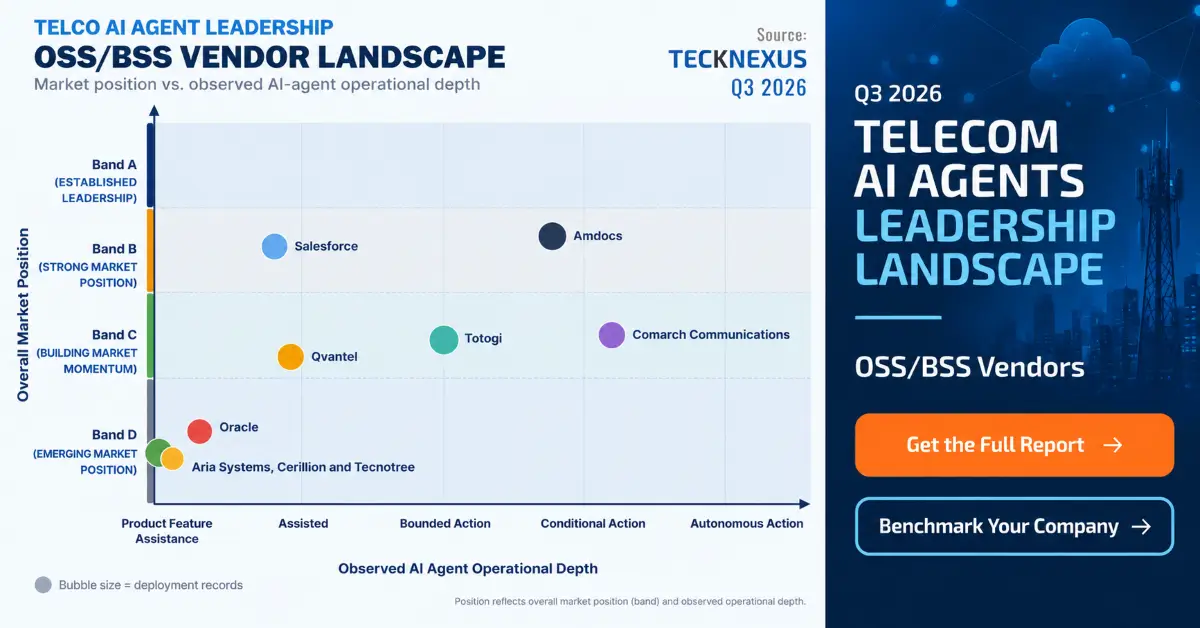
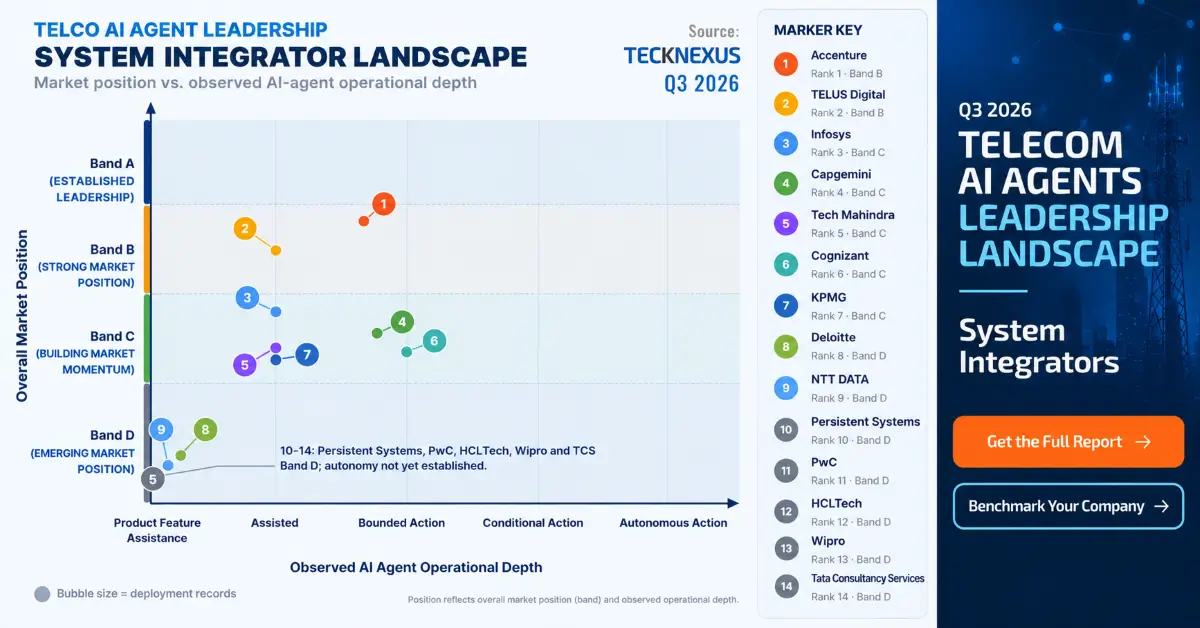
→ See how vendors and integrators are taking AI into network operations in the TeckNexus Telecom AI Agents Leadership Landscapes.
3. Fixed wireless, fibre and backhaul keep expanding
Fixed access grew on every front in October, from mmWave and unlicensed-band wireless to multi-PON fibre, DOCSIS 4.0 and higher-capacity backhaul.
- Verizon (US): plans to deliver 1 Gbps fixed wireless over its mmWave holdings; TeckNexus analysis “mmWave FWA Gets a Second Act as Verizon Turns Idle Spectrum into Gigabit Broadband” explains why fixed mmWave works where mobile struggled. Separately, UK vendor CBNG entered administration, affecting about 75 jobs, after Verizon decided not to use its mmWave product.
- Reliance Jio (India): aims to expand home broadband from about 30 million to 100 million households, using an in-house wireless solution in unlicensed bands that reportedly accounts for about 40% of new additions; Indian operators also asked for standard-power FWA and point-to-multipoint use to reach rural and semi-urban areas.
- Federated Wireless and Element8 (US): Element8 used Federated Wireless‘s Adaptive Network Planner during a five-week deployment, raising FWA installation success from 79% to over 90%.
- Inseego and Verizon (US): launched the MiFi PRO M4335, a portable 5G router with Wi-Fi 7 for Verizon’s Business Internet On-the-Go service, supporting up to 50 devices.
- Fibre access: Nokia introduced a 16-port Multi-PON line card on its Quillion chipset, with each port supporting GPON, 10G, 25G and 50G PON; VodafoneZiggo began deploying Hitron’s CGNDP4 DOCSIS 4.0 field testing platform; NVIDIA said it has no plans for an AI-RAN equivalent in fixed access.
- AT&T (US): signed a multiyear fibre and cable supply partnership with Corning worth more than $3 billion, supporting its goal of reaching 60 million Americans with high-speed internet by 2030, and will hold 50% of a joint venture combining Gigapower with Forged Fiber 37.
- Backhaul and transport: Orange Egypt and Huawei deployed co-channel interference cancellation microwave across Orange Egypt’s backhaul network with up to 400% spectrum efficiency gains, Arelion and Nokia achieved a 21% increase in usable optical spectrum on a 500 km Amsterdam to London route, and Movandi announced a 60 GHz connectivity platform built on its MV6055 transceiver.
Why it matters for buyers: buyers now have more ways to connect sites than fibre alone, from gigabit mmWave and portable 5G to unlicensed-band wireless. Each option carries different installation risk and supplier dependence, as Element8’s install rates and CBNG’s exit show, so delivery track record belongs in the evaluation.
4. Operators sell, merge and slim down
October’s deal flow showed operators reorganising around focus, scale and outside capital, with earnings and job cuts adding pressure.
- AT&T: agreed to sell AT&T Mexico to Grupo Televisa and Fintech Holdings to focus on US 5G and fibre; Mexico’s antitrust regulator cleared Telefónica’s US$450 million sale of Telefónica México to an Oxio-led consortium.
- BT Group (UK): acquired TalkTalk Telecommunications and PlatformX Communications out of administration on a debt-free basis, with an estimated FY27 cash impact of about £400 million and the businesses operating separately during a regulatory review; the CMA raised provisional concerns over Nexfibre’s planned acquisition of Netomnia.
- Deutsche Telekom: decided not to submit a formal offer to merge with T-Mobile US at this time, following opposition from its works council and trade unions.
- Towers and regional deals: Zain Group and Ooredoo Group closed the first phase of a 50:50 tower joint venture combining 4,000 towers in Kuwait and Qatar, VEON agreed to acquire Rubicon Wireless (Perfectum) in Uzbekistan, and AIS will acquire a 24.01% indirect stake in Lao Telecom for $43.35 million.
- Smaller deals: KPN acquired Xelion for its SME communications business, Noble Mobile acquired SmartLess Mobile, and Univastu India bought remaining Cambium Networks assets for $5.1 million; Telefónica Deutschland added Revolut as a wholesale mobile customer in Germany.
- Earnings: Samsung‘s Mobile eXperience and Networks unit posted a KRW600 billion operating loss despite revenue rising 11% to KRW37.7 trillion, Chinese operators reported deeper Q3 losses, and Amphenol raised CommScope’s 2026 sales outlook to $5.1 billion on AI data centre demand.
- Workforce: AT&T and Verizon cut about 8,000 jobs in Q3 2026, with Verizon reducing headcount by 4,300 and AT&T by 3,700.
- TeckNexus analysis: “Shrinking to Grow: What October’s Deals Reveal About Telecom Consolidation in 2026” and “Jio Platforms IPO: What India’s Record Listing Says About the Value of 5G Scale and AI Ambition”.
Why it matters for buyers: ownership changes affect roadmaps, support and contract terms. Enterprises with contracts in Mexico, the UK broadband market or with affected vendors should confirm service commitments and change-of-control clauses now, and factor supplier stability into upcoming tenders.
5. Enterprise, venues and resilience
Operators extended connectivity into businesses, stadiums, transport and remote sites, with resilience and security packaged alongside access.
- Telefónica (Spain): its Titán Connect portfolio passed 800 customers in Spain within nine months, and Telefónica and NOS signed a collaboration on secure, interoperable 5G for European defence after combining their networks at the REPMUS 2026 exercise.
- AT&T (US): launched its fourth-generation High-Speed Arena Network with the NBA and WNBA, backed by more than 68,000 miles of fibre, and extended its multiyear marketing partnership with USA Basketball.
- Transport corridors: South Korea’s MSIT will back a nationwide rollout of 5G-based Wi-Fi on subway networks after Incheon Metro deployments, and Vodafone Czech Republic and Vantage Towers added 5G along the Prague to Ostrava railway corridor with a branch to Brno.
- Remote and resilient coverage: MTS launched the MFO-15, a 15-metre self-powered rapidly deployable tower for off-grid sites, and VodafoneThree began a three-year partnership with National Parks UK and Cairngorms National Park using AI, IoT sensors and connected cameras for wildfire prevention.
- Managed networking and security: Netskope and BT International expanded Security Service Edge connectivity through BT’s Global Fabric, Vi Business partnered with Cisco Meraki on Hybrid SD-WAN in India, HPE aligned EdgeConnect SD-WAN with HPE Mist and HPE Aruba, and Lumen integrated its programmable network with Snowflake’s AI Data Cloud.
- Partnerships: Polsat Plus Group signed a three-year Vodafone Partners agreement focused on AI customer service and B2B growth in Poland, and Bharti Airtel signed a premium content partnership with YouTube.
- Customer view: J.D. Power’s 2026 US Business Wireless Satisfaction Study rose nine points to 735 out of 1,000, with timely access to knowledgeable representatives still a priority despite more automation.
Why it matters for buyers: connectivity offers for enterprises increasingly bundle resilience, security and managed operations. Buyers should evaluate the service model and support access as carefully as speed and coverage, since J.D. Power’s results show human support remains a deciding factor.
6. Policy, spectrum and supply chain security
Regulators were active on spectrum use, device security and coverage obligations, with the US FCC setting much of the agenda.
- FCC (US): voted to allow drone operations in 50 MHz of the 800 MHz band, proposed barring Covered List entities from direct access to US phone numbers for VoIP, blocked the US sale of a dashcam and video transmitter using HiSilicon chips, and set a vote on rules letting prisons jam contraband cellphones.
- TP-Link: its request for an FCC waiver to market two Wi-Fi 8 routers in the US faces opposition from state lawsuits and letters from 21 state attorneys general.
- Broadcast: the National Association of Broadcasters and Sinclair opposed a petition to let low-power TV stations deploy 5G Broadcast, citing fragmentation of ATSC 3.0.
- Australia: passed the UOMO bill requiring major operators to ensure baseline voice and SMS coverage across the whole country.
- Singapore: authorities allege Simba Telecom‘s senior management approved unauthorised radio frequency use, exposing it to fines and possible licence loss.
- GSMA: set priorities on smartphone affordability, online scams, network investment and 6G cooperation, noting 3.4 billion people remain unconnected; it confirmed a 26-member board and reported Open Gateway participation by operators covering more than 80% of the world’s population.
- Europe and India: Telefónica called for a more flexible, investment-friendly regulatory framework in Spain, and India’s government targets a homegrown smartphone within two years.
Why it matters for buyers: spectrum decisions and equipment restrictions are reshaping which devices and services enterprises can deploy. Procurement teams should check device and component origin against current FCC rules and watch drone and D2D spectrum decisions that may open new options for field operations.
→ Check readiness and compliance gaps with TeckNexus Assessments.
What Advanced Connectivity Insights for October 2026 means if you’re evaluating connectivity
October’s throughline is restructuring: satellites are acquiring terrestrial assets, operators are narrowing their focus, and new access options are arriving. Six moves follow directly from the month:
- Plan for hybrid coverage: SpaceX, Amazon, AST SpaceMobile and the US carrier joint venture all point to satellite and terrestrial services converging from 2027.
- Ask what is live today: 5G Standalone and 5G-Advanced features such as AI-managed beamforming are rolling out as software, so check local availability rather than waiting for 6G.
- Widen your access shortlist: gigabit mmWave, portable 5G, unlicensed-band wireless and multi-PON fibre all reached the market or scaled this month.
- Check supplier stability: sales, administrations and mergers at AT&T, BT, CBNG and others make change-of-control terms and roadmap commitments worth reviewing.
- Value support and resilience: managed security, SD-WAN and human support access matter as much as headline speed, according to this month’s enterprise data.
- Track the policy calendar: FCC decisions on D2D spectrum, drones and Covered List entities will shape device and service options in 2027.
Catching up? Last month’s signal is here: Slices for Sale, Satellites Cleared: Advanced Connectivity Insights, September 2026 →
→ Start with the TeckNexus Intelligence Platform: independent, buyer-neutral tools for spectrum, TCO, architecture, and RFP decisions.
This analysis is drawn from TeckNexus’s full curated Advanced Connectivity Monthly Insights for October 2026. See every deployment, product, and partnership update →
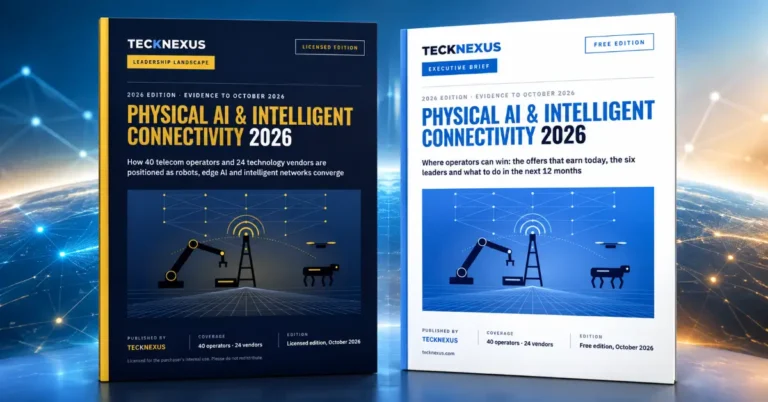
| Related Intelligence: Physical AI & Intelligent Connectivity Leadership Landscape 2026
An assessment of 40 telecom operators on physical AI. It covers the six leaders, the offers already earning revenue, a partner map and a 2027 milestone tracker, based on 220 evidence records current to October 2026. Download the free brief → |