SD-WAN

Software-defined wide area networking (SD-WAN) uses software to manage and optimize connectivity across distributed sites, intelligently routing traffic over multiple links — broadband, cellular, and private circuits — based on application needs. It replaces rigid, hardware-centric WANs with flexible, centrally managed networks that cut cost and improve performance for cloud-era applications. SD-WAN is increasingly bundled into broader secure access frameworks like SASE, blurring the line between networking and security. For enterprises, it’s a practical way to connect branches, remote sites, and clouds efficiently; for operators and vendors, it’s a managed-service opportunity. This channel covers SD-WAN across enterprise and operator deployments — technology, vendor strategy, and its convergence with security — with analysis of where software-defined WANs deliver measurable gains and how they fit into wider connectivity and security architectures.

The European Commission has approved Orange’s plan to acquire the remaining stake in MasOrange, signaling limited competitive impact and clearing the path for full control in Spain. Orange will purchase the roughly 50% it does not already own in MasOrange from the Lorca consortium for about €4.3 billion. MasOrange was created in 2024 by combining Orange Spain and MásMóvil, and the new deal converts the joint venture into a wholly owned Orange subsidiary. The Commission used its simplified merger review, indicating no structural change in market concentration. Closing is expected before July 2026, after which MasOrange will be integrated into Orange’s operations and financial reporting.
Private LTE, 5G, and CBRS networks are becoming the backbone of industrial operations. This article maps private network security vendors to a Four Pillars framework—Core Controls, Device Visibility, Detection & Response, and Orchestration—revealing where structural gaps emerge in real-world industrial deployments. From slice isolation and SIM lifecycle governance to OT micro-segmentation and SOC integration, it explains why layered enforcement—not vendor breadth—determines private 5G security resilience.
SpaceX’s anticipated 2026 IPO is not just a space-launch story; it is a capital and scale inflection that could reorder parts of the mobile and broadband value chain. Market chatter pegs SpaceX’s IPO valuation around the trillion-plus mark with a potential multibillion-dollar primary raise, a war chest that would dwarf most rivals’ balance sheets. For telecom, the same cash advantage accelerates Starlink’s network deployment, ground infrastructure, and device partnerships—compressing the window for incumbents to respond. Starlink reports more than 9,000 satellites in orbit, 9.2 million paying customers, and over $10 billion in annual revenue.
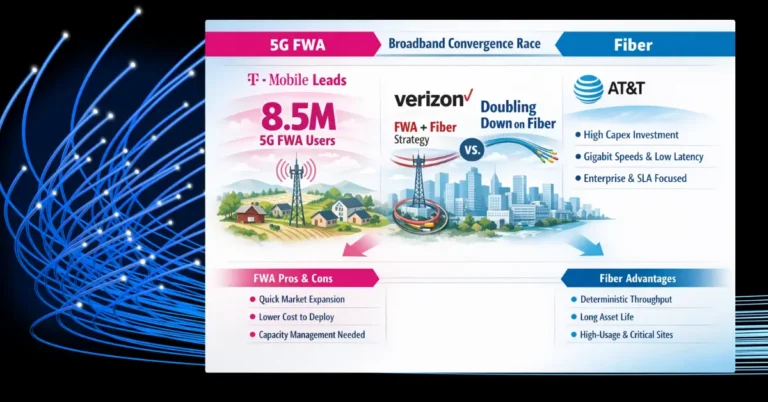
FWA is capex-light and fast to deploy, especially in mid-band-rich markets, which makes it ideal for quick share gains, addressable market expansion, and rural or underserved pockets. Its constraint is shared capacity: as mobile traffic grows, operators must manage prioritization, peak congestion, and plan mix to preserve experience. Fiber demands higher upfront capital but delivers deterministic throughput, low latency, and long asset life that underpins premium ARPU, enterprise SLAs, and wholesale opportunities. Expect operators to steer FWA toward segments with favorable traffic profiles and use fiber for high-usage clusters and enterprise-critical sites.
The merger creates a $1.25 trillion private giant that fuses launch, satellites, and AI, but the strategic logic goes beyond orbiting data centers. SpaceX brings rockets, Starship scale, and the world’s largest NGSO broadband network via Starlink. xAI brings models, AI R&D, and a brand in the hottest capital market category. Together, they present a single story to investors: own the stack from compute to constellation to connectivity, on and off Earth. Consolidation gives Musk freedom to reallocate cash flows and simplifies the roadshow pitch.
The operators that control both dense fiber and performant 5G, and that package them coherently, will set the pace for the next telecom cycle. AT&T’s targets—more fiber passings, higher bundle attach, and measured wireless growth—put it squarely in the camp that sees integrated networks as the winning model. If the company executes on build cadence and cross-sell while keeping experience clean, expect continued share gains in fiber markets and a tougher environment for single-asset competitors. For buyers, the practical takeaway is to lean into converged sourcing now to lock in economics and resiliency as these footprints expand.
TeraWave combines 5,280 low Earth orbit satellites with 128 medium Earth orbit satellites—5,408 spacecraft in total—tied together via optical inter-satellite links. The design targets global coverage with two distinct performance tiers: up to 144 Gbps symmetrical RF links per enterprise customer using Q/V-band in LEO, and optical links in MEO delivering up to 6 Tbps for high-throughput trunking between hubs. Blue Origin positions the service for point-to-point private links and enterprise-grade internet access, with an initial target of up to 100,000 customers. The company intends to launch on its own New Glenn vehicles and leverage reusable engines to scale deployment.
A new analysis of U.S. fixed wireless access shows subscriber momentum outpacing performance, a signal that capacity and management strategies are under pressure. Fixed wireless access from T-Mobile, Verizon, and AT&T added about 1.04 million net customers in Q3 2025, taking the U.S. FWA base to roughly 14.7 million. T-Mobile remains the U.S. FWA speed leader, posting a median download around 209 Mbps in Q3 2025. Median uploads dipped below 20 Mbps across providers, creating a hurdle for the FCC’s 100/20 benchmark. Urban FWA customers are more likely to meet the FCC’s 100/20 threshold than rural users due to radio geometry and site density.
Work at local distribution points often triggers unintended service cuts, driving spikes in complaints, repeat truck rolls, and SLA penalties. By empowering on-site technicians to detect and remediate cuts instantly—rather than wait for back-office workflows—operators can compress mean time to repair, avoid secondary visits, and reduce inbound support volume. The result is fewer avoidable outages and a more predictable experience for consumers and businesses using fiber for VPN, SD-WAN, and cloud access. Previous collaboration (Lot 1) notified operators when their customers were impacted by nearby work, but the model was still largely reactive. Lot 2 integrates detection and authorization directly into technicians’ mobile tools.
Alphabet’s Google will spend $40 billion to build three AI-focused data centers in Texas, signaling that power access and grid proximity now define hyperscale strategy more than any single technology feature. The build spans one campus in Armstrong County in the Texas Panhandle and two in Haskell County near Abilene, with investments running through 2027. Google expects the program to create thousands of construction and supplier jobs and hundreds of long-term operations roles, consistent with typical hyperscale staffing patterns. Texas offers relatively low-cost power, faster interconnection timelines, abundant land, and pro-investment policies, making it second only to Virginia in U.S. data center count.
Amazon has moved its low Earth orbit broadband effort out of code-name mode and into a market-facing brand with strategic implications for telecom and enterprise buyers. Project Kuiper is now Amazon Leo, a direct reference to the low Earth orbit constellation underpinning the service. The rebrand signals a transition from R&D to commercial execution. Amazon reports more than 150 satellites in orbit today—roughly 153 by recent counts—following a string of successful launches and a completed prototype mission. The company says it will light up service as it adds coverage and capacity.
Hewlett Packard Enterprise and seven partners have formed a global consortium to accelerate fault-tolerant, hybrid quantum computing that can be deployed alongside today’s high performance computing and semiconductor ecosystems. Dr. Masoud Mohseni of HPE Labs serves as quantum system architect, coordinating a full-stack effort to design a practically useful, cost-effective “quantum supercomputer,” with the near-term emphasis on hybrid integration, error-correction maturity, and manufacturability. The Alliance is structuring work around the most stubborn barriers to scale: error correction, orchestration with classical systems, and semiconductor-grade design and manufacturing. Aligning supercomputing and semiconductor leaders around a single roadmap increases the odds of reaching fault tolerance on economically viable timelines.

Frequently Asked Questions

What does SD-WAN do differently from a traditional WAN?
SD-WAN uses software to intelligently manage and route traffic across multiple types of connections, such as broadband, cellular, and MPLS, automatically choosing the best path for each type of traffic rather than relying on fixed, manually configured routing. A centralized controller defines policies that determine how traffic should be handled, for example, prioritizing video conferencing traffic over a connection with lower latency while routing less time-sensitive traffic over a cheaper, higher-latency connection, and those policies are then automatically applied across all of an organization’s branch locations without needing to manually reconfigure routing at each individual site. This represents a meaningful shift from older WAN architectures, where routing decisions were typically fixed and required manual reconfiguration to change.
Why have businesses moved away from traditional MPLS networks toward SD-WAN?
MPLS, the traditional dedicated-line approach to wide-area networking, offers reliable, consistent performance but at considerably higher cost than standard internet connections, and with much less flexibility, since adding or changing an MPLS connection typically requires working directly with a carrier and can take weeks to provision. SD-WAN is generally more flexible and less expensive, since it can use standard broadband and cellular connections instead of dedicated leased lines, while still applying centralized policies and intelligent prioritization to approximate much of MPLS’s reliability benefit. This combination, lower cost and faster provisioning while still maintaining strong performance for critical applications, has driven a substantial shift among businesses toward SD-WAN, often as a hybrid approach that still retains some MPLS for specific high-priority connections.
How does 5G fit into SD-WAN deployments?
5G is increasingly used as a primary or backup WAN connection within SD-WAN setups, especially for retail locations, pop-up sites, or remote branches where running wired connections is slow, expensive, or simply impractical given a short-term lease. Because 5G connections can typically be activated quickly without waiting for a wired installation, organizations can stand up a fully functional branch location’s network connectivity considerably faster than waiting for a traditional wired internet connection to be installed. SD-WAN’s software-defined approach to traffic management works well with 5G specifically because it can automatically detect if a primary wired connection fails and seamlessly shift traffic to a 5G backup without manual intervention, giving organizations a more resilient connectivity setup.
What role does SD-WAN play in supporting cloud application performance?
Since SD-WAN can dynamically prioritize traffic and intelligently choose the best available connection for a given application, it’s commonly used to ensure cloud applications, which used to route inefficiently through a central corporate data center under older WAN architectures, get a more direct, optimized path to the internet rather than backhauling that traffic unnecessarily. Under older WAN designs, traffic destined for a cloud application might travel from a branch office all the way back to a central data center before being routed out to the internet, adding unnecessary latency. SD-WAN can instead route that cloud-bound traffic directly from the branch location to the internet, improving performance for the growing share of business applications running in the cloud.
How does SD-WAN actually decide which connection to use for a given piece of traffic?
SD-WAN systems typically make routing decisions based on a combination of factors defined in centrally configured policies: the specific application generating the traffic, real-time performance metrics like latency, packet loss, and jitter on each available connection, and the relative cost of different connection types. For example, a policy might specify that video conferencing traffic should always use whichever available connection currently has the lowest latency, even if that connection costs more, while routine email traffic can be routed over whatever connection is cheapest as long as it meets a basic reliability threshold. These decisions happen continuously and automatically, meaning SD-WAN can shift traffic mid-session if a connection’s performance degrades.
What happens if one of an organization’s internet connections fails while using SD-WAN?
One of SD-WAN’s core advantages is automatically detecting connection failures and rerouting traffic to a remaining functional connection without requiring manual intervention from IT staff. If an organization has multiple connections at a given location, for example, a primary fiber connection and a backup cellular connection, SD-WAN continuously monitors the health of each connection and can shift traffic to the backup automatically within seconds of detecting that the primary connection has failed or degraded significantly. This failover capability is one of the more commonly cited practical benefits organizations point to when justifying SD-WAN adoption, since it meaningfully reduces the business impact of an outage at a given location.
Is SD-WAN secure on its own, or does it need additional security layered on top?
SD-WAN itself typically includes basic security features like encryption for traffic moving between locations and some access control capabilities, but it’s generally not considered a complete security solution on its own, particularly for organizations with more complex security requirements or significant direct internet access at many distributed locations. This gap is part of what drove the development of SASE, which specifically combines SD-WAN’s networking capabilities with a more comprehensive set of integrated security functions, including firewall protection and zero-trust access control. Organizations using SD-WAN without a more comprehensive security layer typically need to deploy additional, separate security tools to achieve the same level of protection a fully integrated SASE platform would provide.
What kinds of organizations benefit most from SD-WAN?
Organizations with multiple physical locations, like retail chains, restaurant franchises, and distributed branch offices, tend to benefit most from SD-WAN, since it directly addresses the challenge of managing consistent network performance and policy across many sites without individually configuring expensive, dedicated connections at each one. Organizations with significant cloud application usage also benefit meaningfully, since SD-WAN’s ability to route cloud-bound traffic directly becomes increasingly valuable as more business applications move to the cloud. Organizations needing rapid deployment of new locations, like a fast-growing retail chain opening many new stores, particularly benefit from SD-WAN’s ability to get a new location connected quickly using readily available connections like broadband or cellular.

Sponsored by Palo Alto Networks
⚡ Utilities ⏱ 8 min ✓ Free
This tool is built and hosted by TeckNexus.
Launch Tool →
Whitepaper
Neutral host, network slicing, and autonomous ground vehicles look like three unrelated topics — but they share the same hidden security risk. See what 100 airport deployments reveal about securing the components with the broadest reach across the network....
Whitepaper
Airports are deploying AI surveillance, biometrics, and autonomous vehicles faster than most networks can secure them. See what 100 real-world airport deployments reveal about the airside/landside security gap — and the 4-layer framework built to close it....
Scroll to Top