5G FWA vs Fiber: US telco strategies and growth
With phone growth flattening, T-Mobile US, Verizon, and AT&T are tilting competition toward broadband, bundles, and network monetization.

T-Mobile SA 5G drives FWA subscriber growth
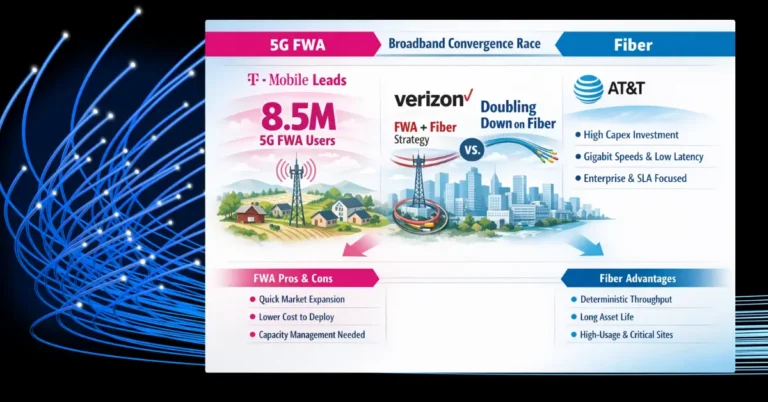
T-Mobile is leaning on its early move to a standalone 5G core to fuel both postpaid growth and rapid fixed wireless access (FWA) expansion. The operator posted industry-leading postpaid net additions again in 2025 and ended the year with 8.5 million 5G broadband customers, after adding nearly half a million 5G home internet lines in Q4 alone. Management credits a multi‑year head start on 5G SA—migrated in 2021—and mid‑band spectrum depth for better spectral efficiency, faster feature rollout (VoNR, uplink gains, and early slicing pilots), and the ability to light up more FWA capacity where demand is strongest. Financially, service revenue grew solidly in Q4 and for the full year, and 2026 guidance calls for nearly a million postpaid net account adds with strong EBITDA consistency—signaling confidence that FWA can continue to pull through converged accounts.
Verizon scales FWA + fiber amid AI-driven cost reset
Verizon remains the revenue leader and showed renewed postpaid phone momentum in late 2025 while growing FWA to more than 5.7 million customers. The carrier is also extending its fiber reach to tens of millions of locations, reinforcing a convergence strategy that blends 5G mobility, FWA, and fiber-to-the-premises where it is economically viable. Leadership has framed 2025 as the start of a company-wide reset, targeting multibillion-dollar operating expense reductions and a shift to “AI‑first” operations to streamline care, marketing, field service, and network planning. The combination—scale, cost transformation, AI tooling, and fiber depth—aims to stabilize share and improve customer lifetime value in a bundle-centric market.
AT&T accelerates fiber-first convergence strategy
AT&T posted steady wireless gains while accelerating fiber buildout past 32 million locations, with a near-term target of 40 million and ambitions to add several million more locations per year beyond 2026. The strategy is clear: lead with fiber where returns justify it, then cross-sell 5G and enterprise services to households and businesses at scale. Broadband adds are tilting toward fiber, and management is positioning fiber plus 5G as a differentiated, long-lived platform for multi-product relationships.
Why 5G FWA and fiber matter now
Broadband—delivered via 5G FWA or fiber—has become the core lever for growth, retention, and cross-sell in a mature wireless market facing cable bundle pressure.
Cable MVNO bundles force telco convergence plays
Cable operators have weaponized their home broadband bases to sell mobile via MVNOs, raising the bar on price and simplicity. In response, mobile operators are pushing the inverse: lead with wireless, add home internet, and wrap with content, device financing, security, and IoT. The result is a convergence race where household-level relationships trump single-line phone share, and where the stickiest accounts will combine broadband, mobility, and Wi‑Fi in one bill.
FWA cost advantages vs fiber ROI and use cases
FWA is capex-light and fast to deploy, especially in mid-band-rich markets, which makes it ideal for quick share gains, addressable market expansion, and rural or underserved pockets. Its constraint is shared capacity: as mobile traffic grows, operators must manage prioritization, peak congestion, and plan mix to preserve experience. Fiber demands higher upfront capital but delivers deterministic throughput, low latency, and long asset life that underpins premium ARPU, enterprise SLAs, and wholesale opportunities. Expect operators to steer FWA toward segments with favorable traffic profiles and use fiber for high-usage clusters and enterprise-critical sites.
5G-Advanced, mid-band spectrum, and CPE will drive performance
5G-Advanced features from 3GPP Release 18—enhanced uplink, smarter scheduling, improved mobility, and more mature slicing—can tighten FWA performance in dense markets. Mid-band depth (2.5 GHz, C-band, 3.45 GHz) remains the primary FWA performance driver, while mmWave is a targeted tool for dense fixed hotspots. On the premises, next-gen CPE with better antennas and Wi‑Fi 7 backbones will reduce in-home loss and raise effective throughput. Policy and funding also matter: fiber-friendly subsidies will shape where FWA is a long-term fixture versus a bridge solution.
2026 outlook: capacity, fiber builds, and AI ops
Operators’ near-term moves will reveal how sustainable FWA growth is and how far convergence can push margins and retention.
Managing capacity headroom and peak traffic
Monitor how carriers balance FWA and mobile during peaks, including prioritization tiers, traffic shaping, and any soft caps. Mid-band refarming, additional carrier aggregation, and uplink enhancements will be early indicators of headroom. Watch for commercial network slicing or tiered QoS that differentiates business-grade FWA from best-effort consumer service.
Fiber deployment cadence and subsidy impact
The cadence of fiber passings, take-rates, and per-location economics will determine where fiber-led bundles displace FWA. State-level broadband programs and pole-attachment timelines will influence whether telcos can outbuild altnets and municipals. Expect selective overbuilds in high-ARPU suburbs and targeted rural pushes where funding closes gaps.
AI-first operations to cut Opex and churn
Verizon’s AI-first pivot and broader industry adoption of predictive care, marketing mix modeling, and automated field ops should trim Opex and churn. The bigger prize is monetization—using AI to pre-qualify FWA households with the right QoS tier, proactively upsell fiber where available, and orchestrate multi-line, multi-product bundles without margin leakage.
Enterprise guidance: match access to workload
Match access technology to workload, negotiate for outcomes, and design for resilience at the edge.
Use FWA as primary or failover based on criticality
FWA can be a strong primary for pop-up sites, SD-WAN-enabled retail, and distributed IoT with modest upstream needs, and an excellent failover for fiber. For latency- or jitter-sensitive apps—real-time collaboration, upstream video, low-latency POS—favor fiber where available or require business-grade FWA with performance commitments and static IP options.
Negotiate bundles with SLAs, tiers, and credits
Bundle mobility with broadband to capture pricing power, but insist on clear performance tiers, enterprise CPE, rapid replace SLAs, and credits for missed targets. Explore pilots for 5G network slicing or prioritized APNs on FWA to separate mission-critical traffic. Align term lengths with known fiber build timelines to preserve upgrade flexibility.
Design for edge resilience and Wi‑Fi 7 upgrades
Standardize on CPE that supports dual-WAN (fiber plus 5G), application-aware routing, and Wi‑Fi 7 for dense client environments. Where private cellular is in scope, evaluate CBRS or licensed 5G for on-site determinism, and integrate with the same SD-WAN fabric used for FWA and fiber. Instrument sites with active monitoring to baseline latency, jitter, and loss so contract terms map to observed experience.
Bottom line: convergence wins with right-fit access
FWA has given T-Mobile a growth wedge while Verizon and AT&T bet on fiber scale, but the winning playbook is convergence—using the right access for the right customer, then monetizing the bundle with disciplined operations and measurable experience.