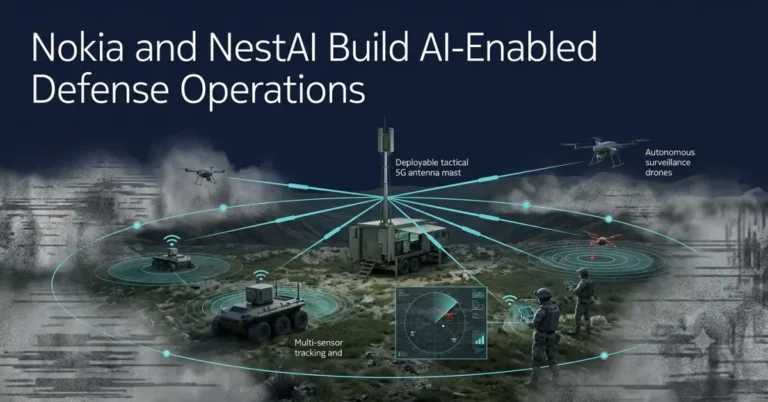
Nokia Defense and NestAI, one of Europe‘s fastest-growing defence-focused AI laboratories, published the first operational capability results from their partnership on 9 July 2026. The three capabilities they have developed — AI-enabled command and control on deployable 5G networks, mission planning with assured connectivity, and integrated sensing and communications for early threat detection — are described in explicitly military terms, designed for NATO operational requirements, and built to perform in conditions of denied communications, active electronic attack and emerging drone threats. But the underlying engineering problem these capabilities address is not a problem that belongs only to defence. It is the problem of making AI systems work reliably when the infrastructure assumptions on which they were designed do not hold.

The connectivity assumption problem in deployable AI
NestAI founder and executive chairman Peter Sarlin has been direct about what drove the partnership’s design philosophy. Existing defence AI systems, he argues, are typically built on assumptions about connectivity, sensor access and infrastructure that do not hold in contested environments. The gap between what a system was designed for and what a deployed environment actually provides has been a recurring source of operational failure in military AI deployments — one that becomes more consequential as AI moves from supporting human decision-making to enabling or directing autonomous systems.

That observation applies with equal force to industrial private network deployments, and for similar structural reasons. Private 5G networks in manufacturing, mining, ports and utilities are frequently evaluated in controlled environments — vendor demonstration facilities, purpose-built test sites, or well-provisioned greenfield deployments — where connectivity assumptions are satisfied by design. The challenge emerges when those same AI-enabled systems encounter the real operating environment: a deep-level mining section where signal propagation is unpredictable, a port terminal with dense metal structures and congested spectrum, a remote substations site with limited backhaul and no path to cloud inference during connectivity outages. The AI is still expected to function. The assumptions it was built on no longer apply.
Three deployable 5G capabilities, three industrial private network parallels
The Nokia and NestAI partnership is delivering capabilities across three domains that map directly onto industrial private network requirements, though the industrial applications are different in kind and consequence from their military counterparts.
The first is AI-enabled command and control on deployable 5G networks, combining Nokia’s deployable network infrastructure with NestOS, NestAI’s adaptive battlefield operating system. The intent is to sustain AI-enabled operations for autonomous systems without reliance on fixed communications infrastructure. For industrial operators, the direct parallel is the requirement for private network continuity during planned infrastructure changes, emergency situations or operations in areas without fixed connectivity. Mining operations that extend into new sections, port operations during infrastructure maintenance, or utilities field teams working in remote locations without site-level connectivity all face a version of the same requirement: AI-enabled operations that can continue when the assumed infrastructure is not present.
The second is mission planning with assured connectivity, integrating Nokia’s radio-network planning models directly into NestAI’s operational planning tools. The effect is that coverage assessment and adaptation become part of the operational planning process rather than a separate pre-deployment activity. The industrial application is equally direct. Private network coverage planning is typically completed during initial site survey and deployment, then treated as static. In dynamic environments — a port reconfiguring terminal operations, a manufacturing floor restructuring production lines, a mining operation extending its active area — the coverage map of the private network changes continuously, but the planning that accounts for it often does not. Embedding connectivity assessment into operational planning, as Nokia and NestAI are doing for military missions, represents a different model of how private network performance is managed over the life of a deployment.
The third, and technically the most forward-looking, is the integration of Nokia’s Integrated Sensing and Communications (ISAC) capability with NestAI’s multi-sensor tracking for early threat detection. ISAC uses the same 5G radio infrastructure for both data communications and radar-like sensing simultaneously, providing wide-area awareness without dedicated sensor hardware at every location. In defence applications, the primary use case is drone and threat detection in contested environments. In industrial applications, the same underlying technology supports perimeter security, drone monitoring over port and airport environments, intrusion detection at utilities sites, and — in the longer term — object and personnel tracking in complex indoor environments without requiring a separate sensor network deployed alongside the communications infrastructure.
European sovereign technology for denied-environment operations
The Nokia and NestAI announcement is framed explicitly as a European sovereign technology initiative, with the partnership established alongside Nokia’s and Finnish state investment company Tesi’s joint €100 million investment in NestAI in November 2025. The technologies are described as built to NATO requirements and developed on European-controlled platforms, with the stated intent to reduce European defence forces’ dependence on technology that originates outside European sovereign control.
That framing is specific to defence, but the underlying concern is increasingly present in industrial critical infrastructure procurement as well. European operators of ports, airports, utilities and critical manufacturing facilities are subject to expanding requirements and expectations around the provenance of communications technology — which vendors’ equipment can be deployed on critical infrastructure, which supply chains are considered trusted, and what happens to operational data once it has been processed on a private network platform. The Nokia and NestAI partnership reflects an accelerating investment in European-developed, sovereign technology stacks that, in time, will extend beyond defence applications and into the industrial critical infrastructure environments that share the same security policy framework.
From denied environments to industrial private networks
Nokia Defence’s chairman Mikko Hautala summarises the partnership’s foundational premise: “AI only works in the field when it has secure, resilient connectivity behind it.” The observation is straightforward but its implications are broader than defence. It is a restatement of the assumption problem that Peter Sarlin identifies: AI systems designed for environments where connectivity is assured fail when they encounter environments where it is not. The engineering response — build the system to handle degraded and denied connectivity as the baseline condition rather than the exception — is the correct response to that problem wherever AI-enabled operations depend on private network connectivity.
Defence is the environment where this engineering problem is being solved with the most urgency, the most resources, and the least tolerance for failure. The capabilities Nokia and NestAI are building — deployable 5G that sustains AI operations without fixed infrastructure, connectivity-aware operational planning, ISAC that fuses sensing and communications on a single radio platform — will not remain in defence environments indefinitely. The commercial technology transfer pathway from military private network deployments to industrial private network products is well-established, and the capabilities being proven in contested environments today describe the private network architecture that critical industrial environments will require as their own AI deployments mature.
For industrial private network buyers in manufacturing, mining, ports, airports and utilities, the NestAI and Nokia partnership is worth tracking for that reason alone. The assumption problem their capabilities are solving is not a military problem. It is the private network problem of the next decade.
| Related Tool: Private Network Site Survey Readiness Checklist
Evaluating whether a site is genuinely ready for private 5G deployment means assessing the conditions that will define network performance once construction is complete — including challenging RF propagation environments, interference risks, backhaul constraints and the coverage assumptions that AI-enabled applications will depend on. The TeckNexus Site Survey Readiness Checklist helps enterprise buyers and their teams assess site conditions systematically before procurement commitments are made, so deployment assumptions are grounded in site reality rather than vendor demonstration conditions. Access TeckNexus Private Network and AI tools → |