

AI Agent Competitive
Intelligence
Intelligence
Private Network
Intelligence
Intelligence
Intelligence Journeys
Utilities Private Broadband Planning
AI Use Case Planning for Utilities
Intelligence Tools
By Tool Type
▼
By Industry
▼
Access Type
▼
Resources
▼
Technology Hubs
▼
Partner Hubs
▼
Monthly Trackers
▼


Home » Network Infrastructure
Network Infrastructure
Network infrastructure encompasses the physical and logical foundation of connectivity — radio sites, fiber, transport, data centers, and the equipment that ties them together. Modern infrastructure is increasingly software-defined, virtualized, and cloud-native, blurring the line between hardware and the software that runs on it. Decisions about infrastructure shape capacity, coverage, cost, and the ability to support new services like slicing, private networks, and edge computing. For operators and enterprises, infrastructure strategy balances capital cost, vendor choice, and the shift toward open, disaggregated, and cloud-based architectures. This channel covers network infrastructure across radio, transport, and core — including the move to virtualized and cloud-native systems, open architectures, and the vendors building them — with analysis of how operators are modernizing the foundations their services depend on, and what it costs.
- Partner Event
- October 2, 2026
- Hema Kadia

Start: Nov 04, 2026
End: Nov 05, 2026
Venue: Times Square, New York
Location: New York, US
End: Nov 05, 2026
Venue: Times Square, New York
Location: New York, US
- Tech News & Insight
- September 29, 2026
- Hema Kadia
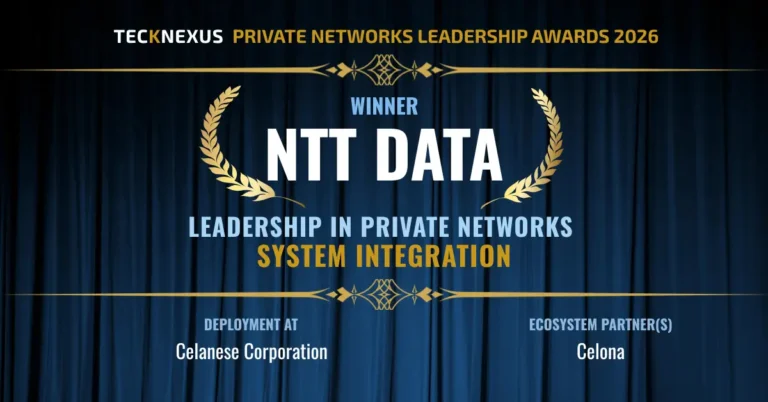
NTT DATA deployed a fully managed private 5G network, built on Celona's P5G platform, across Celanese's Clearlake and Bishop, Texas manufacturing facilities, supporting connected workers, automation, and emerging Edge AI use cases including energy and pump monitoring.
- Tech News & Insight
- September 29, 2026
- Hema Kadia

Nokia is designing, deploying, and managing a private 5G network across Exelon's U.S. utility footprint, consolidating legacy grid communications systems onto one secure, mission-critical platform supporting automation, renewable integration, and field operations at scale.
- Tech News & Insight
- September 24, 2026
- Canio Campaniello

SASE architectures secure the network edge, but attackers rarely need to touch the edge once they're inside. Kerberos delegation abuse lets adversaries move laterally through fully "zero-trust" networks without triggering a single perimeter alert.
- Tech News & Insight
- September 3, 2026
- Hema Kadia

August 2026's roundup: Nvidia forms $500B+ AI compute financing platforms with the world's largest asset managers, SK Telecom's SK Hyper data centre unit and Microsoft's new Hyderabad hyperscale region both go live, the custom silicon race widens to include OpenAI's own inference chip and a reported $12.9B Nvidia bid for Hugging Face, and SpaceX's infrastructure ambitions extend from a $16.8B Texas fab to orbital data centers.
- Tech News & Insight
- September 1, 2026
- Mohamed Idrissi

Private 5G business cases are usually built with care: radios counted, spectrum priced, TCO compared against the Wi-Fi estate it replaces. What they rarely price is the cost of operating a mobile network, which the enterprise has just acquired along with the radios. This article sets out the five operational disciplines an enterprise inherits on day one, why managed-service SLAs thin out around year two, indicative five-year cost ranges for fully managed, hybrid and in-house models, and eight questions worth answering before signing.
- Tech News & Insight
- August 25, 2026
- Hema Kadia

Telecom operators cutting headcount while pouring capital into AI infrastructure, and chipmakers financing fabs at infrastructure scale, are two sides of the same reallocation. TeckNexus traces the connections across SK Telecom, KT, LG Uplus, T-Mobile, AT&T, Verizon, Nvidia, SK hynix, and SpaceX to show how the AI buildout has become the organising logic the telecom and semiconductor industries are restructuring around.
- Tech News & Insight
- August 6, 2026
- Hema Kadia

July 2026's roundup: Hughes Network Systems nears bankruptcy as SpaceX files to launch 100,000 satellites, Nokia's AI-RAN commercial deployments trail Ericsson's 15+ by a full order of magnitude, the FCC finalizes a $6.3B C-band incentive package and closes AT&T's $23B EchoStar spectrum deal, and fiber capital and industrial 5G both keep expanding globally.
- Partner Event
- August 3, 2026
- Hema Kadia
Start: Oct 13, 2026
End: Oct 15, 2026
Venue: VIECON
Location: Vienna, Austria
End: Oct 15, 2026
Venue: VIECON
Location: Vienna, Austria
- Tech News & Insight
- August 2, 2026
- Hema Kadia
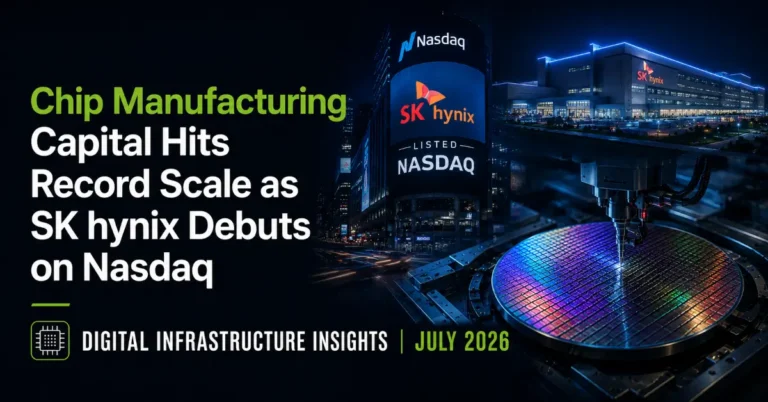
July 2026's roundup: TSMC raises its Arizona commitment to $265 billion, Micron commits more than $250 billion to US DRAM manufacturing through 2035, SK hynix's $26.5 billion Nasdaq listing prices and begins trading, and hyperscaler data center and interconnect infrastructure keeps expanding from Alberta to Google's dark fiber network.
- Partner Event
- July 7, 2026
- Hema Kadia

Start: Sep 22, 2026
End: Sep 23, 2026
Venue: Marina Bay Sands, Singapore
Location: Singapore
End: Sep 23, 2026
Venue: Marina Bay Sands, Singapore
Location: Singapore
Frequently Asked Questions
What’s typically included under ‘network infrastructure’ as a category?
It generally covers the physical and virtual building blocks of a telecom network: cell towers and small cells that handle wireless connections to devices, fiber-optic and microwave transport links that connect those cell sites back to the broader network, data centers running virtualized network functions and core network software, and increasingly, the cloud-based and virtualized systems that have replaced much dedicated, single-purpose hardware. It also encompasses supporting infrastructure like power systems, cooling, and physical site security at network facilities, which become increasingly important as networks add more, smaller, distributed sites to support 5G’s denser coverage requirements.
How has network infrastructure changed with the shift to 5G and cloud-native architectures?
Infrastructure has moved from largely fixed, purpose-built hardware toward software running on standardized servers, a shift broadly described as virtualization or cloud-native architecture. This makes infrastructure considerably more flexible to upgrade, scale, and reconfigure, since adding capacity or introducing a new network function often becomes primarily a software deployment rather than requiring new physical hardware installation at every affected site. However, this flexibility comes with added complexity: virtualized infrastructure running across cloud platforms, often from multiple different vendors, requires more sophisticated orchestration, security, and assurance tools than the comparatively simpler task of managing a fixed set of dedicated hardware boxes.
What’s driving continued infrastructure investment even after 5G is widely deployed?
Ongoing demand growth from video streaming, IoT device proliferation, AI workloads, and enterprise applications keeps pushing operators to add network capacity even after initial 5G coverage milestones are achieved. Densifying coverage with additional small cells remains necessary to deliver 5G’s fastest speeds consistently in crowded urban areas, since high-band 5G’s short range requires considerably denser site coverage than earlier, longer-range network technologies needed. Infrastructure also needs ongoing investment to prepare for 5G-Advanced features and eventual 6G requirements, meaning operators are frequently investing in upgrades simultaneously with, rather than strictly after, completing earlier-generation rollout milestones.
Why do ‘brownfield’ and ‘greenfield’ come up so often in infrastructure discussions?
Greenfield refers to building a new network from scratch with the latest available technology, which is generally easier to design optimally since there’s no legacy equipment to work around, but requires substantial upfront capital, making it more common for new market entrants or operators in regions without significant existing infrastructure. Brownfield refers to upgrading existing infrastructure, which is typically cheaper and faster than building entirely new infrastructure, but is constrained by legacy equipment, existing site locations, and earlier design choices. Most established carriers in mature markets operate primarily brownfield networks, continuously upgrading existing infrastructure incrementally rather than rebuilding it from the ground up.
How do operators decide where to invest limited infrastructure budget first?
Operators generally prioritize infrastructure investment based on a combination of factors: where existing network congestion is most acutely affecting customer experience, where competitive pressure from rival carriers makes infrastructure quality a more pressing business concern, where regulatory requirements or government incentives, like rural coverage mandates, create specific obligations, and where enterprise customer opportunities, like a major private 5G network deal, justify targeted investment. Dense, high-revenue urban and suburban areas typically receive investment priority since they generate the most subscriber revenue relative to infrastructure cost, while rural and remote area investment is often driven more by regulatory requirements or subsidy programs than purely commercial return calculations.
What’s the difference between core network infrastructure and access network infrastructure?
The core network refers to the central infrastructure that handles functions like routing calls and data, managing subscriber identity and billing, and connecting a carrier’s network to other networks and the broader internet, typically concentrated in a smaller number of data centers. The access network, sometimes called the radio access network or RAN, refers to the infrastructure that actually connects end-user devices to the network, including cell towers, antennas, and radio equipment distributed across thousands of physical locations to provide coverage. These two layers require different kinds of infrastructure investment: the core involves fewer, larger, centralized facilities, while the access network involves managing many smaller, distributed sites.
How does network sharing between competing carriers actually work?
Network sharing arrangements let two or more competing carriers jointly build, own, or use certain pieces of infrastructure, most commonly cell towers and sometimes radio access network equipment, rather than each carrier independently building entirely separate, duplicate infrastructure covering the same geographic area. This is particularly common for tower infrastructure, where independent tower companies often own physical structures and lease space on the same tower to multiple competing carriers’ equipment, reducing the capital cost and environmental footprint of network buildout. More extensive forms of sharing, extending to radio equipment itself, are more common in certain markets and regulatory environments than others, since regulators need to ensure shared arrangements don’t undermine meaningful competition.
What role does fiber play in supporting wireless network infrastructure?
Fiber plays a foundational role in supporting wireless network infrastructure, even though it’s not the wireless connection end users directly experience on their phones. Cell towers and small cells need to connect back to the broader network core, a connection known as backhaul, and fiber-optic cabling generally provides the most reliable, highest-capacity backhaul option compared to alternatives like microwave wireless links. As 5G networks add more, denser small cell sites to support high-band coverage in urban areas, the need for fiber backhaul connecting each additional site grows correspondingly, making fiber deployment an essential, if less visible, companion investment. In some cases, a lack of available fiber in a specific area becomes the actual limiting factor on how quickly 5G capacity can be added there.




Telco AI Agent Leadership

