
AI Agent Competitive
Intelligence
Intelligence
Private Network
Intelligence
Intelligence
Intelligence Journeys
Utilities Private Broadband Planning
AI Use Case Planning for Utilities
Intelligence Tools
By Tool Type
▼
By Industry
▼
Access Type
▼
Resources
▼
Technology Hubs
▼
Partner Hubs
▼
Monthly Trackers
▼


Home » Network Infrastructure » Page 2
Network Infrastructure
Network infrastructure encompasses the physical and logical foundation of connectivity — radio sites, fiber, transport, data centers, and the equipment that ties them together. Modern infrastructure is increasingly software-defined, virtualized, and cloud-native, blurring the line between hardware and the software that runs on it. Decisions about infrastructure shape capacity, coverage, cost, and the ability to support new services like slicing, private networks, and edge computing. For operators and enterprises, infrastructure strategy balances capital cost, vendor choice, and the shift toward open, disaggregated, and cloud-based architectures. This channel covers network infrastructure across radio, transport, and core — including the move to virtualized and cloud-native systems, open architectures, and the vendors building them — with analysis of how operators are modernizing the foundations their services depend on, and what it costs.
- Tech News & Insight
- July 2, 2026
- Hema Kadia

June 2026's roundup: SK Group, GS Group, and Naver unveil a $650 billion, 10-year AI infrastructure megaproject, Google shifts part of its TPU manufacturing from TSMC to Intel, Nvidia diversifies its HBM4 supply chain, and AI data center capacity keeps expanding into new global markets from Indonesia to Paraguay.
- Tech News & Insight
- June 23, 2026
- Hema Kadia

T-Mobile CTO John Saw's 'kinetic token' framework describes how Physical AI — robots, autonomous vehicles, industrial automation — changes what networks must do. The public telco debate that followed misses the most immediate implication: industrial private 5G networks are already, structurally, kinetic token infrastructure.
- Tech News & Insight
- June 17, 2026
- Aiva Strelca
European consortium of 19 partners will develop AI-driven cyber threat intelligence, automated response, and resilient security capabilities for next-generation connectivity.
- Tech News & Insight
- June 16, 2026
- Hema Kadia
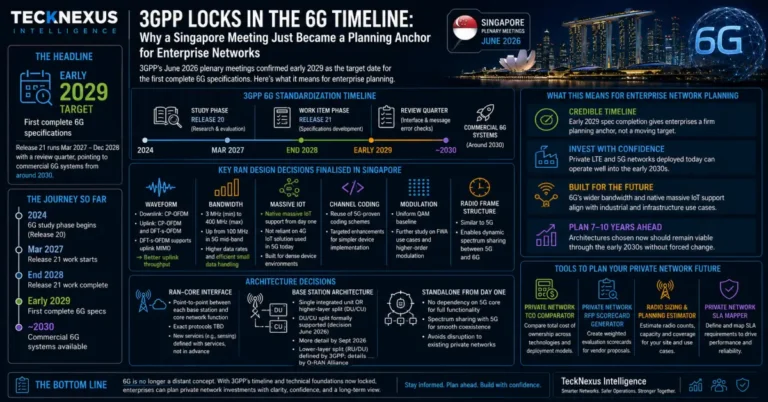
3GPP's June 2026 plenary meetings in Singapore confirmed early 2029 as the target date for the first complete 6G specifications, alongside a long list of finalised RAN design decisions on waveform, bandwidth, and architecture. Here's what the confirmed timeline and technical decisions mean for enterprise private network planning.
- Tech News & Insight
- June 16, 2026
- Hema Kadia
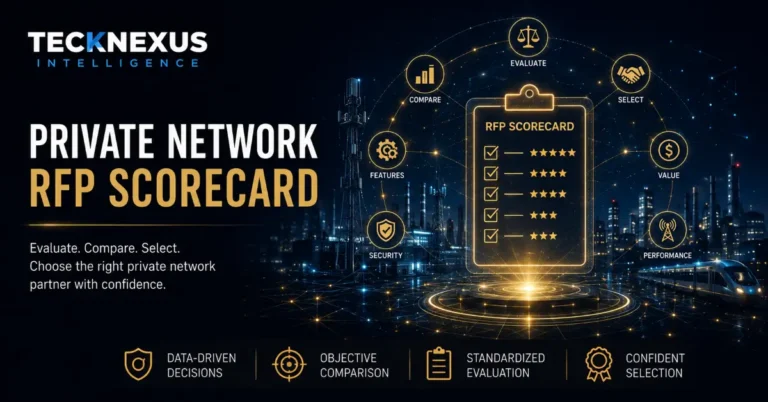
Most organisations evaluate private network vendors after the RFP - by which point it is too late to set objective criteria. The TeckNexus RFP Scorecard Generator builds your weighted evaluation framework before you issue the tender, so vendor proposals land against pre-defined, context-specific criteria.
- Tech News & Insight
- June 2, 2026
- Hema Kadia
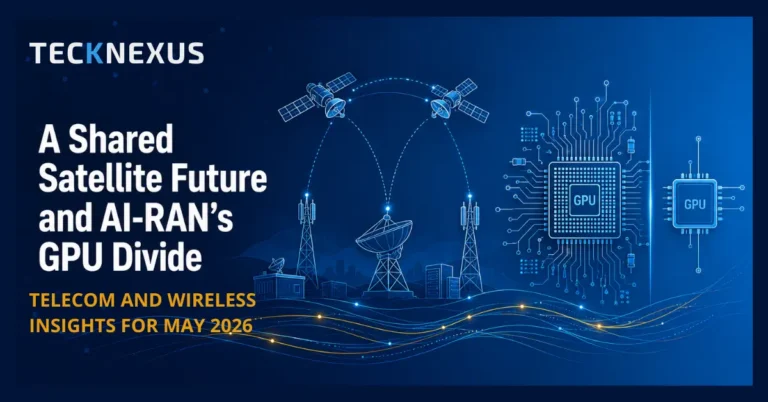
May 2026's roundup: AT&T, T-Mobile, and Verizon explore a joint satellite D2D venture, Ericsson tests GPU-free AI-RAN against Nvidia's GPU-embedded approach at the same two operators, 5G-Advanced sensing moves into live security deployments, and fiber capital both consolidates and expands.
- Tech News & Insight
- June 2, 2026
- Hema Kadia
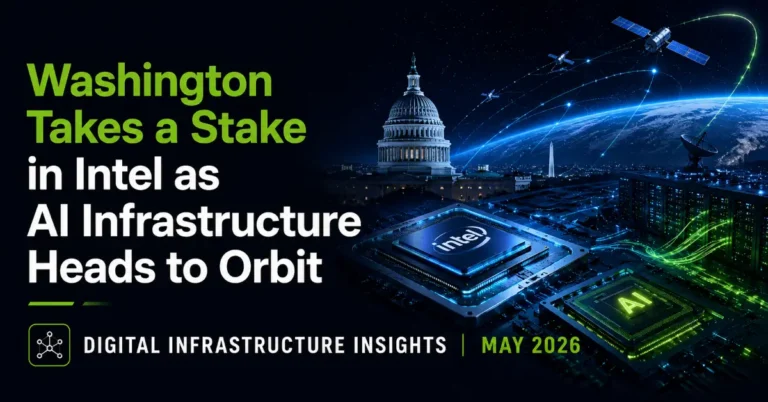
May 2026's roundup: the US government's 10% equity stake in Intel (now valued above $50B) underscores how strategic chip manufacturing has become, India and Vietnam both advance new chip fab and testing capacity, the AI chip supply chain keeps fragmenting beyond Nvidia, and Pixxel and Sarvam AI plan India's first orbital data center satellite.
- Tech News & Insight
- May 13, 2026
- Hema Kadia
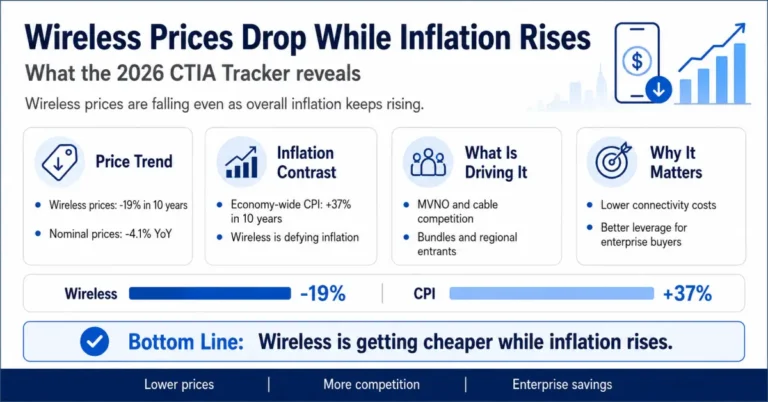
Wireless services are defying U.S. inflation trends in a way virtually no other sector is. According to CTIA's newly released More for Less: 2026 Wireless Affordability Tracker, nominal wireless prices have declined 4.1% over the past year and 19% over the past decade, while the economy-wide CPI rose more than 37% over the same period. Adjusted for inflation, postpaid unlimited plans are down roughly 10% year-over-year, and prepaid options have fallen more than 50% over five years. For enterprise decision-makers, this pricing trajectory represents a structurally favorable condition for mobile workforce and IoT connectivity planning.
- Tech News & Insight
- May 5, 2026
- Hema Kadia

T-Mobile Czech Republic's Technology Innovations Day 2026 delivered live operational proof that 5G Standalone architecture is no longer a roadmap item. Running entirely on 5G SA infrastructure at the Magenta Experience Center in Prague, demonstrations spanned autonomous robotics, tele-surgery with military hospitals, AI-powered AR wearables, live field broadcasting, and quantum state transfer over existing fiber. For enterprise decision-makers evaluating private network investments or industrial automation strategies, the event confirmed that 5G SA now meets the reliability, latency, and isolation requirements of mission-critical operations across multiple verticals.
- Tech News & Insight
- May 2, 2026
- Hema Kadia
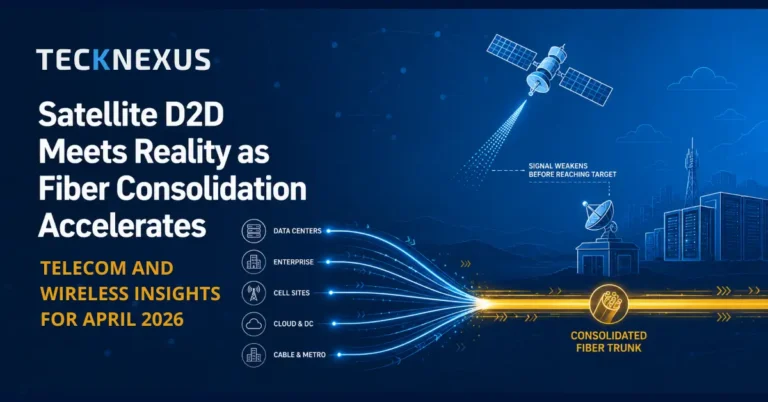
April 2026's roundup: T-Mobile admits satellite direct-to-device usage is falling short of expectations, fiber consolidation accelerates through new JVs and a potential €20B SFR deal, 6G's timeline gets murkier rather than clearer, and optical networking rides the AI supercycle.
- Tech News & Insight
- May 2, 2026
- Hema Kadia
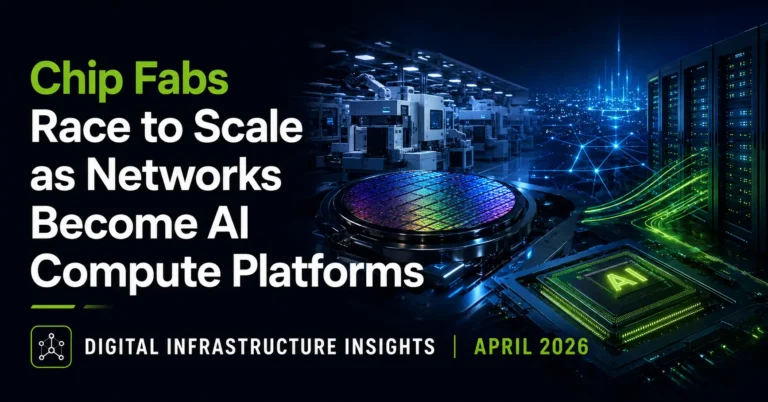
April 2026's roundup: Samsung's Taylor fab comes online with 2nm production for Tesla's AI chips, Intel joins Elon Musk's Terafab project targeting 1 terawatt of annual AI compute, Nokia and NVIDIA position telecom networks as distributed compute platforms, and hyperscalers commit tens of billions more to AI data centers across Asia-Pacific.
Frequently Asked Questions
What’s typically included under ‘network infrastructure’ as a category?
It generally covers the physical and virtual building blocks of a telecom network: cell towers and small cells that handle wireless connections to devices, fiber-optic and microwave transport links that connect those cell sites back to the broader network, data centers running virtualized network functions and core network software, and increasingly, the cloud-based and virtualized systems that have replaced much dedicated, single-purpose hardware. It also encompasses supporting infrastructure like power systems, cooling, and physical site security at network facilities, which become increasingly important as networks add more, smaller, distributed sites to support 5G’s denser coverage requirements.
How has network infrastructure changed with the shift to 5G and cloud-native architectures?
Infrastructure has moved from largely fixed, purpose-built hardware toward software running on standardized servers, a shift broadly described as virtualization or cloud-native architecture. This makes infrastructure considerably more flexible to upgrade, scale, and reconfigure, since adding capacity or introducing a new network function often becomes primarily a software deployment rather than requiring new physical hardware installation at every affected site. However, this flexibility comes with added complexity: virtualized infrastructure running across cloud platforms, often from multiple different vendors, requires more sophisticated orchestration, security, and assurance tools than the comparatively simpler task of managing a fixed set of dedicated hardware boxes.
What’s driving continued infrastructure investment even after 5G is widely deployed?
Ongoing demand growth from video streaming, IoT device proliferation, AI workloads, and enterprise applications keeps pushing operators to add network capacity even after initial 5G coverage milestones are achieved. Densifying coverage with additional small cells remains necessary to deliver 5G’s fastest speeds consistently in crowded urban areas, since high-band 5G’s short range requires considerably denser site coverage than earlier, longer-range network technologies needed. Infrastructure also needs ongoing investment to prepare for 5G-Advanced features and eventual 6G requirements, meaning operators are frequently investing in upgrades simultaneously with, rather than strictly after, completing earlier-generation rollout milestones.
Why do ‘brownfield’ and ‘greenfield’ come up so often in infrastructure discussions?
Greenfield refers to building a new network from scratch with the latest available technology, which is generally easier to design optimally since there’s no legacy equipment to work around, but requires substantial upfront capital, making it more common for new market entrants or operators in regions without significant existing infrastructure. Brownfield refers to upgrading existing infrastructure, which is typically cheaper and faster than building entirely new infrastructure, but is constrained by legacy equipment, existing site locations, and earlier design choices. Most established carriers in mature markets operate primarily brownfield networks, continuously upgrading existing infrastructure incrementally rather than rebuilding it from the ground up.
How do operators decide where to invest limited infrastructure budget first?
Operators generally prioritize infrastructure investment based on a combination of factors: where existing network congestion is most acutely affecting customer experience, where competitive pressure from rival carriers makes infrastructure quality a more pressing business concern, where regulatory requirements or government incentives, like rural coverage mandates, create specific obligations, and where enterprise customer opportunities, like a major private 5G network deal, justify targeted investment. Dense, high-revenue urban and suburban areas typically receive investment priority since they generate the most subscriber revenue relative to infrastructure cost, while rural and remote area investment is often driven more by regulatory requirements or subsidy programs than purely commercial return calculations.
What’s the difference between core network infrastructure and access network infrastructure?
The core network refers to the central infrastructure that handles functions like routing calls and data, managing subscriber identity and billing, and connecting a carrier’s network to other networks and the broader internet, typically concentrated in a smaller number of data centers. The access network, sometimes called the radio access network or RAN, refers to the infrastructure that actually connects end-user devices to the network, including cell towers, antennas, and radio equipment distributed across thousands of physical locations to provide coverage. These two layers require different kinds of infrastructure investment: the core involves fewer, larger, centralized facilities, while the access network involves managing many smaller, distributed sites.
How does network sharing between competing carriers actually work?
Network sharing arrangements let two or more competing carriers jointly build, own, or use certain pieces of infrastructure, most commonly cell towers and sometimes radio access network equipment, rather than each carrier independently building entirely separate, duplicate infrastructure covering the same geographic area. This is particularly common for tower infrastructure, where independent tower companies often own physical structures and lease space on the same tower to multiple competing carriers’ equipment, reducing the capital cost and environmental footprint of network buildout. More extensive forms of sharing, extending to radio equipment itself, are more common in certain markets and regulatory environments than others, since regulators need to ensure shared arrangements don’t undermine meaningful competition.
What role does fiber play in supporting wireless network infrastructure?
Fiber plays a foundational role in supporting wireless network infrastructure, even though it’s not the wireless connection end users directly experience on their phones. Cell towers and small cells need to connect back to the broader network core, a connection known as backhaul, and fiber-optic cabling generally provides the most reliable, highest-capacity backhaul option compared to alternatives like microwave wireless links. As 5G networks add more, denser small cell sites to support high-band coverage in urban areas, the need for fiber backhaul connecting each additional site grows correspondingly, making fiber deployment an essential, if less visible, companion investment. In some cases, a lack of available fiber in a specific area becomes the actual limiting factor on how quickly 5G capacity can be added there.




Telco AI Agent Leadership

