


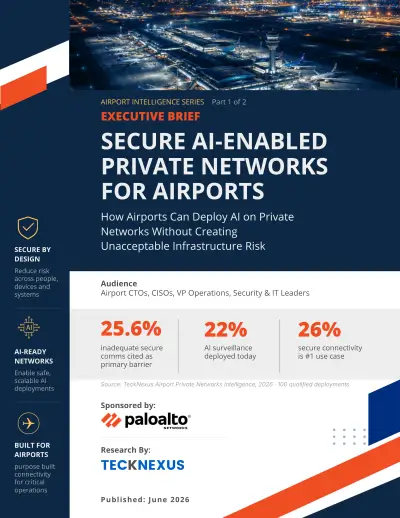

Airports have quietly become one of the most complex critical infrastructure environments on the planet — and most of them don’t have the network architecture to prove it.
A single hub airport can host an airport authority, 50-plus airlines, dozens of ground handlers, cargo operators, fuel companies, concessions, TSA, customs and border protection, police, fire, and emergency services, all running on shared physical and digital infrastructure. That’s not a hypothetical risk scenario. It’s Tuesday.
New research from TeckNexus’s Airport Private Networks Intelligence programme — drawn from 100 qualified airport deployments worldwide — shows that airports are already past the point of “should we deploy AI?” They’re deploying it now, on networks that in many cases were never designed to secure it.
The Real Airport Attack Surface: Airside vs. Landside
Utilities have the IT/OT divide. Airports have something structurally similar: the boundary between airside operations (aircraft, ground support equipment, fueling, airfield safety) and landside operations (terminals, passenger processing, baggage, retail, facilities).
That boundary is exactly where attacks like Volt Typhoon did the most damage in the utility sector — establishing a foothold in one environment and moving laterally into the other. Airports face the same exposure, arguably at greater scale, because so many independent organizations share the same physical network.
If segmentation isn’t enforced at the network level, a compromised landside system is a potential doorway to airside operational systems. That’s the core problem this research sets out to quantify.
Seven Use Cases, One Common Thread
The evidence base identifies the seven most security-relevant deployments airports are running today — AI surveillance and perimeter analytics, biometric boarding verification, autonomous ground vehicles, automated baggage sortation, connected workforce tools, passenger flow analytics, and neutral host carrier roaming.
Every one of them depends on trusted, real-time data flowing over a network. And every one of them has a distinct failure mode when that network isn’t architected to protect it — from sensor feed manipulation that blinds an AI surveillance system, to a compromised neutral host management plane that exposes every airline and agency on the platform simultaneously.
A few numbers from the research stand out:
- AI surveillance is already live at a meaningful share of airports today, with a large additional share planning deployment next.
- Autonomous ground vehicles — baggage tractors, pushback tugs, aircraft towing systems — are the single most common planned deployment, ahead of every other use case in the evidence base.
- Inadequate secure communications for critical operations is cited as one of the top barriers airports report when trying to scale these deployments.
In other words: the AI is already there. The security architecture, in many cases, is still catching up.
Why Public and Shared Networks Aren’t Built for This
Most airports today run on a patchwork of public cellular, Wi-Fi, DAS infrastructure, and legacy radio — carrying serious operational traffic on networks that were never governed for it. Public/shared infrastructure has no enforced airside/landside isolation, no SIM-based device verification for OT and IoT endpoints, and no role-based access control across the dozens of stakeholders using it.
A private mobile network changes that equation: segmentation enforced by design, uplink performance tuned for AI workloads instead of passenger downloads, every device individually authenticated, and sensitive operational data kept on local breakout instead of transiting public infrastructure.
A 4-Layer Framework Built for Airport Reality
The brief lays out a four-layer security architecture — Core, Edge, AI Ecosystem, and Governance — adapted specifically for airport environments:
- Core Security — encrypted, resilient transport connecting terminals, airside operations, cargo, MRO zones, and control rooms, with SIM-based authentication and zero trust enforcement at the core.
- Edge Security — protection where AI workloads actually live: cameras, biometric devices, sensors, and airside IoT.
- AI Ecosystem Security — runtime integrity checks, model scanning, and adversarial testing for every AI system in the airport, from surveillance to autonomous navigation.
- Governance and Compliance — aligning with TSA cybersecurity directives and CISA critical infrastructure guidance across every stakeholder connecting to the network, not just the airport authority’s own systems.
Where Most Airports Actually Stand
The full brief includes a rapid, five-dimension readiness self-assessment — IT/OT segmentation, endpoint identity, multi-stakeholder governance, AI security, and regulatory alignment — scored Red, Amber, or Green. It’s built so a CTO, CISO, or VP Operations can identify priority gaps in minutes, before committing further budget to AI-enabled deployments that will only widen the exposure if the underlying network isn’t ready.
It’s paired with a three-phase implementation roadmap (Assessment → Foundation → AI Deployment) that sequences the work realistically, instead of asking airports to solve everything at once.
Get the Full Executive Brief
This article covers the framework — the full brief covers the evidence. Secure AI-Enabled Private Networks for Airports is Part 1 of TeckNexus’s Airport Intelligence Series, sponsored by Palo Alto Networks, and includes:
- The complete deployment data across all seven use cases
- The full 4-layer security architecture with implementation detail for each layer
- The 5-dimension readiness self-assessment tool
- The three-phase roadmap from assessment to AI-ready deployment
- Three concrete recommendations for airport security leaders
Download the full executive brief via the form above →
Looking for more independent research on private networks across critical infrastructure sectors? Browse the full TeckNexus whitepaper library for additional intelligence briefs.
This brief was produced by TeckNexus and sponsored by Palo Alto Networks. The research, analysis, and recommendations are solely those of TeckNexus and reflect the independent judgement of TeckNexus analysts.
FAQ
Is this brief vendor-specific or vendor-neutral? TeckNexus is a vendor-neutral research and media platform. Palo Alto Networks sponsored this brief but did not contribute to, review, or approve the editorial content prior to publication.
Who should read this brief? Airport CTOs, CISOs, VPs of Operations, and security and IT leaders evaluating or scaling private network and AI deployments.
Is there a Part 2? Yes — Part 2, Securing Airport Network Architecture: Neutral Host, Slicing, and Autonomous Operations, goes deeper on neutral host tenant isolation, network slicing, and securing autonomous ground vehicles. [Read that brief here.]




