Standards timelines rarely make for exciting reading, but the one that came out of 3GPP‘s June 2026 plenary meetings in Singapore is worth pausing on if your organisation is planning private network infrastructure that needs to stay relevant past 2030. For the first time, the body responsible for mobile standards has put a firm date on when the first complete 6G specifications will be finished, and it has also locked in a long list of underlying technical decisions that determine what 6G will actually look like when it arrives.
The Headline: A Confirmed Date for First 6G Specifications
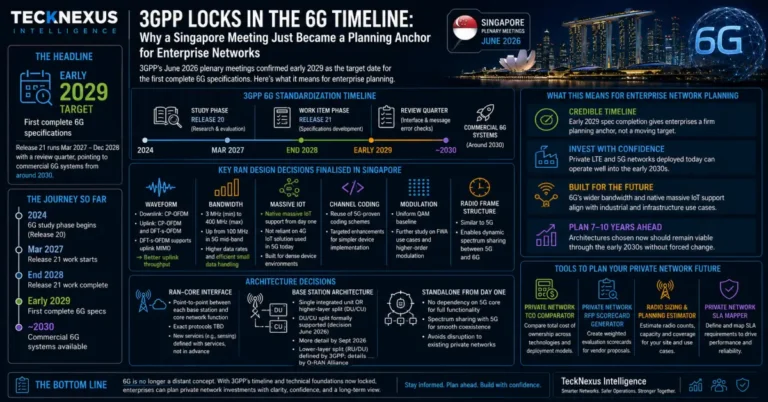
3GPP has set early 2029 as the target for completing the first full set of 6G specifications. That date is the product of two separate agreements reached at different points: an earlier decision on how long the technical study phase for Release 20 would run, and the June 2026 Singapore agreement on the timeline for turning those studies into finished specification text under Release 21.

Release 21, the work item phase where studies become formal specifications, is set to run from March 2027 through the end of 2028, with an additional review quarter built in afterward to catch errors in the interfaces and configuration messages that let phones and base stations talk to each other correctly. Put together, that points to commercial 6G systems becoming available from around 2030, a full standards cycle that’s only now coming into clear focus six years after the first preparatory work began in 2024.
What Was Actually Decided at the Singapore Meetings for 6G Specifications
The Singapore plenaries weren’t just about dates. A long list of foundational radio access network (RAN) design choices, the kind that hardware and chipset teams need locked down well before mass production can start, were finalised at the same meetings. Several of these decisions had been targeted for completion by June 2026 specifically because they carry major implications for both hardware design and network architecture.
On the waveform side, 3GPP settled on cyclic-prefix orthogonal frequency-division multiplexing (CP-OFDM) for the downlink, with both CP-OFDM and discrete Fourier transform spread OFDM (DFT-s-OFDM) supported for uplink. The inclusion of DFT-s-OFDM matters for coverage, and a notable departure from 5G design is that DFT-s-OFDM will now support uplink multiple-input, multiple-output (MIMO), a change expected to meaningfully improve uplink throughput because devices can make fuller use of their available transmit power.

Bandwidth limits were also finalised, ranging from as little as 3 MHz in certain spectrum allocations up to 400 MHz at the top end, a substantial jump from the 100 MHz ceiling typical of 5G mid-band deployments today. That wider ceiling opens the door to higher data rates and faster, more efficient handling of small data transmissions, which matters directly for massive IoT use cases. Notably, 6G is being built with native massive IoT support from day one, rather than continuing to lean on the 4G-based IoT solution that 5G networks still rely on.
Channel coding decisions largely reuse the coding schemes already proven in 5G, with targeted enhancements aimed at simplifying device-side implementation, while modulation will be based on uniform quadrature amplitude modulation (QAM), with further study continuing around fixed wireless access (FWA) use cases and additional modulation orders. The basic radio frame structure will closely mirror 5G’s, a deliberate choice that supports dynamic spectrum sharing between the two generations as networks transition.
6G Architecture Decisions: How Base Stations and Core Networks Will Connect
Beyond the air interface, 3GPP also finalised how 6G base stations will connect internally and to the core network. The interface between base stations and the core network will follow a point-to-point design, meaning each base station establishes a direct signalling relationship with its corresponding core network function, with the exact protocols for that connection still to be worked out. Newer non-connectivity services, such as network-based sensing, will have their RAN-core interface requirements defined alongside those services rather than in advance.
On internal base station architecture, two implementation paths remain open. A base station can be built as a single integrated unit, an option agreed at the start of the 6G study phase, or it can use a higher-layer split that divides processing between a distributed unit (DU) and a centralised unit (CU), echoing the architecture already used in many 5G deployments. The decision to formally support the DU/CU split option was reached at the June 2026 meetings, with further detail on how functionality divides between the two expected by September 2026. A lower-layer split between the base station’s processing component and its radio unit, the interface relevant to multi-vendor radio equipment, will also exist, defined at a schematic level by 3GPP with implementation detail handled separately by the O-RAN Alliance.
6G will be Standalone From Day One, With Smart Spectrum Sharing
Perhaps the most strategically important architectural decision is that 6G is being designed as a standalone system from the outset, with no dependency on 5G core infrastructure for full functionality. That’s a deliberate correction: 5G’s initial rollout relied heavily on non-standalone (NSA) operation, where devices connected simultaneously to a legacy 4G core while 5G carriers were layered on top mainly to boost data rates, an approach that delayed access to many of 5G’s more advanced capabilities for years. By designing for standalone operation from day one, 3GPP aims to let 6G deliver its full capability set immediately, without being held back by compatibility constraints inherited from older networks.
That said, smooth migration still matters, so 3GPP is studying mechanisms that would let a single carrier be dynamically shared between 5G and 6G, with the explicit goal of making that sharing far less overhead-intensive than the spectrum-sharing techniques used in the move from 4G to 5G. That study is set to run through September 2026, alongside a parallel study examining whether standalone 6G with carrier aggregation alone would be sufficient for the 5G-to-6G migration, and a separate look at how millimetre-wave and Frequency Range 1 spectrum might be aggregated together under a single unified solution, rather than the two separate techniques, carrier aggregation and dual connectivity, that 5G currently uses.
Why This 6G Timeline Matters for Enterprise Private Networks
None of this changes anything about today’s private network decisions in the short term. CBRS, private LTE, and 5G deployments planned now will run their course well before 6G commercial systems arrive around 2030. But the confirmed Release 21 timeline does give enterprise planning teams something they haven’t had until now: a credible date to plan around rather than a moving target.
For manufacturing, mining, ports, airports and utilities organisations evaluating private network investments with a 7-to-10-year operating horizon, the practical takeaway is straightforward. Equipment and contracts signed today should reasonably be expected to operate through the early 2030s without requiring a forced architecture change, since 6G’s standalone-by-design approach and its planned spectrum-sharing mechanisms are explicitly intended to avoid disrupting networks already in place. It’s also worth noting that 6G’s wider bandwidth ceiling and native massive IoT support are squarely aimed at the kind of dense sensor and device environments common in industrial and infrastructure settings, which means today’s IoT and automation investments are likely to carry forward rather than need replacing.
| Related Tool
Planning a private network with a multi-year lifecycle? Use the TeckNexus Private Network TCO Comparator to model costs across CBRS, licensed private LTE and private 5G, and factor in technology-transition risk before you commit to a multi-year architecture. Visit: tecknexus.com/intelligence/ |